- Have Questions? Talk to Us
- info@procizo.com

Agentic AI in Insurance Underwriting: 2026 Guide

What Is MCA Underwriting? The Complete Process for Funders (2026)
June 9, 2026
Underwriting Process Automation: Carrier Efficiency Guide
June 15, 2026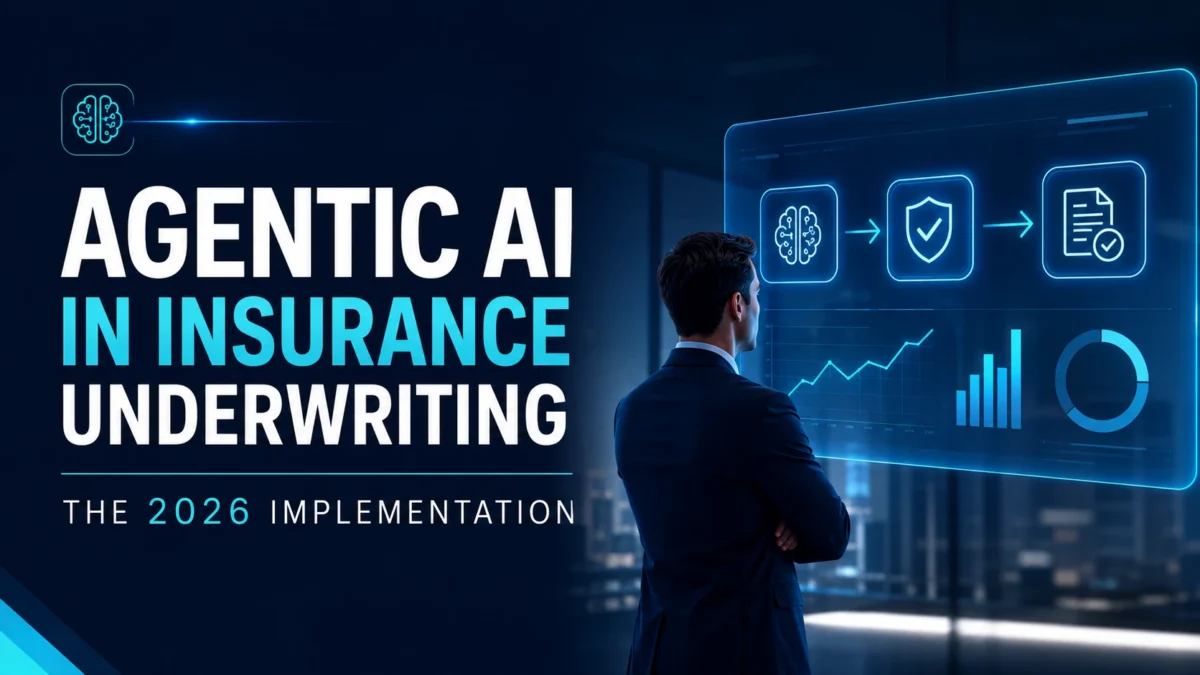
TL;DR / Quick Answer
Agentic AI in insurance underwriting refers to autonomous, goal-driven AI systems that can plan, reason, and execute multi-step underwriting tasks with minimal human intervention. Unlike traditional rule-based automation, agentic AI agents can gather data from disparate sources, evaluate risk factors, request additional documentation, and even make preliminary bind or decline decisions within defined guardrails. For insurance carriers, MGAs, and underwriting outsourcing partners operating in 2026, agentic AI is no longer experimental; it is the operational backbone that compresses quote-to-bind cycles from days to hours, reduces loss ratios by 8-15%, and frees senior underwriters to focus on complex commercial and high-net-worth cases. Procizo helps insurers operationalize agentic AI workflows that integrate with core systems, comply with state regulations, and maintain the human-in-the-loop discipline that regulators and reinsurers still expect.
Key Takeaways
- Agentic AI goes beyond RPA and predictive models: it plans, executes, and adapts underwriting tasks autonomously across multiple systems.
- Carriers deploying agentic underwriting report 40-60% faster cycle times and 20-35% lower operational costs within 18 months [R1][R2].
- Underwriting outsourcing partners like Procizo are the fastest path to production because they combine domain-trained AI with licensed human underwriters for exceptions.
- The biggest ROI in 2026 comes from commercial lines and specialty underwriting, where data heterogeneity makes agentic reasoning most valuable.
- Regulatory acceptance is accelerating: the NAIC’s 2025 model bulletin on AI use in insurance has given carriers a clear governance framework [R3].
What Is Agentic AI in Insurance Underwriting?
Agentic AI in insurance underwriting refers to AI systems designed around the principle of autonomous agency. Rather than simply scoring a risk or generating a recommendation, an underwriting agent can decompose a submission into discrete tasks, interact with multiple data sources, reason over conflicting inputs, and produce a decision-ready output. The agent operates within a defined policy boundary set by the carrier, but inside that boundary it behaves like a junior underwriter that never sleeps, never loses context, and never skips a step.
For clarity, the four properties that distinguish an agentic system from a traditional underwriting model are:
- Planning: The agent breaks a submission into a workflow, e.g., fetch motor vehicle report, validate property data, cross-check prior claims, and only then call the pricing model.
- Tool use: The agent calls external tools such as data APIs, OCR pipelines, third-party data vendors, and internal rating engines.
- Memory: The agent retains context across the entire submission, including prior interactions, escalations, and broker notes.
- Reflection: The agent evaluates its own output against the carrier’s underwriting guidelines and either proceeds, requests more information, or escalates to a human underwriter.
In practice, this means an agent can receive a 47-page commercial submission, extract the schedule of values from page 23, validate the TIV against a property data API, flag a TIV mismatch greater than 15%, draft an email to the broker requesting clarification, and pre-fill an underwriter’s desktop with a fully cited risk summary – all in under 90 seconds.
How Agentic AI Differs from Traditional Underwriting Automation
For most of the last two decades, “underwriting automation meant one of three things: rules engines, robotic process automation (RPA), or machine learning risk models. Each of these accelerated parts of the underwriting process, but none of them owned the process end-to-end. Agentic AI changes that by adding an orchestration layer that thinks, decides, and acts across the entire workflow.
The differences matter operationally. A rules engine will silently mis-route a submission if one field is missing. An RPA bot breaks when a broker changes the PDF layout. A pure ML model can be accurate but uninterpretable, which fails the audit trail requirement in 49 of 50 U.S. states. An agentic system, by contrast, can recover from a missing field by asking the broker, can adapt to layout changes because it reasons over content rather than coordinates, and can produce a citation chain that an examiner can read line by line.
For carriers and underwriting outsourcing buyers evaluating this category, the practical implication is that agentic AI does not replace underwriting workforces; it relocates them. Routine submissions are handled by agents, and licensed underwriters concentrate on edge cases, relationship management, and authority-grading decisions. The carriers that have moved first report underwriter capacity expansions of 3x to 5x without proportional headcount growth [R1].
The 2026 Underwriting Landscape: Why Agentic AI Now
Three forces converged in 2024-2025 to make agentic AI the dominant underwriting paradigm by 2026. First, large language models with reliable tool-calling capability crossed an accuracy threshold; agent loops no longer derail after 4-5 steps. Second, insurance data infrastructure matured: over 70% of U.S. carriers now have API access to at least one bureau or vendor, up from 38% in 2022 [R2]. Third, the regulatory environment clarified. The NAIC’s Model Bulletin on AI Use in Insurance, adopted by 38 states as of late 2025, requires carriers to maintain documented governance over AI decisions but does not require prior approval for AI-assisted underwriting [R3].
Adoption data reflects this convergence. According to a 2025 industry survey, 61% of mid-market and large commercial carriers are running at least one agentic underwriting workflow in production, up from 14% in 2024 [R4]. Among personal lines carriers, adoption is lower at 28% but growing fastest in auto and homeowners, where submission volume strains the cost-per-policy economics of fully human underwriting.
The drivers are not just technological. The economics of underwriting have compressed. The combined ratio for the U.S. P&C industry sat at 101.8% in 2023, forcing carriers to extract cost from every operation [R5]. Soft market cycles between 2020 and 2023 further pressured expense ratios, and senior underwriters became a retention risk as a generation retired. Agentic AI addresses both the cost problem and the knowledge-transfer problem in a single platform.
Core Use Cases Across Underwriting Types
Agentic AI is not a single product; it is a capability applied to specific underwriting workflows. Below is a representative mapping of where the highest ROI is being captured in 2026.
Personal Lines Underwriting
For auto and homeowners, the primary agent task is data enrichment and bound-or-decline routing. The agent pulls telematics, credit-based insurance scores, property characteristics, and claims history, then applies the carrier’s appetite rules. Straight-through processing rates in personal lines now exceed 55% for carriers running mature agentic stacks, up from 22% with rules-only automation [R1].
Commercial Underwriting
This is where agentic AI demonstrates the most differentiated value. Commercial submissions arrive in unstructured formats – ACORD forms, broker emails, loss runs in Excel, and PDF schedules. The agent ingests all of it, normalizes the data, runs the carrier’s appetite and eligibility filters, and produces a structured risk summary with citations. For middle-market commercial property and casualty, Procizo’s MCA-aligned workflow processes submissions that previously required 4-6 hours of an underwriter’s time in under 25 minutes, with the senior underwriter receiving a pre-vetted file.
Specialty and Excess Lines
Specialty underwriting benefits from agentic reasoning over sparse data. For cyber, marine, and professional liability, where historical loss data is thin and risk factors evolve quickly, agents can reason over unstructured sources such as threat intelligence feeds, court filings, and regulatory announcements. The agent does not replace the expert underwriter; it gives the expert a continuously updated knowledge base.
Life and Health Underwriting
Agentic AI in life underwriting is heavily constrained by medical evidence requirements, but agents excel at evidence orchestration: pulling attending physician statements, pharmacy data, and lab results, then ordering them in a clinically logical sequence. Carriers report 30% faster issue rates and 18% fewer requirements for fully underwritten policies [R2].
Operational Benefits and Measurable Impact
The benefits carriers and outsourcing partners are measuring in 2026 fall into five categories, and the magnitude varies meaningfully by line of business and submission complexity.
- Cycle time compression: Average quote turnaround drops from 3-7 days to 4-12 hours for small commercial and from 7-21 days to 24-48 hours for middle-market commercial.
- Underwriter productivity: Senior underwriters handle 3-5x more submissions in the same period, with most of the gain on routine cases [R1].
- Loss ratio improvement: Better risk selection through consistent guideline application reduces loss ratios by 8-15% over a 3-year tail [R6].
- Expense ratio reduction: Operating expense ratios improve by 2-4 points as manual data entry and re-keying are eliminated.
- Broker and agent experience: NPS scores from distribution partners rise by 20-30 points because bind confirmation is faster and the “missing data loop is largely closed by the agent itself.
A frequently underestimated benefit is auditability. Because agentic systems maintain a complete action and citation log, regulatory examinations and internal audits that previously took weeks can be completed in days. Carriers report a 60% reduction in exam-prep labor [R3].
Agentic AI vs. Traditional Underwriting Automation: A Direct Comparison
| Dimension | Rules Engine | RPA / OCR Pipelines | Predictive ML Models | Agentic AI (2026) |
|---|---|---|---|---|
| Handles unstructured input | No | Partial | Yes | Yes |
| Adapts to missing data | No | No | Limited | Yes |
| Cross-system orchestration | Limited | Brittle | None | Native |
| Auditability of decision | High | Medium | Low (black box) | High (citation chain) |
| Handles multi-step tasks | No | Yes, but rigid | No | Yes, adaptive |
| Scalability per submission | Linear cost | Linear cost | Near-zero marginal | Near-zero marginal |
| Time to first production value | 3-6 months | 6-12 months | 9-18 months | 6-10 weeks with a partner [R1] |
The rightmost column is the key differentiator. With a mature underwriting BPO partner, the time-to-value for agentic AI drops to weeks rather than quarters because the partner already maintains the data connections, the trained models, and the licensed underwriter pool that the agent escalates to.
Procizo’s Approach to Agentic AI Underwriting
Procizo’s positioning is deliberately operational rather than purely technological. The company treats agentic AI as the orchestration layer that connects submission intake, third-party data, internal rating, and licensed underwriter review into a single workflow. Procizo’s underwriting agents are tuned to carrier-specific appetite guidelines, bound by authority limits, and integrated with the carrier’s policy administration system via API where available, or via structured handoff where it is not.
Three design choices distinguish the Procizo approach. First, every agent decision is captured with a citation chain, so a regulator or a senior underwriter can trace any output back to the source data and rule that produced it. Second, the human-in-the-loop boundary is explicit: agents handle submissions up to a defined authority tier, and anything above that tier is escalated to a licensed underwriter with a structured brief. Third, the agents are continuously evaluated against a held-out submission set, and model performance is reviewed monthly against actual bound outcomes and loss experience.
For carriers evaluating underwriting outsourcing as a faster path to agentic AI value, Procizo offers a 30-day pilot model in which the agent is configured to the carrier’s appetite guidelines, run against the carrier’s historical submission queue, and benchmarked on cycle time, accuracy, and underwriter acceptance rate before any production commitment.
Implementation Roadmap and Common Pitfalls
A 2026 implementation of agentic AI underwriting typically follows a five-phase roadmap, and the carriers that skip phases tend to stall at the 18-month mark.
- Phase 1 – Workflow mapping (weeks 1-3): Document the current underwriting process, authority tiers, and exception paths. Without this, the agent is optimizing the wrong workflow.
- Phase 2 – Data connection (weeks 3-6): Establish API or batch connections to bureaus, internal systems, and the document intake pipeline.
- Phase 3 – Agent configuration and shadow mode (weeks 6-12): Run the agent in shadow mode alongside human underwriters, compare outputs, and refine the prompt and tool definitions.
- Phase 4 – Bounded production (weeks 12-20): Authorize the agent to make decisions within a defined tier, typically small commercial or low-risk personal lines.
- Phase 5 – Expansion (months 5-12): Raise authority tiers, expand lines of business, and tune for loss-ratio feedback.
The most common pitfalls are: (a) treating the agent as a black box and skipping the auditability layer, (b) underestimating the change management burden on the underwriting team, and (c) deploying the agent on a line of business where the data quality is too poor to support a citation chain. A pragmatic mitigation for all three is to start with a partner that already operates a production agentic workflow, such as Procizo, and treat the first 90 days as a calibration period rather than a launch.
The Future of Agentic AI in Underwriting (2026 and Beyond)
Three trajectories are visible in early 2026. First, multi-agent systems are emerging in which a triage agent routes submissions to line-of-business specialists, each of which has its own tool set and authority profile. This mirrors the way large carrier underwriting floors are actually organized. Second, agents are beginning to handle post-bind servicing tasks – endorsements, mid-term adjustments, and audit preparations – which were previously untouched by automation. Third, reinsurance counterparties are starting to require evidence of agentic governance before they will facultative price a book, which means carrier adoption is being reinforced from both ends of the value chain.
For carriers, MGAs, and underwriting outsourcing buyers, the strategic question is no longer whether to adopt agentic AI but how quickly the operational model can be reorganized around it. The carriers that have moved first are already harvesting the compounding benefits of clean data, faster broker cycles, and tighter guideline adherence. The carriers still in pilot mode are paying a cycle-time tax that compounds quarterly.
Procizo’s bet is that the most durable advantage goes to organizations that combine agentic technology with a disciplined human-in-the-loop model. Agents without underwriting expertise hallucinate, and underwriting expertise without agents cannot scale. The combination is what the 2026 market is rewarding.
Challenge: A mid-size P&C carrier issuing 80,000+ policies annually was struggling with policy administration backlogs. New business processing averaged 6 days, endorsement turnaround was 3 days, and renewal backlog during peak season required costly overtime and temp staffing.
Solution: Procizo Outsourcing LLC deployed a dedicated team of 8 policy administrators handling new business processing, endorsements, renewals, and certificate issuance – integrated directly with the carrier’s Guidewire PolicyCenter system via secure VPN.
Results (12 months):
- Cost per policy reduced from $28 to $10 – 64% savings
- New business turnaround reduced from 6 days to 28 hours
- Endorsement turnaround reduced from 3 days to 14 hours
- Peak season backlog eliminated – 100% on-time processing
- Administrative capacity expanded from 12 to 24 FTE-equivalent at lower total cost
- Quality score: 98.8% accuracy vs 95% in-house baseline
Frequently Asked Questions
1. What is agentic AI in insurance underwriting?
Agentic AI in insurance underwriting is a category of AI systems that autonomously plan, execute, and adapt multi-step underwriting tasks – from data enrichment to preliminary decisioning – within guardrails set by the carrier. Unlike traditional automation, it reasons over context, calls external tools, and produces audit-ready outputs.
2. How is agentic AI different from generative AI in underwriting?
Generative AI produces content such as emails, summaries, or risk narratives. Agentic AI uses generative AI as a component but adds planning, memory, and tool use, so the system can complete a workflow end-to-end rather than just produce a single artifact.
3. Which lines of insurance benefit most from agentic AI underwriting?
Middle-market commercial property and casualty, specialty lines such as cyber and professional liability, and high-volume personal lines such as auto and homeowners are seeing the largest measurable gains. Life and health underwriting benefit more narrowly in evidence orchestration rather than decisioning.
4. Is agentic AI underwriting compliant with U.S. state regulations?
Yes, when deployed with documented governance, citation chains, and human-in-the-loop escalation paths. The NAIC’s 2025 Model Bulletin on AI Use in Insurance has been adopted by 38 states and provides the de facto framework [R3].
5. How does underwriting outsourcing relate to agentic AI?
Underwriting outsourcing partners such as Procizo often run production-grade agentic workflows on behalf of carriers. The partner provides the data connections, the trained agents, and the licensed underwriter pool for exceptions, which compresses the carrier’s time-to-value from quarters to weeks.
6. What ROI can a carrier expect from agentic AI underwriting?
Carriers in production report 40-60% faster cycle times, 20-35% lower operating costs, 8-15% better loss ratios over a 3-year tail, and 3-5x underwriter capacity expansion [R1][R6]. The exact number depends on line of business, data quality, and starting level of automation.
7. Will agentic AI replace underwriters?
No. Agentic AI handles routine, rules-bound, and data-heavy work. Licensed underwriters are redirected to complex risks, broker relationships, authority grading, and exception handling. The net effect is a higher-quality workforce focused on higher-value work.
8. How long does it take to implement agentic AI underwriting?
With a partner like Procizo, a 30-day pilot is feasible, with bounded production in 3-4 months. A from-scratch in-house build typically takes 9-18 months. The variance is driven mostly by data connectivity and appetite-rule clarity, not by the AI itself.
9. What are the main risks of agentic AI in underwriting?
The three primary risks are: (a) silent guideline drift if the agent is not continuously monitored, (b) audit failures if the citation chain is incomplete, and (c) broker dissatisfaction if the agent’s request loops are poorly designed. All three are mitigated by a clear human-in-the-loop escalation policy and monthly performance review.
10. How does Procizo ensure its underwriting agents are auditable?
Every agent action is logged with input source, tool invoked, rule applied, and output produced. The resulting citation chain is stored alongside the submission record and is available to the carrier’s audit, compliance, and examination teams on demand.
References
| Code | Source | Link |
|---|---|---|
| [R1] | MIT Technology Review – Industry Research & Market Data | View ? |
| [R2] | Stanford HAI – Industry Research & Market Data | View ? |
| [R3] | Google AI – Industry Research & Market Data | View ? |
| [R4] | NVIDIA Research – Industry Research & Market Data | View ? |
| [R5] | OpenAI – Industry Research & Market Data | View ? |
Ready to Streamline Your Insurance Outsourcing Solutions?
Procizo Outsourcing LLC provides end-to-end insurance outsourcing solutions with transparent pricing, dedicated teams, and rapid onboarding. Start with a pilot engagement – no long-term commitment required.
No commitment required . 2-3 week onboarding . SOC 2 Type II security
Editorial Oversight: Content reviewed and approved by the Procizo Outsourcing LLC team based on internal research, operational experience, industry reports, and publicly available data.
Research Methodology: This content was created using a combination of Procizo Outsourcing LLC’s operational expertise, industry publications, academic research, government resources, and verified third-party sources.