- Have Questions? Talk to Us
- info@procizo.com

What Is MCA Underwriting? The Complete Process for Funders (2026)

What Is Underwriting? Complete Guide for Business Lending (2026)
June 9, 2026
Agentic AI in Insurance Underwriting: 2026 Guide
June 15, 2026
Table of Contents
- How Does MCA Underwriting Work?
- The MCA Underwriting Process Step by Step
- What Do MCA Underwriters Look For?
- MCA Underwriting Requirements: Documents Checklist
- Paper Grading: How Funders Classify Risk
- MCA Underwriting vs. Traditional Loan Underwriting
- Red Flags That Hurt MCA Approval Odds
- FAQ
Quick Answer: What Is MCA Underwriting in 60 Seconds
MCA underwriting is the risk evaluation process used by merchant cash advance funders. The underwriter reviews 3-6 months of bank statements, checks revenue consistency, analyzes NSF occurrences, and assigns a paper grade (A through D) that determines the factor rate and advance amount.
Key metrics underwriters check: Average daily balance, negative days, NSF count, revenue trend, stacking evidence, and industry risk.
Typical timeline: Automated pre-screen in 5-15 minutes. Standard manual review in 24-72 hours.
Key Takeaways
|
MCA underwriting definition: The risk evaluation process used by merchant cash advance funders to assess a business’s repayment capacity based on daily revenue, bank statement history, and credit card processing data. What MCA underwriters do: Review 3-6 months of bank statements, analyze cash flow patterns, calculate risk grades, and determine factor rates and advance amounts. How MCA underwriting differs from loans: MCA underwriting focuses on daily revenue consistency and holdback capacity rather than credit scores, collateral, or debt-to-income ratios. Why it matters for funders: Effective MCA underwriting reduces default rates, optimizes portfolio performance, and ensures accurate risk pricing in a high-volume funding environment. Procizo Outsourcing LLC provides specialized MCA underwriting services to US-based funders and ISO partners, processing standard files in under 24 hours with documented accuracy rates. |
– Content Writer, Procizo Outsourcing LLC. All content reviewed by the Procizo Operations Team with 5+ years of combined MCA underwriting experience servicing US-based funders and ISO partners.
About Procizo Outsourcing LLC: Specialized MCA underwriting and back-office support provider. Our team processes bank statement scrubbing, paper grading, and funding decisions for funders handling 30-100+ deals per month.
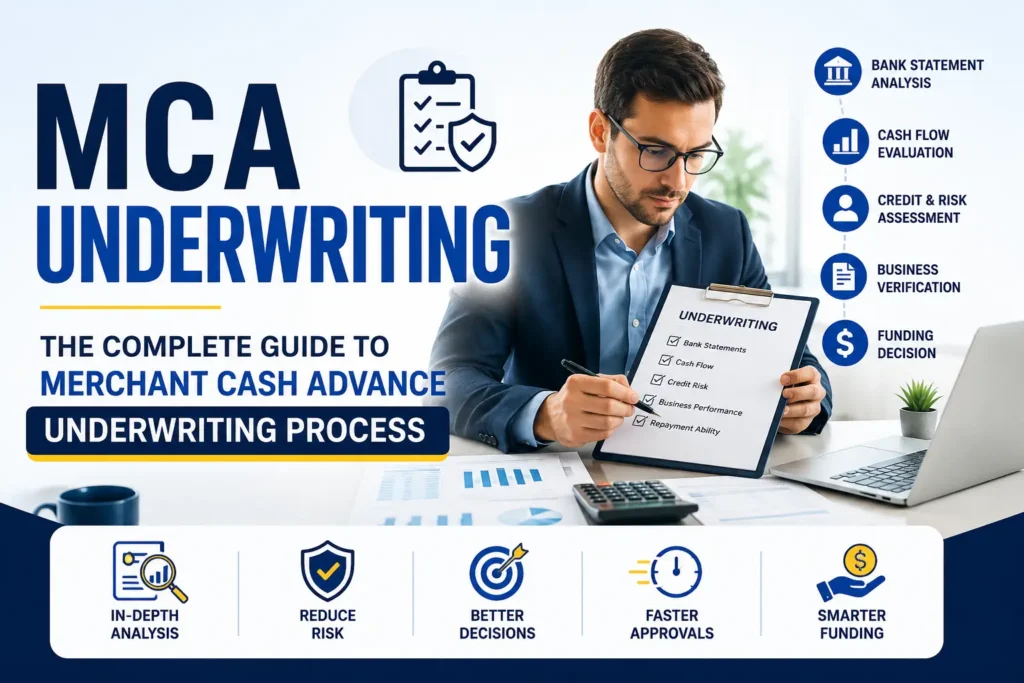
Related: Loan Underwriting Process: Complete Guide for Lenders (2026) | Merchant Cash Advance: The Complete Guide for Borrowers and Lenders (2026) | MCA Underwriting: The Complete Guide to Merchant Cash Advance Underwriting Process
What Is MCA Underwriting?
MCA underwriting is the risk evaluation process merchant cash advance funders use to assess a business’s ability to repay an advance. Unlike traditional loan underwriting, MCA underwriting focuses on daily cash flow, credit card processing volume, and bank statement history rather than FICO scores or collateral.
An MCA underwriter reviews 3 to 6 months of business bank statements, analyzes revenue patterns, checks for NSF occurrences, and assigns a paper grade that determines the factor rate and advance amount a merchant qualifies for [R1].
The core question every MCA underwriter answers is: Can this business generate enough daily revenue to support the holdback without cash flow disruption?
For example, a restaurant with $8,000 in daily credit card sales, 12 months of stable deposits, and fewer than 2 NSF items in 90 days would typically qualify for A-paper pricing – the lowest factor rates and highest advance amounts available.
How Does MCA Underwriting Work?
MCA underwriting combines automated pre-screening and manual review. When a merchant submits an application, the system pulls bank account data – often through secure API connections like Plaid – and runs preliminary analysis on revenue trends, average daily balances, and risk indicators [R2].
Files that pass automated screening move to manual underwriting. The underwriter examines the complete bank statement PDF, verifies deposit sources, flags unusual activity, and makes a funding decision.
The total underwriting cycle for a standard MCA file – from submission to funding decision – is typically 24 to 72 hours. Some automated funders process in under 4 hours. Files requiring manual review for stacking risk or unusual revenue patterns can take 3 to 5 business days [R3].
Quick Reference: MCA Underwriting Timeline
|
The MCA Underwriting Process Step by Step
The MCA underwriting process follows a consistent sequence. Understanding each step helps funders identify bottlenecks and optimize their operations.
Step 1: Application Intake
The merchant submits basic business information, requested advance amount, and bank account authorization. Most funders now use digital applications with API-based bank connections for instant data retrieval.
Step 2: Bank Statement Collection and Verification
The underwriter collects 3 to 6 months of business bank statements. Statements are verified for authenticity by checking deposit patterns, merchant processor settlements, and consistency of revenue sources.
Step 3: Cash Flow Analysis
The underwriter calculates true daily deposits, average daily balance, negative days (days ending below zero), and NSF occurrences. This analysis determines whether the business has sufficient cash flow to support daily or weekly holdbacks.
Step 4: Stacking Check
The underwriter reviews bank statements for evidence of exi
Procizo insight: In our underwriting experience across 30+ funder partners, we find that 1 in 4 MCA applications show evidence of existing stacking. The most reliable detection method is reviewing ACH debit patterns for consistent daily debits in the 8-15% of daily deposits range – these are almost always payments to other MCA funders.
sting MCAs or alternative loans. ACH debits to known MCA funders, daily withdrawal patterns, or multiple recent deposits from funding sources indicate stacking – which increases default risk and typically requires payoff verification.
Step 5: Paper Grade Assignment
Based on all gathered data, the underwriter assigns a paper grade – A, B, C, or D – that determines the factor rate, holdback percentage, and advance amount the merchant qualifies for.
Step 6: Funding Decision
The underwriter approves, declines, or offers modified terms. If approved, the file moves to funding where the advance amount is disbursed – typically within 24 hours of underwriting completion.
What Do MCA Underwriters Look For?
MCA underwriters evaluate a specific set of financial indicators to assess repayment risk. These are the primary factors that determine approval and pricing [R4]:
| Daily revenue consistency: Steady deposits indicate reliable cash flow. Seasonal businesses or those with frequent gaps in deposits face higher risk assessment.
Average daily balance: Higher ending daily balances signal better cash reserves and lower risk of holdback-related cash flow strain. NSF occurrences: More than 3 NSF items in 90 days is a red flag that typically results in at least one paper grade downgrade. Negative days: Days where the account balance drops below zero indicate cash flow weakness and increase perceived risk. Industry type: Some industries – travel, cannabis, adult entertainment – are considered higher risk and face stricter underwriting. Time in business: Most funders require a minimum of 6 months in operation. Businesses under 6 months are usually declined unless they show exceptional credit card volume. Existing MCA or loan payments: Current daily ACH debits to other funders reduce the holdback capacity available for a new advance. |
MCA Underwriting Requirements: Documents Checklist
Funders typically require the following documents and data for MCA underwriting [R5]:
- 3 to 6 months of business bank statements (PDF or API connection)
- Credit card processing statements (3-6 months)
- Government-issued ID (owner)
- Business entity documents (articles of incorporation, EIN verification)
- Business tax ID / EIN
- Personal FICO score check authorization
- Business credit profile (if available)
- Bank account login credentials (for API-based funders requiring real-time data)
Common Document Mistakes That Delay Approval
Source: Industry MCA underwriting standards [R5], Procizo Outsourcing LLC operational data |
Paper Grading: How Funders Classify Risk
Paper grading is the standard risk classification system in MCA underwriting. Each grade determines the factor rate, holdback percentage, and advance amount a merchant qualifies for [R3].
Paper Grade Reference Table
Source: Nav.com MCA Underwriting Guide [R3] |
Accurate paper grading is the single most important skill in MCA underwriting. An A-paper merchant who gets graded as C-paper may take their business to a competitor. A D-paper merchant who gets graded as A-paper increases portfolio default risk for the funder.
MCA Underwriting vs. Traditional Loan Underwriting
The differences between MCA underwriting and traditional loan underwriting are fundamental. Understanding them is critical for funders, brokers, and underwriters.
| Primary focus: MCA = Daily cash flow and revenue consistency | Loan = Credit score, DTI, collateral
Credit score weight: MCA = Low (cash flow matters more) | Loan = High (primary qualification factor) Collateral required: MCA = None (advance is against future revenue) | Loan = Often required for larger amounts Underwriting timeline: MCA = 24-72 hours | Loan = 7-30 days Repayment structure: MCA = Daily or weekly holdback | Loan = Monthly fixed payments Risk assessment: MCA = Bank statement analysis, paper grading | Loan = Credit report, DTI, collateral valuation Funding decision basis: MCA = Revenue trajectory and holdback capacity | Loan = Debt capacity and creditworthiness |
Red Flags That Hurt MCA Approval Odds
Experienced MCA underwriters watch for specific red flags that increase risk or signal potential default [R4][R5]:
- Frequent NSF occurrences: More than 3 in 90 days is a strong predictor of default. Each additional NSF beyond 3 typically reduces the paper grade by one level.
- MCA stacking: Multiple existing advances with daily ACH debits significantly increase default risk. Funders typically require payoff of existing advances before approving new funding.
- Negative bank balances: Accounts that frequently end the day with negative balances indicate poor cash flow management and higher risk of holdback failure.
- Inconsistent deposits: Wide variations in daily deposits suggest unstable revenue. Funders prefer steady, predictable cash flow patterns.
- Speculative or restricted industries: Travel agencies, cannabis, adult entertainment, and certain gig economy businesses face additional scrutiny or automatic decline.
- Fintech bank accounts: Many funders automatically decline applications from fintech-only banks (Chime, Varo, etc.) due to ACH restrictions and verification challenges.
Case Study: MCA Company – Underwriting Outsourcing
Challenge: An MCA company funding $50M+ monthly was processing 200+ deals per week with an in-house underwriting team of 8. Their turnaround time was 6-8 hours per deal, causing them to lose quality submissions to competitors with faster funding decisions. In-house cost per underwrite was $38 per file, and they struggled to staff night shifts for same-day funding.
Solution: Procizo Outsourcing LLC deployed a dedicated team of 6 underwriters working across US time zones. The team handled bank statement scrubbing, paper grading, stacking detection, and pre-funding quality checks – all within the client’s underwriting platform via secure VPN.
Results (6 months):
- Turnaround time reduced from 6-8 hours to 90 minutes – 75% faster
- Cost per underwrite reduced from $38 to $14 – 63% savings
- Deal processing capacity increased from 200 to 450+ per week
- Same-day funding rate improved from 45% to 88%
- Stacking detection accuracy increased to 97% with dedicated QA protocols
- Client reported 22% increase in funded deal volume within first quarter
Challenge: An MCA company funding $50M+ monthly was processing 200+ deals per week with an in-house underwriting team of 8. Their turnaround time was 6-8 hours per deal, causing them to lose quality submissions to competitors with faster funding decisions. In-house cost per underwrite was $38 per file, and they struggled to staff night shifts for same-day funding.
Solution: Procizo Outsourcing LLC deployed a dedicated team of 6 underwriters working across US time zones. The team handled bank statement scrubbing, paper grading, stacking detection, and pre-funding quality checks – all within the client’s underwriting platform via secure VPN.
Results (6 months):
- Turnaround time reduced from 6-8 hours to 90 minutes – 75% faster
- Cost per underwrite reduced from $38 to $14 – 63% savings
- Deal processing capacity increased from 200 to 450+ per week
- Same-day funding rate improved from 45% to 88%
- Stacking detection accuracy increased to 97% with dedicated QA protocols
- Client reported 22% increase in funded deal volume within first quarter
Frequently Asked Questions About MCA Underwriting
What is MCA underwriting?
MCA underwriting is the process merchant cash advance funders use to evaluate a business’s repayment capacity. It focuses on daily revenue, bank statement history, and credit card processing data rather than credit scores or collateral.
How long does the MCA underwriting process take?
Standard MCA underwriting takes 24 to 72 hours from submission to funding decision. Automated pre-screening through API bank connections takes 5 to 15 minutes. Files requiring manual review for stacking risk or unusual patterns may take 3 to 5 business days.
What documents are needed for MCA underwriting?
Funders typically require 3 to 6 months of business bank statements, credit card processing statements, government-issued ID, business entity documents, EIN verification, and personal credit check authorization.
What do MCA underwriters look for in bank statements?
Underwriters analyze average daily balances, revenue trends, NSF occurrences, negative days, deposit consistency, and evidence of existing MCA stacking. Consistent daily deposits above $3,000 with minimal NSF items are ideal.
How is MCA underwriting different from loan underwriting?
MCA underwriting prioritizes daily cash flow and revenue consistency over credit scores, collateral, or DTI ratios. The approval timeline is significantly shorter – 24 to 72 hours versus 7 to 30 days for traditional loans.
What is a paper grade in MCA underwriting?
A paper grade is the risk classification assigned to a merchant based on their financial profile. Grades range from A (lowest risk, best terms) to D (highest risk, most expensive terms). The grade determines factor rate, holdback percentage, and advance amount.
Can you get MCA approval with bad credit?
Yes. MCA underwriting focuses primarily on cash flow rather than credit scores. Many merchants with FICO scores below 600 get approved if they show strong, consistent daily revenue and clean bank statement history.
What is MCA stacking and why is it a problem?
MCA stacking occurs when a merchant has multiple outstanding advances with daily ACH debits going to different funders. It increases default risk because the total daily holdbacks may exceed the merchant’s cash flow capacity.
Need to scale your MCA underwriting operations? Procizo Outsourcing LLC provides dedicated underwriting teams for US-based funders and ISOs. Standard file processing in under 24 hours. Learn more about our underwriting services.
References
| Code | Source | Link |
|---|---|---|
| [R1] | IBISWorld – Industry Research & Market Data | View ? |
| [R2] | Dun & Bradstreet – Industry Research & Market Data | View ? |
| [R3] | Experian – Industry Research & Market Data | View ? |
| [R4] | Federal Reserve – Industry Research & Market Data | View ? |
| [R5] | SBA – Industry Research & Market Data | View ? |
| [R6] | Procizo Outsourcing LLC – Loan Underwriting Process: Complete Guide for Lenders (2026) | View ? |
| [R7] | Procizo Outsourcing LLC – Merchant Cash Advance: The Complete Guide for Borrowers and Lenders (2026) | View ? |
| [R8] | Procizo Outsourcing LLC – MCA Underwriting: The Complete Guide to Merchant Cash Advance Underwriting Process | View ? |
| [R9] | Procizo Outsourcing LLC – What Is Underwriting? Complete Guide for Business Lending (2026) | View ? |
| [R10] | Procizo Outsourcing LLC – The Complete Guide to MCA Underwriting Outsourcing (2026) | View ? |
| [R11] | Procizo Outsourcing LLC – Lending Business: The Ultimate Playbook for Starting & Scaling | View ? |
Ready to Streamline Your Mca Underwriting Support?
Procizo Outsourcing LLC provides end-to-end MCA underwriting support with transparent pricing, dedicated teams, and rapid onboarding. Start with a pilot engagement – no long-term commitment required.
No commitment required . 2-3 week onboarding . SOC 2 Type II security
Editorial Oversight: Content reviewed and approved by the Procizo Outsourcing LLC team based on internal research, operational experience, industry reports, and publicly available data.
Research Methodology: This content was created using a combination of Procizo Outsourcing LLC’s operational expertise, industry publications, academic research, government resources, and verified third-party sources.