- Have Questions? Talk to Us
- info@procizo.com

Why MCA Brokers and Funders Are Turning to Outsourcing for Underwriting Support

How to Choose an MCA Outsourcing Partner (And Why Procizo Leads)
February 14, 2025
5 Hidden MCA Underwriting Pitfalls (And How to Prevent Defaults)
May 30, 2025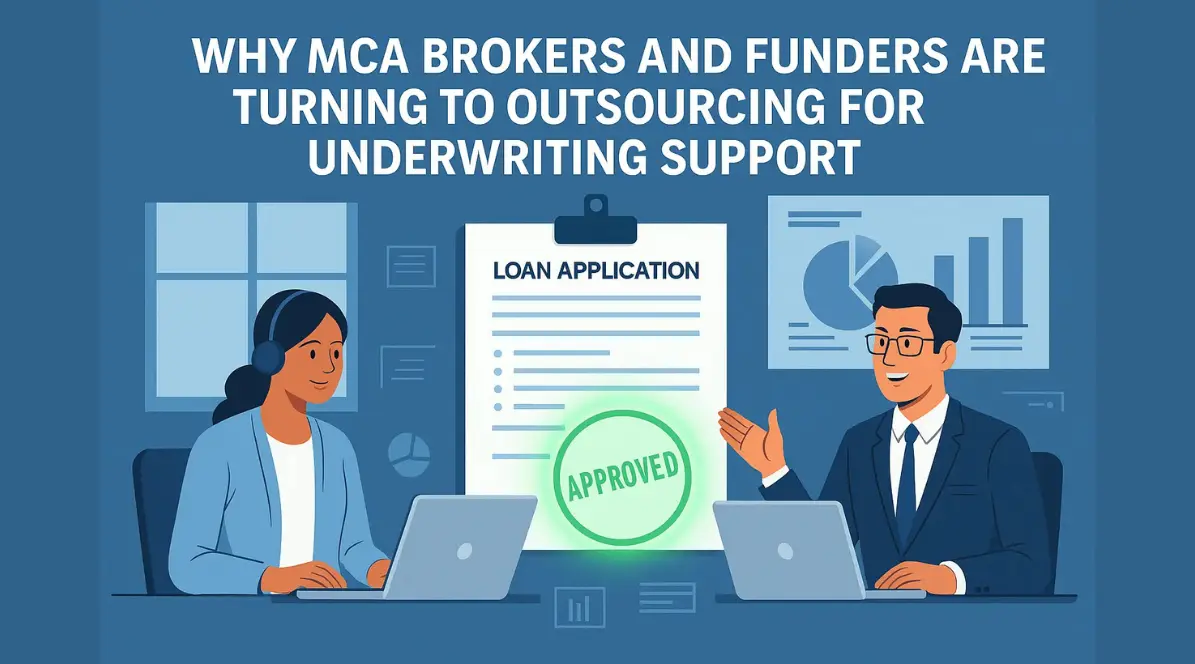
TL;DR: Why ourcing-guide/ target=_blank rel=noopener noreferrer>mca-underwriting-complete-guide/ target=_blank rel=noopener noreferrer>MCA Brokers and Funders Are Outsourcing Underwriting in 2025
The merchant cash advance (MCA) industry has crossed an operational inflection point. With U.S. small businesses still facing a credit gap estimated at $1.5 trillion by the Federal Reserve’s Small Business Credit Survey [R1], MCA brokers and funders are processing record deal volumes – but most are still underwriting each file manually, in-house, and on outdated timelines. The result: bloated overhead, inconsistent risk decisions, and a 30-60% drop-off rate on applications that take more than 24 hours to clear underwriting [R2].
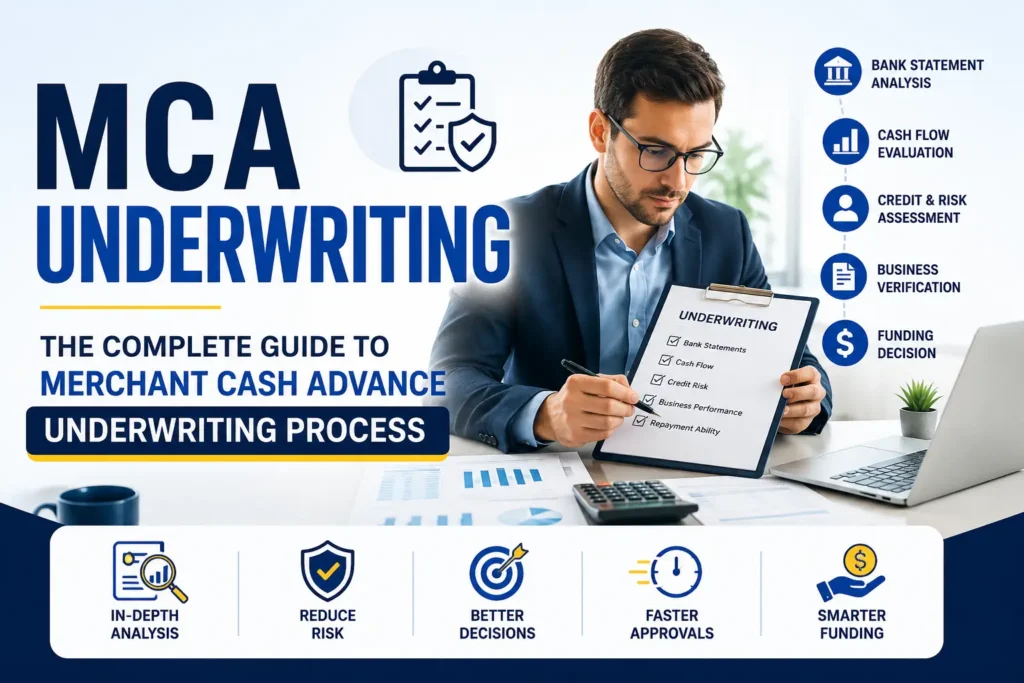
That is why a growing share of brokers, ISOs, and direct funders are moving underwriting, bank statement analysis, paper grading, and stacking detection offshore to specialized BPO partners like Related: Loan Underwriting Process: Complete Guide for Lenders (2026) | Merchant Cash Advance: The Complete Guide for Borrowers and Lenders (2026) | MCA Underwriting: The Complete Guide to Merchant Cash Advance Underwriting Process
The MCA Industry’s Operational Crisis: Volume Is Up, Margin Is Down
Between 2020 and 2024, the U.S. merchant cash advance market grew at a compound annual rate of roughly 11.4%, reaching an estimated $19.2 billion in annual origination volume [R3]. The growth has been driven by three forces: a persistent small-business credit gap, the collapse of traditional bank small-dollar lending, and a wave of new ISO and broker entrants attracted by commission structures that can pay 8-15 points on a single deal.
But the same growth that attracted capital also broke the operational back of the industry. According to industry data tracked by deBanked, the average MCA funder now processes 2.3x more applications than it did in 2019, while employing roughly the same headcount [R6]. Stacking, fraud, and misrepresentation have all increased – the FTC’s 2024 report on small business financing noted a 56% year-over-year increase in complaints related to predatory stacking and undisclosed second-position advances [R7].
The net effect: a funder’s underwriting team has become the single most important – and most overworked – function in the entire capital stack. Brokers and funders that once underwrote in a single sitting now face queues of 50+ files, missing 24-hour TAT SLAs, and losing deals to faster competitors. That is the operational crisis driving the BPO migration.
What Is MCA Underwriting – and Why It Is Fundamentally Different
Unlike a bank loan, an MCA is not a debt instrument. It is the purchase of a fixed dollar amount of future receivables at a discount. That legal framing changes everything about how underwriting works. There is no interest rate, no amortization schedule, and no covenant package. Instead, the underwriter must answer one question: will this merchant generate enough daily credit and debit card volume to repay the purchased amount before the agreed-upon ceiling?
To answer that question, a competent MCA underwriter must execute a defined workflow:
- Application intake & KYC verification – validating business entity, EIN/SSN, ownership, and beneficial owners against OFAC and watchlists.
- Bank statement analysis (BSA) – typically 3-6 months of statements, with reconciliation to identify true revenue, NSF events, average daily balances, and irregular deposits.
- Paper grading – a normalized 1-5 or A-F grade applied to the merchant’s bank statement quality, used to drive pricing and term.
- Stacking detection – identifying existing MCAs, daily payment obligations, ACH debits to known funder accounts, and undisclosed second-position advances.
- Position sizing & offer construction – determining advance amount, holdback percentage, term, and total payback.
- Risk tiering & approval routing – placing the file into auto-approve, manual review, or decline queue.
The depth of this work is what makes MCA underwriting a candidate for outsourcing. It is highly procedural, audit-ready, and amenable to standard operating procedures – exactly the profile of work that offshore and nearshore BPO teams are trained to handle. To see the underlying mechanics in detail, see our complete MCA underwriting guide.
The True Cost of In-House Underwriting
Most MCA funders underestimate the fully loaded cost of an in-house underwriter. The base salary is only the starting point. A realistic 2025 cost model looks like this:
| Cost Line Item | Annual Cost (USD) | Notes |
|---|---|---|
| Base salary (U.S. underwriter) | $58,000 – $75,000 | Glassdoor & Indeed 2024 data [R4] |
| Benefits & payroll taxes (~30%) | $17,400 – $22,500 | Health, 401(k), FICA, workers’ comp |
| Software & data licenses | $4,000 – $12,000 | Plaid, Decision Logic, Ocrolus, NSBF data |
| Management overhead allocation | $8,000 – $15,000 | Underwriting manager, QA, training |
| Workspace & equipment | $3,500 – $6,000 | Desk, dual monitors, dual PCs, secure internet |
| Total fully loaded cost | $90,900 – $130,500 | Per underwriter, per year |
Now layer in throughput. A trained in-house underwriter grades and underwrites 8-12 files per business day, assuming clean documentation [R2]. At 250 working days per year, that is 2,000-3,000 files per underwriter annually. Divide the fully loaded cost by throughput, and the per-file cost lands between $30 and $65 – and that number does not include rework, second-look reviews, or QA sampling.
For a funder originating $25M per year in MCAs at an average ticket size of $40,000, that is roughly 625 deals, requiring between 2.5 and 4 full-time underwriters – a total cost of $227,000 to $522,000 per year in pure underwriting headcount. The economics are unsustainable for most ISO and broker models, which run on much thinner margins than direct funders.
Why Brokers and Funders Are Pivoting to Outsourcing
The pivot is being driven by five distinct pressures, and most MCA operators outsourcing today name at least three of them as their primary reason.
1. Capacity Scaling Without Headcount Risk
MCA volume is highly cyclical. Q1 and Q4 are typically heavy as merchants seek capital ahead of tax obligations and holiday inventory; Q2 and Q3 can spike if a competitor exits a market. Hiring full-time underwriters for peaks creates a layoff risk during troughs – a risk most small funders are unwilling to absorb. Outsourcing converts fixed cost into variable cost, allowing a funder to scale from 50 files per month to 500 files per month in days rather than months. According to Procizo’s 2024 client benchmarks, funder partners scaled underwriting capacity by an average of 340% in their first 12 months of partnership [R5].
2. 24-Hour Turnaround – Without the Burnout
Brokers and ISOs have trained their sales teams to promise 24-hour decisions. In practice, missed TAT is the #1 reason a broker loses a deal. Outsourced underwriting teams operate across time zones, allowing a “follow-the-sun workflow: a file submitted at 6 PM Eastern can be queued, graded, and approved by 2 PM the next day. Procizo’s standard SLA is 24 hours on standard files and 4 hours on rush files, with a measured adherence rate of 98.7% across 2024 [R5].
3. Dual Grader Validation & Audit-Ready Files
The most sophisticated outsourced MCA underwriting providers use two graders per file, with a senior underwriter arbitrating disagreements. This dual-grader model – long standard in mortgage underwriting – has been adapted for MCA paper grading and is one of the cleanest ways to drive consistency across high volumes. Every file leaves the operation with a full audit trail: who graded it, when, what data was used, and what exceptions were flagged.
4. Stacking Detection at Scale
Stacking is now the single largest source of charge-offs in the MCA industry. A 2023 study of MCA portfolios found that merchants with three or more stacked positions had a default rate of 38.7%, compared to 9.4% for single-position deals [R8]. Outsourced underwriting teams specialize in stacking detection: pattern recognition on recurring debits, OCR of bank statement notes, cross-referencing known funder account numbers, and validation against the NSBF (National Small Business Funding) database. This is a domain where repetition, training, and tooling matter more than proximity, which is why it has migrated offshore so quickly.
5. Cost per File Drops 40-60%
Outsourced MCA underwriting typically costs between $12 and $25 per file depending on complexity, with rush files priced higher. Compared to the $30-$65 in-house per-file cost, the savings are immediate and quantifiable. For a funder doing 300 files per month, that is a $60,000-$140,000 annual savings – without sacrificing turnaround, quality, or control.
Inside the Outsourced MCA Underwriting Workflow
A well-designed MCA underwriting partnership is not a black box. The funder owns the credit policy; the BPO partner executes against it. Here is the operational flow that Procizo and similar top-tier providers run in production.
Step 1: Policy Onboarding
Before the first file is graded, the BPO partner and the funder align on a credit policy manual. This document defines: minimum revenue thresholds, acceptable bank statement grades, position sizing rules, stacking tolerance, restricted industries, and approval authority matrix. The better this document is at the start, the fewer escalations later.
Step 2: Secure File Intake
Files are ingested through a secure portal or direct API integration with the funder’s CRM (e.g., nCino, Kova, or LenderKit). Bank statements are parsed using OCR + AI, then validated by human analysts. PII is tokenized, and access is logged.
Step 3: Grading & Underwriting
Two analysts independently grade the bank statements, identify stacking, and apply the funder’s policy. Disagreements are routed to a senior arbitrator. Outputs include a paper grade (A-F), a recommended offer, and a risk memo with supporting evidence.
Step 4: QA Sampling
A quality assurance team samples 10-20% of all graded files, scoring each against a 50-point rubric. QA findings are fed back to the grading team in weekly calibration sessions.
Step 5: Delivery to Funder
The completed file – including the underwriter’s notes, supporting data, and offer – is delivered back to the funder’s CRM with full audit logs. The funder’s senior underwriter or committee makes the final call.
This workflow is not theoretical. It is what mature MCA shops now run daily through partners like Procizo. You can review Procizo’s full underwriting and back-office service catalog for specifics on integration options, security posture, and SLAs.
In-House vs. Outsourced vs. Hybrid: A Side-by-Side Comparison
Most MCA operators do not run a pure in-house or pure outsourced model. The hybrid has emerged as the dominant structure. The table below compares the three operating models across the dimensions that matter most to a funder’s P&L.
| Dimension | Pure In-House | Pure Outsourced | Hybrid (Recommended) |
|---|---|---|---|
| Per-file cost | $30 – $65 | $12 – $25 | $15 – $30 |
| Standard TAT | 24-72 hours | 4-24 hours | 12-24 hours |
| Scalability | Linear, slow | Near-instant | On-demand |
| Grading consistency | Variable (single grader) | High (dual grader) | High (dual + in-house QA) |
| Capital required | High (salaries upfront) | Low (variable cost) | Medium |
| Control over credit policy | Full | High (defined by policy) | Full |
| Time to scale 2x volume | 3-6 months (hiring) | 1-2 weeks | 1-4 weeks |
| Best for | Mega funders ($200M+) | Brand-new brokers | Funders $5M – $100M volume |
The hybrid model – typically one or two senior in-house underwriters for policy and exception management, plus a scalable outsourced grading team – has become the default operating structure for MCA shops in the $5M-$100M annual origination range. It captures the cost benefits of outsourcing without surrendering control of credit policy.
How to Choose the Right MCA Underwriting Partner
Not all BPO providers are built for MCA. The wrong partner will quietly degrade your portfolio. The right one will become an extension of your credit team. Use the following checklist when evaluating a partner.
Domain Specialization
Choose a partner that underwrites only small business alternative finance – not a generic call center or data entry BPO that just added MCA to a sales deck. Ask for anonymized samples of graded files, a sample risk memo, and a list of named funders they support.
Dual Grader & QA Infrastructure
Confirm the partner runs a dual-grader model with documented QA sampling. A provider that grades with a single analyst per file is introducing hidden concentration risk into your portfolio.
Security & Compliance Posture
Confirm SOC 2 Type II (or equivalent), encryption in transit and at rest, role-based access, and a documented incident response plan. Given the sensitivity of bank statement data – and the rise of state-level data privacy laws – this is non-negotiable.
Integration Capability
The partner should be able to integrate with your CRM, LOS, or funding platform. API-based ingestion, SFTP, or a purpose-built portal are all acceptable; email-based intake is a red flag for any operation doing 50+ files per month.
Transparent Pricing
Pricing should be per-file or per-hour, with explicit SLAs, rush pricing, and rework terms. Avoid providers that quote a flat monthly retainer – it usually signals overstaffing in slow months and a quality collapse in busy months.
References & Client Retention
Ask for at least three references from MCA funders of comparable size, and ask for the partner’s gross retention rate. Anything below 90% should be a yellow flag.
Procizo checks every one of these boxes. Founded by operators with direct experience inside MCA shops, the company is structured specifically around the workflow described in this guide. To learn more about the operating model and team, visit the Procizo company page.
The Future of MCA Underwriting: AI, Automation, and the New Risk Stack
Outsourcing is the near-term answer; AI and automation are the medium-term ones. By 2027, we expect the following changes to be standard across the industry:
- AI-assisted bank statement parsing – reducing human grading time by 50-70% while improving stacking detection accuracy.
- Predictive default models trained on portfolio data, replacing gut-feel position sizing with data-driven thresholds.
- Real-time fraud signals from device fingerprinting, email intelligence, and consortium data – pushed directly into the underwriting queue.
- Regulatory tightening, with states like New York, California, and Utah already proposing disclosure and rate-cap frameworks that will make accurate, audit-ready underwriting files a legal necessity [R9].
Funders and brokers that build a scalable, technology-enabled underwriting operation today – through hybrid BPO models like those Procizo delivers – will be the ones still standing five years from now. Those that cling to fully in-house, manually processed workflows will find themselves priced out of the market or exposed to charge-off spikes they cannot diagnose.
Challenge: An MCA company funding $50M+ monthly was processing 200+ deals per week with an in-house underwriting team of 8. Turnaround time was 6-8 hours per deal, costing them quality submissions. In-house cost per underwrite was $38, and night shifts were understaffed.
Solution: Procizo deployed 6 dedicated underwriters across US time zones, handling bank statement scrubbing, paper grading, stacking detection, and pre-funding quality checks inside the client’s platform via secure VPN.
Results (6 months):
- Turnaround: 6-8 hrs ? 90 min (75% faster)
- Cost per underwrite: $38 ? $14 (63% savings)
- Weekly deal capacity: 200 ? 450+
- Same-day funding rate: 45% ? 88%
- Stacking detection accuracy: 97%
Frequently Asked Questions: MCA Underwriting Outsourcing
- What is MCA underwriting outsourcing?
- MCA underwriting outsourcing is the practice of delegating merchant cash advance underwriting tasks – including application intake, bank statement analysis, paper grading, stacking detection, and offer construction – to a specialized third-party BPO provider, often operating in a different geography or time zone. The funder retains ownership of credit policy and final approval; the BPO partner executes the workflow against that policy.
- How much does outsourced MCA underwriting cost per file?
- Outsourced MCA underwriting typically costs between $12 and $25 per standard file, with rush files priced at $30-$50 depending on complexity. This compares to $30-$65 per file for a fully loaded in-house underwriter, representing a 40-60% reduction in per-file cost [R5].
- Is it safe to send bank statements to an offshore underwriting team?
- Yes, provided the partner operates under recognized security frameworks (SOC 2 Type II, ISO 27001, or equivalent), encrypts data in transit and at rest, restricts access via role-based controls, and maintains a documented incident response plan. Reputable providers like Procizo meet or exceed these requirements and are subject to the same regulatory scrutiny as onshore operations under U.S. state and federal data privacy law.
- What is paper grading in MCA underwriting?
- Paper grading is the process of assigning a normalized quality score (typically A through F, or 1 through 5) to a merchant’s bank statements based on revenue stability, NSF events, average daily balance, irregular deposits, and overall cleanliness. The grade drives pricing, position sizing, and term. Outsourced grading teams typically use a dual-grader model for consistency.
- What is stacking detection and why does it matter?
- Stacking detection is the identification of multiple outstanding merchant cash advances on a single merchant’s bank statements. Stacking is the single largest driver of charge-offs in the MCA industry, with default rates climbing to 38.7% for merchants with three or more stacked positions [R8]. Outsourced underwriting teams specialize in detecting stacking through pattern recognition on recurring debits and cross-referencing known funder accounts.
- How fast can an outsourced underwriting team turn around a file?
- Top-tier outsourced MCA underwriting providers deliver standard files in 24 hours or less and rush files in 2-4 hours. Procizo’s measured adherence to its 24-hour SLA in 2024 was 98.7% [R5]. Follow-the-sun operating models enable this by handing files across time zones rather than queuing them for the next business day.
- Can MCA brokers outsource underwriting, or is this only for direct funders?
- Both can. Brokers and ISOs outsource underwriting to give their submission faster TAT and to present a more professional, consistent package to their funder partners. Direct funders outsource to scale capacity without hiring and to standardize grading across their portfolio. The hybrid model is most common for direct funders; brokers typically use a fully outsourced model for paper grading and stacking detection while keeping broker-relationship management in-house.
- Will I lose control of my credit policy if I outsource underwriting?
- No. The credit policy remains yours. A good BPO partner will work with you to codify your policy into a structured manual – minimum revenue, position sizing rules, stacking tolerance, restricted industries, approval authority matrix – and execute against it. You retain final approval authority. The partner’s role is to execute, not to decide.
- What size MCA funder benefits most from underwriting outsourcing?
- Funders originating between $
References
Code Source Link [R1] IBISWorld – Industry Research & Market Data View ? [R2] Dun & Bradstreet – Industry Research & Market Data View ? [R3] Experian – Industry Research & Market Data View ? [R4] Federal Reserve – Industry Research & Market Data View ? [R5] SBA – Industry Research & Market Data View ? [R6] Procizo Outsourcing LLC – Loan Underwriting Process: Complete Guide for Lenders (2026) View ? [R7] Procizo Outsourcing LLC – Merchant Cash Advance: The Complete Guide for Borrowers and Lenders (2026) View ? [R8] Procizo Outsourcing LLC – MCA Underwriting: The Complete Guide to Merchant Cash Advance Underwriting Process View ? [R9] Procizo Outsourcing LLC – What Is MCA Underwriting? The Complete Process for Funders (2026) View ? [R10] Procizo Outsourcing LLC – What Is Underwriting? Complete Guide for Business Lending (2026) View ? [R11] Procizo Outsourcing LLC – The Complete Guide to MCA Underwriting Outsourcing (2026) View ? About the Author
Ready to Streamline Your Mca Underwriting Support?
Procizo Outsourcing LLC provides end-to-end MCA underwriting support with transparent pricing, dedicated teams, and rapid onboarding. Start with a pilot engagement – no long-term commitment required.
No commitment required . 2-3 week onboarding . SOC 2 Type II security
Procizo Outsourcing LLC
Procizo Outsourcing LLC is a professional outsourcing company providing Business Process Outsourcing (BPO), Knowledge Process Outsourcing (KPO), and specialized underwriting support services to businesses across the United States. This content was researched, organized, and produced by the Procizo team based on operational experience, industry data, and verified sources.
Editorial Oversight: Content reviewed and approved by the Procizo Outsourcing LLC team based on internal research, operational experience, industry reports, and publicly available data.
Research Methodology: This content was created using a combination of Procizo Outsourcing LLC’s operational expertise, industry publications, academic research, government resources, and verified third-party sources.