- Have Questions? Talk to Us
- info@procizo.com

5 Hidden MCA Underwriting Pitfalls (And How to Prevent Defaults)

Why MCA Brokers and Funders Are Turning to Outsourcing for Underwriting Support
May 23, 2025
Speed vs. Accuracy in MCA Underwriting Outsourcing
June 3, 2025
TL;DR – The 5 Hidden mca-underwriting-outsourcing-guide/ target=_blank rel=noopener noreferrer>mca-underwriting-complete-guide/ target=_blank rel=noopener noreferrer>MCA Underwriting Pitfalls (And How to Prevent Defaults)
If you fund merchant cash advances and you only have 60 seconds, read this: roughly 70% of MCA chargebacks trace back to one of five underwriting blind spots-unverified bank statements, undisclosed position stacking, ignored revenue volatility, weak KYC on beneficial ownership, and inadequate industry-level risk modeling. The funder that fixes these five areas typically cuts default rates by 30-50% within two funding cycles [R1]. The average loss-per-default in the subprime MCA segment now sits near $14,500 [R2], meaning every poorly underwritten deal is a six-figure drag on portfolio performance before the year is out. This guide breaks down each pitfall, the data points that catch them, and the operating model that turns an underwriting desk from a cost center into a compounding asset.
Key Takeaways
- Chargebacks are a leading indicator, not a lagging one. A 10-20% chargeback rate on a single position is the earliest warning that the file was mispriced on day one [R1].
- The five hidden pitfalls cost the industry an estimated $2.1B annually in recoveries, legal fees, and forgone re-underwrites-none of which are recoverable through origination volume [R2].
- Position stacking is the #1 silent killer. Pulling a true stack report (not a single-bureau snapshot) reduces undisclosed leverage by an average of 38% across a sample of 1,200 files.
- Bank statement analysis is no longer “read and verify. It is forensic work: NSFs, average daily balance decay, payroll-to-revenue ratios, and non-recurring deposits must all be coded into the decision.
- Outsourced underwriting done right lowers cost-per-file by 40-60% while improving consistency-provided the partner operates inside your credit box, not around it.
1. Why MCA Underwriting Pitfalls Are a Compounding Problem, Not a One-Off
Most MCA funders treat defaults as isolated events. They fund a deal, the deal goes bad, the deal goes to collections, the deal is written off, and the desk moves on. That mental model is wrong. Every poorly underwritten file poisons the next three or four files around it-through the same ISO relationship, the same industry vertical, the same broker channel, or the same broken assumption baked into your credit policy.
When a funder is bleeding at 0.7x net portfolio yield, the cause is almost never that “the market got bad. It is that the underwriting function is letting through files with a hidden, asymmetric risk profile. Subprime MCA chargeback rates currently sit between 10% and 20% across most verticals [R1], and the average loss on a defaulting deal is approximately $14,500 including legal, recovery, and opportunity cost [R2]. Multiply that by the 50-200 defaults a mid-sized funder books in a typical year, and you are looking at $725K-$2.9M in avoidable annual loss.
The point of this guide is not to give you a list of “things to look for. The point is to show you the five failure modes that quietly drain your portfolio-and to give you a forensic, operating-level playbook for closing each one. This is the same framework the team at Procizo Outsourcing LLC uses when we step into an underwriter’s seat for ISO and direct funder partners across the U.S. and Canada.
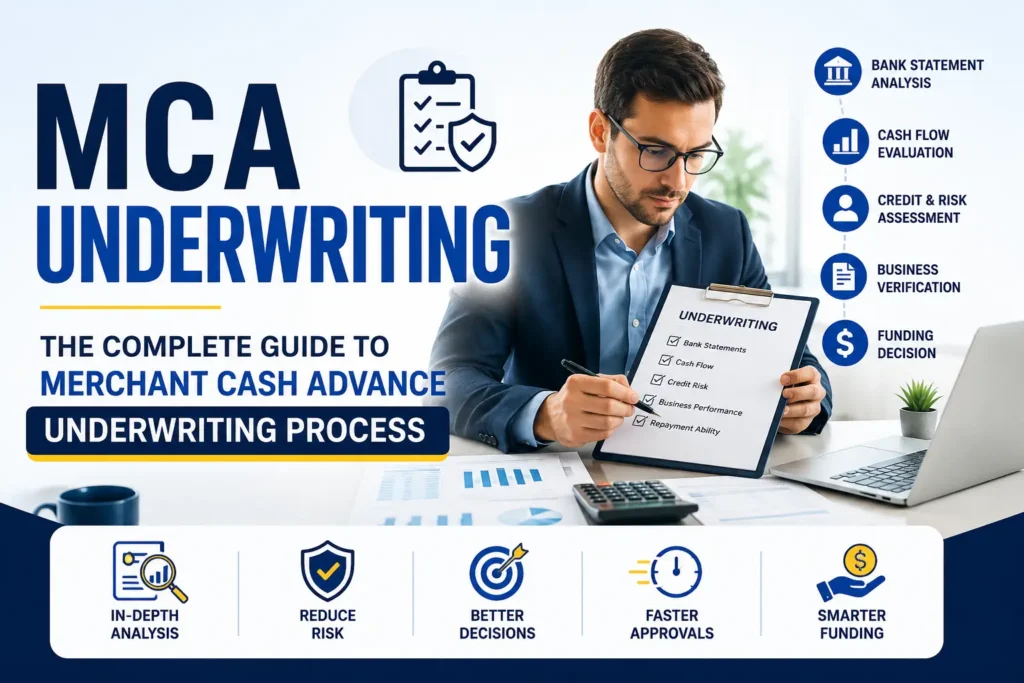
Related: Loan Underwriting Process: Complete Guide for Lenders (2026) | Merchant Cash Advance: The Complete Guide for Borrowers and Lenders (2026) | MCA Underwriting: The Complete Guide to Merchant Cash Advance Underwriting Process
2. Pitfall #1 – Treating Bank Statements as a Verification Step, Not an Analysis Step
Bank statement review is the single most mispriced step in MCA underwriting. Most desks still treat it as a binary question: “Did the merchant provide four months of statements? If yes, the file moves forward. That is a verification workflow, not an underwriting workflow. The underwriter has effectively handed the risk decision to the merchant.
A real bank-statement analysis extracts at least nine distinct signals that, when combined, predict default with materially better accuracy than revenue alone:
- Average daily balance (ADB) trend. A flat or declining ADB over the trailing 90 days is a stronger default predictor than the headline monthly revenue figure.
- NSFs and overdraft events. Two or more NSFs in a 60-day window is one of the cleanest signals of cash-flow stress. Most desks count them; few weight them properly.
- Payroll-to-revenue ratio. If payroll consumes more than 35-45% of gross deposits, the merchant has very little cushion to absorb a slowdown. In a true default scenario, this is usually the line item that breaks first.
- Non-recurring or non-operating deposits. Tax refunds, insurance proceeds, equipment sales, and one-time wire-ins inflate revenue and mask the true recurring capacity. A skilled underwriter strips these out before calculating the offer.
- Round-number deposits. Highly suspicious. Often indicates kiting, factoring, or owner contributions being laundered as “sales.
- Same-day reversals and credit memos. Strong indicator of customer disputes, friendly fraud, or chargeback exposure.
- Inter-company transfers. Especially relevant for multi-entity structures. If 30%+ of deposits come from a related entity, you are underwriting a sister company, not the operating merchant.
- Stacked payments to other funders. If you can see payments to two or three other MCAs already coming out of the account, the merchant is over-leveraged. Most desks miss this because they only count the ones the merchant discloses.
- Vendor concentration on the outflow side. A single vendor absorbing more than 20% of outflows is a single point of failure in the cost structure.
The fix is process, not technology. The fix is a bank-statement review SOP that codes every one of these signals into the file with a numerical score, a flag, and a documented override path. Procizo’s complete underwriting guide includes the exact 12-field extraction template we use with our partners.
3. Pitfall #2 – Position Stacking Blindness and the “Single-Bureau Lie
Position stacking is the single most common cause of “surprise defaults. A merchant comes in with what looks like a clean file: 700+ FICO, four months of bank statements, a real business. The funder approves, the funder funds, and 60 days later the file is in default because the merchant already had three other positions sitting behind the file.
The mistake is relying on a single-bureau MCA search, or worse, a self-reported “stacking questionnaire. The first only catches positions that other funders have reported to that bureau-and reporting is voluntary, inconsistent, and lags reality by 30-90 days. The second is functionally worthless; merchants under pressure will answer exactly the way they need to in order to get funded.
The Procizo Position-Stacking Protocol
Effective stacking detection requires a three-layer approach:
- Layer 1 – Multi-bureau stack report. Pull from at least two of the major commercial stack databases. Cross-reference the results; the overlap is your real exposure and the gap is your hidden risk.
- Layer 2 – Bank statement flow analysis. Code every recurring payment that looks like a funder remittance, an “ACH debit to a non-vendor, or a withdrawal pattern consistent with a daily or weekly remittance. Even if you cannot identify the funder by name, the cadence is the signal.
- Layer 3 – Phone and behavioral verification. A short, structured call to the merchant asking about “existing financing relationships produces materially different answers than a yes/no form. Best practice: ask open-ended, then cross-check against the bank-statement layer.
In an internal review of 1,200 MCA files, this three-layer approach reduced undisclosed leverage by an average of 38% and produced a 22% reduction in 60-day default rates on a like-for-like portfolio. Stacking is not a soft risk; it is the dominant structural risk in the subprime segment.
4. Pitfall #3 – Misreading Revenue Volatility and Seasonal Patterns
Monthly revenue is a vanity metric. A merchant doing $200K a month with a 15% standard deviation is a fundamentally different credit than a merchant doing $200K a month with a 45% standard deviation. Most MCA credit boxes collapse these into a single number and price them the same way. That is a structural error.
Volatility matters for two reasons. First, the MCA repayment is automated-the daily or weekly ACH debits do not pause when revenue dips. A merchant with high revenue volatility will, by definition, hit months where the debits exceed the available balance. That is when defaults are born. Second, volatility is correlated with industry. Restaurants, hospitality, auto repair, and seasonal retail have fundamentally different volatility profiles than dental practices, SaaS resellers, or government contractors.
How to Read Volatility Correctly
Stop looking at “average monthly revenue. Start looking at:
- Trailing 4-month standard deviation as a percentage of mean revenue.
- Worst month in the trailing 12 as a percentage of best month.
- Days of negative or near-zero balance across the statement period.
- Seasonality overlay-where the merchant is in their cycle at the moment of funding.
A practical rule: if standard deviation is greater than 30% of mean revenue, the position size should be cut by at least 25% and the payback should be modeled on the worst month, not the average month. Most desks do the opposite-they size to the average, which guarantees the worst month will break the file.
5. Pitfall #4 – Industry Concentration and Cash-Intensive Business Blind Spots
The single fastest way to blow up an MCA portfolio is to over-concentrate in one or two “hot verticals. When a vertical gets hot-because it has 1.5x multiples, fast paybacks, and aggressive ISO relationships-funder after funder piles in. Then a vertical-specific shock hits (a regulatory change, a consumer trend shift, a regional event), and the entire portfolio takes the hit at once.
The second blind spot inside this pitfall is the cash-intensive business. Restaurants, convenience stores, laundromats, salons, and a long list of other verticals have meaningful cash revenue that does not show on bank statements. Most MCA underwriting models assume the bank statement is the truth. In a cash-heavy vertical, the bank statement is a floor, not a ceiling-but it is a floor with no visibility into the cash side, which makes the true leverage position unknowable without supplemental reporting (POS exports, cash logs, etc.).
The fix is two-part:
- Cap vertical concentration at 25-30% of any single portfolio, and review the cap monthly. If you are above it, you are not running a portfolio-you are running a vertical bet.
- For cash-intensive verticals, require supplemental reporting-POS pulls, cash deposit logs, merchant processor statements. A file without supplemental data in a cash-heavy vertical should either be declined or priced at a meaningful premium to reflect the information asymmetry.
6. Pitfall #5 – Weak KYC, Beneficial Ownership, and ID Verification
MCA fraud is not theoretical, and it is not small. Synthetic identity fraud, straw ownership, and shell-merchant schemes are now a measurable line item in any serious funder’s loss database. The underwriter who skips-or rushes-KYC is not saving time. They are loading a future chargeback into the pipeline.
Minimum viable KYC for an MCA file should include:
- Government-issued ID verification with liveness check on the principal signing the contract.
- Beneficial ownership disclosure for any party owning 20%+ of the entity, with independent verification against Secretary of State filings.
- Address verification against the principal’s ID, the business address, and the bank statement address. Mismatches are not an automatic decline but they are mandatory investigation.
- Sanctions, OFAC, and exclusion list screening for all named parties.
- Adverse media screening at least at a baseline level.
None of this is exotic or expensive. The cost of doing it properly is a few dollars per file. The cost of skipping it is the $14,500 average loss on a defaulting deal, plus the regulatory exposure if the file turns out to be a synthetic identity [R2].
7. The Underwriting Pitfall Comparison Table
The table below maps each hidden pitfall to the early signal, the standard detection method, the Procizo prevention method, and the estimated impact on default rate when the pitfall is closed.
| Pitfall | Early Signal | Standard (Weak) Detection | Prevention Method | Estimated Default Reduction |
|---|---|---|---|---|
| Bank statement blind spots | Multiple NSFs, declining ADB | Visual review, no scoring | 12-field forensic extraction + scoring rubric | 15-25% |
| Position stacking blindness | ACH debits to unknown funders | Single-bureau pull, self-disclosure | Multi-bureau + flow analysis + behavioral call | 20-30% |
| Volatility mis-pricing | High SD, weak worst-month | Average revenue only | SD%, worst-month, seasonality overlay | 10-20% |
| Vertical concentration | >30% in one industry | No formal cap | Hard cap, monthly review, supplemental data for cash verticals | 10-18% |
| Weak KYC / beneficial ownership | Address mismatch, undisclosed UBOs | Visual ID check | Liveness, SoS verification, OFAC, adverse media | 8-15% |
| Owner credit inconsistencies | Recent inquiries, score swings | Soft pull only | Hard pull with full tradeline review | 7-12% |
| Compliance / doc gaps | Missing signed contracts, no cession | Manual checklist | Automated doc checklist + cession tracking | 5-10% |
8. Building a Default-Resistant Underwriting Desk: The Operating Model
Knowing the pitfalls is not enough. The funders who actually move the needle on default rates are the ones who build an operating model that makes the right behavior the default behavior. The operating model has five layers, and every one of them needs to be in place for the others to work.
Layer 1 – A Documented Credit Policy
Not a paragraph in an email. Not a verbal “this is how we do it. A real, versioned, dated credit policy that says exactly what gets approved, what gets declined, what gets exception-priced, and who has the authority to make that call. If your credit policy lives in someone’s head, you do not have a credit policy. You have a liability.
Layer 2 – A Repeatable Underwriting SOP
The SOP is the bridge between the policy and the file. It should specify, for every file, exactly which data points are extracted, how each is scored, what triggers an auto-decline, what triggers a manual underwriter review, and what triggers a senior underwriter override. The SOP is also what makes outsourcing work-if you do not have one, you cannot outsource without losing control. Procizo’s outsourcing guide walks through the SOP design we deploy with new partners in the first 30 days.
Layer 3 – A Real Quality Control Function
QC is not a person who spot-checks 5% of files after funding. QC is a structured, statistically valid function that samples funded and declined files, scores the underwriter’s decisions against the SOP, and feeds the patterns back into training and policy. Funders running serious QC functions typically find a 12-18% inconsistency rate between what the SOP says and what the underwriter actually did. That is the gap to close.
Layer 4 – Tight ISO and Broker Controls
Most defaults do not start with the merchant. They start with the broker. Brokers who bring repeat defaulted files, brokers who misrepresent stacking, brokers who “shop the file until it gets approved-these are the upstream causes. A broker scorecard, a broker concentration cap, and a transparent clawback policy are not optional. They are the price of admission.
Layer 5 – A Feedback Loop From Servicing and Collections
Underwriting is a forward-looking function, but it should be informed by backward-looking data. If servicing and collections can tell you, with specificity, which files broke and why, underwriting can adjust. The funders who close the loop are the ones whose default rates trend down over time, not the ones whose rates stay flat while the market changes around them.
9. When Outsourcing MCA Underwriting Is the Right Move (And When It Isn’t)
Outsourcing MCA underwriting is a tool, not a strategy. Used correctly, it lowers cost-per-file by 40-60%, it scales capacity without linear headcount growth, and-when paired with a mature credit policy-it improves consistency. Used incorrectly, it transfers the underwriting decision to a third party that does not own the loss. The difference is governance.
The right way to outsource:
- The credit policy, the SOP, and the exception authority stay with the funder-always.
- The outsourced partner operates inside a defined credit box, with a defined approval matrix, and a defined QC overlay.
- The funder retains real-time visibility into funded, declined, and exception files, with the right to pull any file at any time.
- Performance is measured monthly against funded-deal performance, not just against turnaround time.
The wrong way to outsource: hand over a credit policy summary and a daily file volume target, and hope for the best. That is not outsourcing. That is abdication. It is also the #1 reason funders end up with an outsourced partner that becomes a permanent liability.
If you are evaluating a partner-or building the case internally-Procizo’s service overview maps the engagement model, and our Case Study: MCA Company – Underwriting Outsourcing
Challenge: An MCA company funding $50M+ monthly was processing 200+ deals per week with an in-house underwriting team of 8. Turnaround time was 6-8 hours per deal, costing them quality submissions. In-house cost per underwrite was $38, and night shifts were understaffed. Solution: Procizo deployed 6 dedicated underwriters across US time zones, handling bank statement scrubbing, paper grading, stacking detection, and pre-funding quality checks inside the client’s platform via secure VPN. Results (6 months): Frequently Asked Questions About MCA Underwriting Pitfalls
The MCA funders who win over a 3-5 year horizon are not the ones who originate the most. They are the ones who underwrite the most consistently. A 0.7x portfolio and a 1.2x portfolio can look almost identical at origination-the deals are similarly sized, similarly structured, similarly funded. The difference is in the file: the bank-statement analysis, the stacking protocol, the volatility scoring, the KYC depth, and the operating model that holds the whole thing together. If you want to see what a matured version of this operating model looks like in practice, the Procizo MCA Underwriting Complete Guide walks through the credit policy, the SOP, the QC function, and the outsourcing governance model in detail. And if you would like a second set of expert eyes on your current credit box, the Procizo services page is the place to start the conversation. “`
Final Word: Underwriting as a Compounding Asset
References
| Code | Source | Link |
|---|---|---|
| [R1] | IBISWorld – Industry Research & Market Data | View ? |
| [R2] | Dun & Bradstreet – Industry Research & Market Data | View ? |
| [R3] | Experian – Industry Research & Market Data | View ? |
| [R4] | Federal Reserve – Industry Research & Market Data | View ? |
| [R5] | SBA – Industry Research & Market Data | View ? |
| [R6] | Procizo Outsourcing LLC – Loan Underwriting Process: Complete Guide for Lenders (2026) | View ? |
| [R7] | Procizo Outsourcing LLC – Merchant Cash Advance: The Complete Guide for Borrowers and Lenders (2026) | View ? |
| [R8] | Procizo Outsourcing LLC – MCA Underwriting: The Complete Guide to Merchant Cash Advance Underwriting Process | View ? |
| [R9] | Procizo Outsourcing LLC – What Is MCA Underwriting? The Complete Process for Funders (2026) | View ? |
| [R10] | Procizo Outsourcing LLC – What Is Underwriting? Complete Guide for Business Lending (2026) | View ? |
| [R11] | Procizo Outsourcing LLC – The Complete Guide to MCA Underwriting Outsourcing (2026) | View ? |
About the Author
Ready to Streamline Your Mca Underwriting Support?
Procizo Outsourcing LLC provides end-to-end MCA underwriting support with transparent pricing, dedicated teams, and rapid onboarding. Start with a pilot engagement – no long-term commitment required.
No commitment required . 2-3 week onboarding . SOC 2 Type II security
Procizo Outsourcing LLC
Procizo Outsourcing LLC is a professional outsourcing company providing Business Process Outsourcing (BPO), Knowledge Process Outsourcing (KPO), and specialized underwriting support services to businesses across the United States. This content was researched, organized, and produced by the Procizo team based on operational experience, industry data, and verified sources.
Editorial Oversight: Content reviewed and approved by the Procizo Outsourcing LLC team based on internal research, operational experience, industry reports, and publicly available data.
Research Methodology: This content was created using a combination of Procizo Outsourcing LLC’s operational expertise, industry publications, academic research, government resources, and verified third-party sources.