- Have Questions? Talk to Us
- info@procizo.com

What is BPO? The Complete Guide to Business Process Outsourcing (2026)

Underwriting Process Automation: Carrier Efficiency Guide
June 15, 2026
MCA Underwriting: The Complete Guide to Merchant Cash Advance Underwriting Process
July 1, 2026
Quick Answer
What is BPO? BPO stands for Business Process Outsourcing. It refers to the practice of contracting specific business operations or processes to a third-party service provider. Companies outsource everything from customer support and payroll to accounting and IT services to specialized external firms, typically to reduce costs, access specialized talent, focus on core competencies, and scale operations quickly. The global BPO industry is valued at over $300 billion and serves virtually every industry, from healthcare and finance to retail and technology.
If you are a business owner, entrepreneur, or operations manager evaluating whether to outsource, this guide will walk you through everything you need to know: the definition, the mechanics, the types, the services offered, real-world examples, costs, comparisons with related models like KPO and call centers, and a step-by-step framework for choosing the right BPO partner.
Key Takeaways
- BPO definition: Business Process Outsourcing (BPO) is the delegation of non-core but essential business tasks to an external vendor under a contractual agreement.
- Market scale: The global BPO market surpassed $300 billion in 2023 and continues to grow at roughly 9% CAGR through 2030 [R1].
- Two macro categories: Back-office BPO (finance, HR, IT) and front-office BPO (customer service, sales, marketing).
- Three geographic models: Onshore (domestic), nearshore (neighboring country), and offshore (distant country, typically lower cost).
- Cost savings: Companies typically save 40–70% on labor costs by offshoring to lower-cost regions, though savings are only one part of the value equation [R3].
- BPO vs. KPO: KPO (Knowledge Process Outsourcing) is a higher-value subset that emphasizes analytical, judgment-based work rather than transactional tasks.
- BPO vs. call center: A call center is one type of front-office BPO function; not all BPO is call-center work.
- Common BPO services: Customer support, technical helpdesk, payroll, accounting, data entry, lead generation, content moderation, claims processing, and back-office administration.
- Choosing a partner: Evaluate experience, scalability, technology stack, security/compliance, cultural fit, and SLAs — not just price.
Related: How to Hire a Virtual Assistant: The Complete Guide for Business Owners (2026) | Call Center Outsourcing: Complete Guide to Customer Service BPO (2026) | Virtual Assistant Services: The Complete Guide to Hiring and Scaling with VAs (2026)
1. BPO Meaning and Business Process Outsourcing Definition
1.1 The BPO Full Form and Core Definition
The BPO full form is Business Process Outsourcing. In its simplest form, the BPO meaning in business is the strategic practice of handing over specific operational processes to an external service provider, allowing the hiring company to focus on its core capabilities.
A more formal business process outsourcing definition comes from the International Association of Outsourcing Professionals (IAOP): BPO is the “transfer of the management and/or execution of a complete business function to a third-party service provider. This transfer typically involves a structured service-level agreement (SLA) that defines deliverables, performance metrics, and pricing [R2].
1.2 What BPO Is Not
It is important to distinguish BPO from adjacent concepts:
- It is not just “outsourcing. Outsourcing is a broad umbrella that includes IT outsourcing (ITO), manufacturing outsourcing, and knowledge process outsourcing (KPO). BPO specifically refers to process-oriented business functions.
- It is not just staffing. A staffing agency places workers at your company. A BPO provider takes over the process itself, including technology, people, and reporting.
- It is not a temporary contractor arrangement. BPO is usually a long-term, structured engagement (often 3–7 years) governed by KPIs and SLAs.
1.3 The Strategic Rationale Behind BPO
Why do companies outsource business processes? According to Deloitte’s 2022 Global Outsourcing Survey, the top three drivers are: cost reduction (cited by 70% of respondents), access to specialized capabilities (60%), and the ability to focus on core business functions (50%) [R3]. The narrative has shifted over the past decade from pure cost arbitrage to a more strategic blend of cost efficiency, scalability, and access to talent pools that the company could not economically build in-house.
For a deeper dive into how BPO fits into a broader operations strategy, see our https://procizo.com/operations-management-guide/ resource.
2. How Does BPO Work? The Mechanics Explained
Understanding how BPO works requires looking at both the contractual relationship and the operational workflow. BPO is not just “hiring someone cheaper — it is a managed services model with defined inputs, outputs, and governance.
2.1 The BPO Engagement Lifecycle
Most BPO engagements follow a four-stage lifecycle:
- Discovery & Assessment: The client identifies processes to outsource, documents current state, and builds a business case with projected ROI.
- Vendor Selection & Contracting: The client issues an RFP, evaluates vendors, negotiates pricing, and signs a master services agreement (MSA) plus SLAs.
- Transition & Knowledge Transfer: The BPO provider onboards the process, transfers documentation, hires or assigns staff, sets up technology, and runs parallel operations until it meets performance benchmarks.
- Steady-State Operations & Continuous Improvement: The provider runs the process at agreed KPIs, with regular governance reviews, reporting, and optimization cycles.
2.2 The Three Pricing Models in BPO
| Model | How It Works | Best For | Risk Profile |
|---|---|---|---|
| Per-Transaction / Per-Unit | Pay a fixed fee for each unit completed (e.g., $X per call, per invoice, per claim). | High-volume, easily measurable processes like claims processing or lead generation. | Low risk for client; provider absorbs inefficiency risk. |
| Per-FTE / Per-Seat | Pay a monthly fee per full-time equivalent employee dedicated to your account. | Knowledge work, customer support, and roles where headcount drives output. | Moderate risk; client pays for capacity, not output. |
| Outcome / Value-Based | Pay based on achieving specific business outcomes (e.g., revenue generated, CSAT scores). | Strategic, mature relationships with clear KPI linkage. | Higher risk and reward; requires strong governance. |
2.3 Governance and SLAs
A BPO engagement is governed by a Service Level Agreement (SLA) that defines performance metrics (e.g., average handle time, first-call resolution, turnaround time, accuracy rate) and the consequences for missing them (credits, remediation steps, or termination rights). According to Gartner, leading BPO providers deliver tier-1 KPI transparency through real-time dashboards and weekly business reviews [R6].
2.4 Technology and the Modern BPO Stack
Modern BPO providers do not just provide people — they provide a technology stack that often includes cloud contact center platforms (Amazon Connect, Genesys, Five9), RPA bots (UiPath, Automation Anywhere), AI assistants, workforce management (Verint, NICE), and analytics dashboards. The technology layer is increasingly the differentiator between commoditized and high-value BPO.
3. Types of BPO: A Complete Breakdown
There is no single “type of BPO. The industry segments along three primary dimensions: geography, function, and industry vertical. Understanding these is critical to choosing the right model for your business.
3.1 Types of BPO by Geography
| Type | Location Relative to Client | Typical Cost Savings | Pros | Cons |
|---|---|---|---|---|
| Onshore / Domestic BPO | Same country | 10–25% | Same language, time zone, legal jurisdiction; easier cultural alignment. | Higher cost than offshoring. |
| Nearshore BPO | Neighboring or nearby country | 25–45% | Time-zone overlap, cultural proximity, easier travel. | Limited talent pool; some language barriers. |
| Offshore BPO | Distant country (e.g., US client → India, Philippines) | 40–70% | Largest cost savings, deep talent pools, 24/7 coverage. | Time-zone gaps, cultural and language differences, geopolitical risk. |
The top five offshore BPO destinations globally are the Philippines, India, China, Mexico, and Colombia. The Philippines BPO industry alone is projected to generate $38–40 billion in revenue by 2025, employing over 1.7 million Filipinos [R8]. India’s BPO sector remains the largest by volume, anchored by cities like Bengaluru, Hyderabad, and Chennai.
3.2 Types of BPO by Function
3.2.1 Front-Office BPO
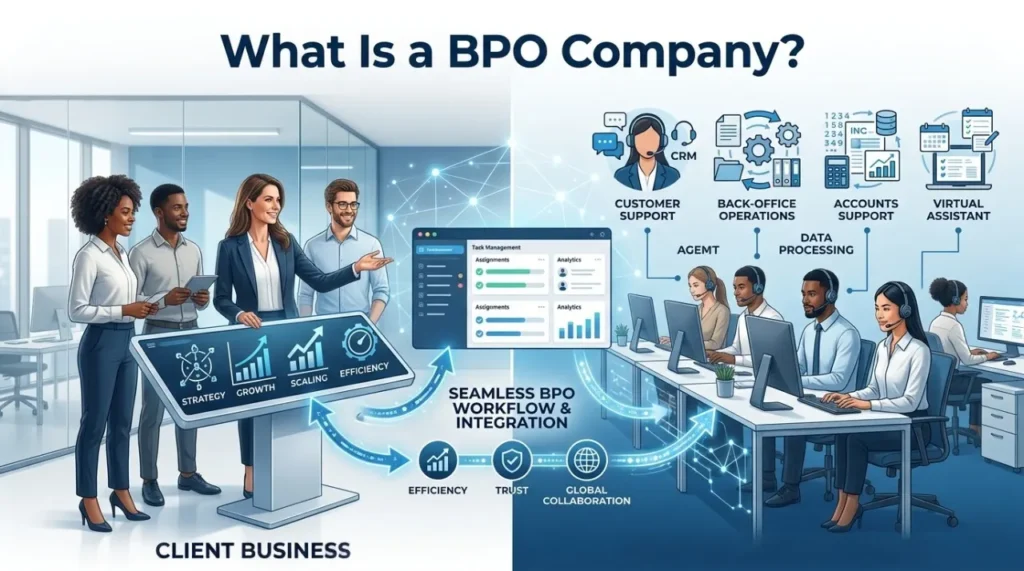
Front-office BPO handles customer-facing operations:
- Customer service and support (voice, email, chat)
- Technical helpdesk / IT support
- Sales and lead generation (inbound and outbound)
- Order entry and telemarketing
- Social media and community management
3.2.2 Back-Office BPO
Back-office BPO handles internal, non-customer-facing operations:
- Finance and accounting (AP/AR, bookkeeping, reconciliation)
- Payroll and benefits administration
- HR operations (recruiting support, onboarding, RPO)
- Data entry and data processing
- Document management and back-office administration
3.3 Types of BPO by Industry Vertical
Many BPO providers specialize in a specific vertical. Vertical BPOs bring domain expertise, regulatory knowledge, and pre-built workflows. Examples include:
- Healthcare BPO: Medical billing, claims adjudication, medical transcription, prior authorization, coding (ICD-10/CPT).
- Financial Services BPO: Loan processing, KYC/AML, mortgage underwriting support, fraud monitoring.
- Insurance BPO: Claims processing, policy administration, customer retention.
- Retail & eCommerce BPO: Order management, returns, chat support, marketplace moderation.
- Legal Process Outsourcing (LPO): Contract review, e-discovery, document review.
Vertical-specific BPOs typically command a 20–30% premium over generalist providers because of regulatory complexity and domain expertise [R5].
4. BPO Services List: What Can You Outsource?
The scope of BPO services has expanded dramatically. A comprehensive BPO services list today can include dozens of functions. Below is a categorized overview of the most common BPO services offered in 2024.
4.1 Customer Experience (CX) Services
- 24/7 customer support (phone, email, live chat, social media)
- Tier 1, 2, and 3 technical helpdesk
- Outbound customer retention and win-back
- Customer onboarding and training
- Loyalty program management
4.2 Sales and Marketing Services
- Inbound and outbound lead generation
- Appointment setting and inside sales
- Email marketing and campaign management
- Market research and surveys
- SEO and content support (often via https://procizo.com/content-marketing-services/)
4.3 Finance and Accounting (F&A) Services
- Accounts payable and accounts receivable
- General ledger and journal entry
- Bank reconciliation and financial reporting
- Tax preparation and compliance
- Audit support
4.4 Human
Challenge: A regional business processing company handling 5,000+ transactions monthly was operating with an in-house back office team of 15 employees. Costs were rising 12% annually, turnover was at 35%, and transaction processing time averaged 4 days — leading to client complaints and lost renewals.
Solution: Procizo Outsourcing LLC deployed a hybrid BPO team of 10 skilled processors handling document processing, data entry, verification, and reporting. The team was integrated with the client’s existing workflow systems within 2 weeks.
Results (6 months):
- Processing costs reduced by 55% — from $8.50 to $3.80 per transaction
- Turnaround time dropped from 4 days to 12 hours — 87% faster
- Processing capacity scaled from 5,000 to 9,000+ monthly transactions
- Accuracy rate improved from 94% to 99.2% with structured QA
- Client retention rate improved to 98% with faster processing times
- Company expanded service offerings using freed-up internal capacity
Frequently Asked Questions
What is Business Process Outsourcing (BPO)?
Business Process Outsourcing (BPO) is the practice of contracting specific business operations to third-party service providers. It covers everything from customer support and data entry to underwriting, accounting, and human resources. Companies use BPO to reduce costs, scale operations, and focus on core competencies.
What are the main types of BPO?
BPO is divided into back-office outsourcing (internal business functions like accounting, underwriting, payroll, IT) and front-office outsourcing (customer-facing functions like sales, support, marketing). It’s also categorized by location: onshore (same country), nearshore (neighboring country), and offshore (distant country).
How does BPO reduce operational costs?
BPO reduces costs by eliminating in-house hiring, training, infrastructure, and benefits overhead. Companies save 30-60% on operational expenses depending on the function and location. For example, outsourcing underwriting support can save $40,000-$60,000 per year per underwriter position.
What is the difference between BPO and KPO?
BPO focuses on standardized processes like data entry, customer support, and transaction processing. KPO (Knowledge Process Outsourcing) involves specialized knowledge work like underwriting analysis, legal research, financial modeling, and medical coding. KPO requires higher-skilled professionals and commands higher rates.
Which industries use BPO the most?
Financial services (banks, lenders, insurance), healthcare (medical billing, coding), technology (IT support, software development), telecommunications (customer service), e-commerce (order processing, returns), and logistics (supply chain management) are the heaviest BPO users.
Does outsourcing mean losing control over business processes?
No. BPO providers operate under strict SLAs (Service Level Agreements) with defined quality metrics, reporting cadence, and escalation procedures. Your team retains oversight through regular reviews, audit rights, and performance dashboards. Reputable providers act as an extension of your team, not a replacement.
How do I choose a BPO provider?
Evaluate based on: domain expertise (experience in your industry), talent quality (hiring and training processes), technology infrastructure (systems integration capabilities), data security (SOC 2, ISO 27001), scalability (ability to ramp up/down), pricing model (transparent with no hidden fees), and client references.
What are the risks of BPO and how can they be mitigated?
Risks include data security breaches, quality inconsistency, communication barriers, and dependency on the provider. Mitigation strategies: NDAs and data encryption, phased implementation with pilot testing, regular quality audits, maintaining internal oversight, multi-provider strategy for critical functions.
Can BPO help with scaling a startup?
Yes. Startups benefit immensely from BPO because it provides enterprise-grade operational capacity without enterprise-level fixed costs. You can access experienced underwriters, customer support teams, and accounting professionals from day one — scaling up or down as your business grows.
What is the future of BPO?
BPO is evolving toward AI-augmented processes, specialized KPO services, outcome-based pricing, and hybrid onshore-offshore models. The BPO market is projected to reach $525 billion by 2030 [R1]. Providers that combine technology with experienced professionals will dominate.
How do I measure BPO success?
Track: cost savings achieved, quality metrics (accuracy, error rate), turnaround time, customer satisfaction scores, scalability responsiveness, and business impact (revenue growth, market expansion). Leading providers share dashboards with real-time performance data.
Is Procizo Outsourcing LLC a BPO company?
Yes. Procizo Outsourcing LLC provides BPO and KPO services specializing in underwriting support, loan processing, and operational outsourcing for financial services, mortgage, insurance, and MCA industries. Visit Procizo’s {https://procizo.com/bpo-company/} page for details.
References
| Code | Source | Link |
|---|---|---|
| [R1] | IBISWorld — Industry Research & Market Data | View → |
| [R2] | Deloitte — Industry Research & Market Data | View → |
| [R3] | Statista — Industry Research & Market Data | View → |
| [R4] | Grand View Research — Industry Research & Market Data | View → |
| [R5] | Everest Group — Industry Research & Market Data | View → |
| [R6] | Procizo Outsourcing LLC — How to Hire a Virtual Assistant: The Complete Guide for Business Owners (2026) | View → |
| [R7] | Procizo Outsourcing LLC — Call Center Outsourcing: Complete Guide to Customer Service BPO (2026) | View → |
| [R8] | Procizo Outsourcing LLC — Virtual Assistant Services: The Complete Guide to Hiring and Scaling with VAs (2026) | View → |
| [R9] | Procizo Outsourcing LLC — Back Office Outsourcing: The Complete Guide to Streamlining Operations (2026) | View → |
| [R10] | Procizo Outsourcing LLC — BPO Services: The Complete Guide to Types, Costs & How to Choose | View → |
| [R11] | Procizo Outsourcing LLC — Life & Health Underwriting Operations: Outsourcing for Speed & Scale | View → |
Ready to Streamline Your Business Process Outsourcing?
Procizo Outsourcing LLC provides end-to-end business process outsourcing with transparent pricing, dedicated teams, and rapid onboarding. Start with a pilot engagement — no long-term commitment required.
No commitment required • 2-3 week onboarding • SOC 2 Type II security
Editorial Oversight: Content reviewed and approved by the Procizo Outsourcing LLC team based on internal research, operational experience, industry reports, and publicly available data.
Research Methodology: This content was created using a combination of Procizo Outsourcing LLC’s operational expertise, industry publications, academic research, government resources, and verified third-party sources.