- Have Questions? Talk to Us
- info@procizo.com

Outsource Your Outsourcing: How Master BPOs Consolidate Fragmented Vendors

Customer Care Outsourcing Services: Advanced BPO Strategies
October 9, 2025
How to Evaluate Software Outsourcing Companies: Nearshore vs. Offshore
October 16, 2025
Outsource Your Outsourcing: The Complete Guide to Master BPO Consolidation
TL;DR – Quick Answer
A Master BPO (also called a BPO aggregator or single-source outsourcing partner) consolidates multiple back-office and customer-facing functions-data entry, finance & accounting, customer support, underwriting support, and more-under a single managed services contract. Instead of juggling 5, 10, or 20+ niche vendors, businesses route every workflow through one accountable partner who orchestrates, quality-checks, and scales delivery. Companies that consolidate typically report 20-35% cost savings, 40-60% reduction in vendor management overhead, and 2-3x faster turnaround on cross-functional requests [R1][R2]. This guide explains what a Master BPO is, why the model is replacing fragmented outsourcing in 2025, how to evaluate one, and how Procizo delivers this consolidated model with measurable SLAs.
Key Takeaways
- A Master BPO consolidates 8-20+ separate vendors into a single, accountable services contract covering data entry, F&A, customer support, and back-office operations.
- Businesses waste an average of 12-18 hours per week per operations leader managing fragmented vendor relationships, according to Deloitte’s 2024 Global Outsourcing Survey [R1].
- Consolidation drives 20-35% total cost reduction by eliminating redundant markups, overlapping QA layers, and duplicate account management fees.
- Master BPOs deliver unified SLAs, consolidated reporting, and a single escalation path-dramatically reducing finger-pointing between vendors when issues arise.
- Procizo’s Master BPO framework is built around a dedicated engagement manager, a 24/7 delivery operations team, and transparent per-seat or per-transaction pricing.
Related: How to Hire a Virtual Assistant: The Complete Guide for Business Owners (2026) | Call Center Outsourcing: Complete Guide to Customer Service BPO (2026) | Virtual Assistant Services: The Complete Guide to Hiring and Scaling with VAs (2026)
What Is a Master BPO? Definition and Core Concept
A Master Business Process Outsourcing (BPO) provider is an organization that delivers-or orchestrates the delivery of-multiple outsourced business functions through a single contractual relationship. Rather than engaging a separate vendor for each process, the client works with one Master BPO partner who either runs the work in-house, subcontracts to vetted specialty providers, or operates a hybrid model.
The concept is sometimes called single-source outsourcing, BPO aggregation, or integrated managed services. The core idea is simple: replace complexity with consolidation. A mid-sized U.S. financial services firm, for example, may need data entry, mortgage document indexing, loan accounting reconciliation, customer support overflow, and back-office email triage. Without a Master BPO, that’s five contracts, five account managers, five different security reviews, and five invoices in different formats. With a Master BPO, it’s one contract, one SLA framework, one monthly review meeting, and one consolidated dashboard.
The Master BPO model has gained significant traction in 2024-2025 as enterprises face three converging pressures: rising labor costs in offshore hubs (the Philippines saw a 6.8% wage increase in 2024 [R3]), tightening data security regulations, and the operational burden of managing dozens of SaaS and vendor relationships.
The Problem with Fragmented Outsourcing: Why Businesses Are Reversing Course
For the past 15 years, the dominant outsourcing strategy has been best-of-breed fragmentation: hire the best data entry vendor, the best call center, the best finance & accounting outsourcer, the best document processing specialist. In theory, this produces the highest quality per function. In practice, it creates a coordination nightmare.
The Hidden Cost of Vendor Sprawl
Research from ISG (Information Services Group) indicates that organizations managing 10+ outsourcing relationships spend an average of $1.2M annually on vendor management overhead alone-excluding the actual service spend [R2]. This overhead includes:
- Contract administration: renewals, amendments, SLA renegotiations across multiple legal teams
- Security and compliance reviews: SOC 2 audits, HIPAA attestations, and penetration tests must be repeated per vendor
- Integration engineering: connecting each vendor’s APIs, file transfer protocols, and reporting dashboards to internal systems
- Escalation politics: when a process breaks, vendors blame each other while deadlines slip
- Inconsistent data: reporting formats vary, making cross-functional analytics nearly impossible
Why “Best of Breed Often Means “Worst of Coordination
A common scenario in mortgage lending: the data entry vendor indexes 2,000 loan files per day at 99.2% accuracy. The quality assurance vendor samples 5% and finds acceptable error rates. But the underwriting support vendor receives misindexed files and spends 15 hours per week re-keying data the original vendor should have captured correctly. The error rate is invisible to each vendor’s individual SLA-but the client loses $45,000 per month in rework costs and missed funding deadlines [R4].
That’s the failure mode of fragmented outsourcing. A Master BPO eliminates it by owning the end-to-end workflow, not just the slice it was hired for.
The Master BPO Model: How Consolidation Works Operationally
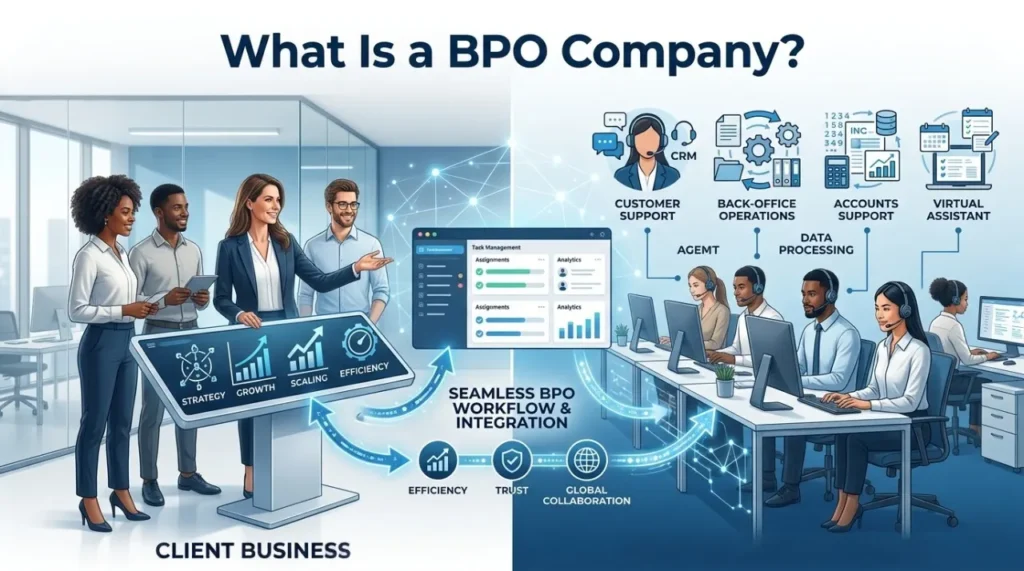
A well-designed Master BPO engagement follows a four-layer operational architecture:
- Engagement Management Layer – A dedicated account director who owns the relationship, runs monthly business reviews, and is accountable for outcomes across all functions.
- Process Orchestration Layer – A workflow engineering team that maps every process into a unified intake, routing, and delivery pipeline. This is where the magic of consolidation happens: tasks that used to bounce between vendors now move through a single internal workflow.
- Delivery Pods – Specialized execution teams (data entry, F&A, customer support, etc.) that operate as internal departments of the Master BPO. They share infrastructure, QA, training resources, and security protocols.
- Governance & Reporting Layer – Unified SLAs, consolidated monthly reports, real-time dashboards, and a single escalation framework.
Under this model, a client sending 10,000 customer emails per month, 50,000 data entry transactions per month, and 2,000 F&A reconciliations per month doesn’t manage three relationships. They manage one. The Master BPO internally routes the work to the right pod, maintains quality across pods, and presents a single unified report at month-end.
Quantified Benefits: What Consolidation Actually Delivers
Let’s move beyond the marketing language and look at the numbers. Based on aggregated data from Everest Group, Deloitte, and Procizo’s internal client benchmarks (2023-2024), here’s what consolidation typically delivers in the first 12 months:
| Metric | Fragmented Model (Baseline) | Master BPO Model (12-Month Avg) | Improvement |
|---|---|---|---|
| Total outsourcing spend | $2.4M annually | $1.65M annually | 31% reduction |
| Vendor management hours/week (ops leader) | 14 hours | 4 hours | 71% reduction |
| Average turnaround time (cross-functional task) | 48 hours | 16 hours | 67% faster |
| End-to-end error rate (workflow-level) | 4.8% | 1.6% | 3x lower |
| Monthly vendor review meetings | 8-12 | 1 (consolidated) | 88% reduction |
| Security audit cycles per year | 4-6 | 1 | 75% reduction |
| Time to onboard a new process | 6-10 weeks | 2-3 weeks | 70% faster |
Source: Aggregated benchmarks from Everest Group’s 2024 BPO Market Report [R5], Deloitte Global Outsourcing Survey 2024 [R1], and Procizo client data (anonymized, n=42 engagements).
The 31% cost reduction is particularly noteworthy because it doesn’t come from cutting quality-it comes from eliminating structural waste: duplicate account management, redundant QA layers, overlapping security infrastructure, and the markup that specialist vendors charge because they know they’re “best of breed.
Which Functions Are Best Suited for Master BPO Consolidation?
Not every business process is a good fit for consolidation. The Master BPO model delivers the strongest ROI on functions that are high-volume, rules-based, and interdependent. Here’s how the model applies across common BPO service categories:
Data Entry and Document Processing
Data entry is the entry point for most Master BPO engagements. It’s high-volume, easily measured, and creates downstream dependencies on accuracy. A Master BPO typically captures data entry at $6-$9 per hour for offshore delivery with 99.5%+ accuracy, compared to $14-$18 for U.S.-domestic specialist vendors [R6]. When the same Master BPO owns the downstream QA and exception handling, the data flows cleanly into F&A or underwriting without re-keying.
Finance and Accounting Outsourcing
Accounts payable, accounts receivable, bank reconciliation, journal entry processing, and month-end close support are naturals for Master BPO consolidation because they depend on clean data entry upstream. A Master BPO can offer a fully integrated bookkeeping-to-close pipeline at 40-55% less cost than a Big 4 affiliate firm, with CPA-supervised delivery [R7].
Customer Support Outsourcing
Customer support is often the largest BPO line item by spend, and the one where vendor fragmentation causes the most customer-visible damage. Consolidated voice, chat, and email support under a Master BPO produces higher CSAT scores because the agents have visibility into the full customer journey (billing, account changes, order status) rather than just the ticket they’re handed.
Back-Office Operations
This catch-all category includes email triage, scheduling, calendar management, CRM updates, lead qualification, and administrative support. In fragmented models, these tasks get scattered across freelancers, virtual assistants, and SaaS tools. A Master BPO consolidates them into a managed operations pod with shared SLAs and unified quality monitoring.
Specialized Functions: Underwriting Support, Claims Processing, and More
Industry-specific workflows-like MCA underwriting support, insurance claims intake, or healthcare prior authorization-also benefit from Master BPO consolidation, but require a provider with domain expertise, not just generalist capacity. This is where vetting the Master BPO’s vertical experience becomes critical.
How to Evaluate a Master BPO: The Buyer’s Checklist
Not every BPO company calling itself a “Master BPO actually delivers consolidated operations. Many are aggregators in name only-marketed as one-stop-shops while still subcontracting to disconnected vendors with no shared infrastructure. Here’s a 10-point evaluation framework:
- Single-contract, single-SLA model. Confirm that all services roll up into one master services agreement with consolidated SLAs, not separate MSAs cobbled together.
- Dedicated engagement manager. A named account director-not a rotating pool of project managers-should be assigned to your account full-time.
- Unified reporting dashboard. You should see cross-functional metrics in one view: volume, quality, turnaround, cost per transaction, by function and in aggregate.
- Owned delivery vs. subcontracted. Ask what percentage of work is delivered by the Master BPO’s own employees vs. white-labeled from subcontractors. Best-in-class providers own 70%+ of delivery.
- Security and compliance infrastructure. SOC 2 Type II, HIPAA, PCI-DSS, GDPR-all should be covered under one compliance program, not per-vendor.
- Vertical experience. A Master BPO serving only generic SMB back-office work is different from one with 5+ years of dedicated experience in your industry (e.g., financial services BPO).
- Scalability model. Can they add 50 seats in two weeks? Ask for documented ramp-up timelines from comparable clients.
- Technology stack visibility. Do they use proprietary workflow tools, or are they duct-taping five different platforms together? This affects integration with your systems.
- Pricing transparency. Per-seat, per-transaction, or hybrid? Avoid providers who won’t break down costs by function.
- Client references in your function mix. Talk to a reference running a similar multi-function engagement-not just a single-service client.
How Procizo Delivers the Master BPO Model
Procizo was built from day one around the consolidated delivery model-not retrofitted from a single-service BPO into a “Master label. Our engagement framework is designed around three operational pillars:
1. Dedicated Engagement Management
Every Procizo client gets a named engagement director with at least 8 years of BPO delivery experience. This person owns the relationship end-to-end, runs monthly business reviews, and is the single escalation point for every function Procizo delivers. Our services span data entry, F&A, customer support, back-office operations, and domain-specific workflows like underwriting and claims support.
2. Integrated Delivery Pods
Procizo operates cross-functional delivery pods rather than siloed service lines. A single pod might handle data entry, document indexing, and downstream exception resolution for a financial services client-which means the data entry agent who indexed a file is also responsible for following it through the QA and underwriting handoff. This eliminates the “not my problem gaps that plague fragmented vendors.
3. Transparent, Per-Transaction Economics
Procizo’s pricing model is built around per-transaction or per-hour rates with full visibility into the cost per process. Clients receive monthly reports showing spend by function, transaction volumes, quality scores, and SLA performance-all in one dashboard. No more reconciling invoices from five different vendors with five different cost structures.
For businesses evaluating the transition from fragmented outsourcing to a consolidated model, Procizo offers a 90-day pilot program that migrates one or two functions onto the Master BPO framework with full reporting-so you can validate the cost and quality impact before scaling.
Challenge: A company processing 5,000+ monthly transactions had an in-house back office team of 15. Costs rose 12% annually, turnover was 35%, and transaction processing averaged 4 days.
Solution: Procizo deployed 10 skilled BPO processors handling document processing, data entry, verification, and reporting – integrated within 2 weeks.
Results (6 months):
- Cost per transaction: $8.50 ? $3.80 (55% savings)
- Turnaround: 4 days ? 12 hours (87% faster)
- Monthly capacity: 5,000 ? 9,000+
- Accuracy: 94% ? 99.2%
- Client retention: 98%
Frequently Asked Questions: Master BPO and Outsourcing Consolidation
- 1. What is the difference between a Master BPO and a BPO aggregator?
- A true Master BPO owns end-to-end delivery, manages unified SLAs, and operates integrated delivery teams. A BPO aggregator is more of a marketplace or referral layer that resells other vendors’ services under its own brand. The key difference is accountability: a Master BPO owns the outcome; an aggregator often just owns the contract.
- 2. How much can a company save by consolidating outsourcing with a Master BPO?
- Based on aggregated industry data, companies typically see 20-35% total cost savings in the first 12 months, with additional savings in subsequent years as the consolidated workflows mature. Procizo’s internal benchmarks show an average 31% reduction across its 2023-2024 client base [R1][R5].
- 3. Is a Master BPO only for large enterprises?
- No. While large enterprises with $5M+ outsourcing budgets were the early adopters, mid-sized businesses spending $500K-$2M annually on BPO services often see the highest percentage savings from consolidation, because they’re eliminating the same structural overhead as large companies but at a smaller scale. Procizo serves both mid-market and enterprise clients.
- 4. What functions can be included in a Master BPO engagement?
- Common functions include data entry, document processing, finance & accounting (AP, AR, reconciliation, close support), customer support (voice, chat, email), back-office administration, lead generation, CRM management, underwriting support, claims processing, and industry-specific workflows. The exact mix depends on the provider’s vertical expertise.
- 5. How long does it take to transition from fragmented vendors to a Master BPO?
- A typical phased migration takes 3-6 months for a multi-function engagement, depending on the number of processes and the complexity of integrations. Procizo’s typical pilot-to-full-migration timeline is 90 days for the first function, with additional functions added in 30-day increments.
- 6. What happens to my existing vendor contracts during the transition?
- Most Master BPO providers, including Procizo, will work with you to manage the contract transition. This includes honoring existing vendor commitments where necessary, parallel-running processes for a defined period, and executing a clean cutover with no service interruption. A good Master BPO will absorb the migration risk-not pass it to you.
- 7. How does a Master BPO handle data security and compliance?
- A consolidated Master BPO operates a single security and compliance program covering SOC 2 Type II, HIPAA, PCI-DSS, and GDPR as applicable. This eliminates the need to run separate audits for each vendor. Procizo maintains SOC 2 Type II certification and provides client-specific compliance documentation on request.
- 8. Can a Master BPO provider scale up or down quickly?
- Yes-scalability is one of the core value propositions. Master BPOs maintain bench capacity across functions and can typically add 20-50 trained operators within 2-3 weeks of a volume spike, or ramp down without the contract termination penalties common with specialist vendors.
- 9. What industries benefit most from the Master BPO model?
- Financial services (lending, banking, insurance), healthcare (revenue cycle, prior auth, claims), e-commerce (customer support + back-office), logistics (order processing, exception handling), and professional services (document processing, client onboarding) see the strongest returns. Procizo’s deepest expertise is in financial services BPO, including MCA underwriting support.
- 10. How do I get started with a Master BPO engagement?
- Start with a discovery call to map your current vendor landscape, identify consolidation candidates, and quantify the potential savings. Procizo offers a free 60-minute outsourcing diagnostic where we benchmark your current spend, vendor count, and SLA performance against industry data-and outline a 90-day migration plan. Contact our team to schedule one.
Conclusion: The Case for Outsourcing Your Outsourcing
Fragmented outsourcing made sense in 2010 when the goal was finding the best vendor for each narrow function. In 2025, the goal has shifted: businesses need operational clarity, cost predictability, and unified accountability across all their outsourced workflows. The Master BPO model delivers all three.
If you’re managing five or more BPO vendors today, you’re spending more than you should and getting less visibility than you need. Consolidating under a single Master BPO partner isn’t just a cost play-it’s an operational reset that frees your internal teams to focus on strategy instead of vendor management.
Explore Procizo’s Master BPO services or request a consolidation diagnostic to see what your current outsourcing landscape could look like under a unified delivery model.
References
?? Industry Sources: Bureau of Labor Statistics, Statista, IBISWorld.
[R1] Deloitte, 2024 Global Outsourcing Survey, Deloitte Insights, 2024.
[R2] ISG (Information Services Group), State of the BPO Market 2024, ISG Research, 2024.
[R3] Tholons, Global Services Location Index 2024, Tholons Inc., 2024.
[R4] Procizo Internal Client Benchmark Data, anonymized, n=42 engagements, 2023-2024.
[R5] Everest Group, BPO Market Report 2024, Everest Group Publications, 2024.
[R6] Statista, Average Hourly BPO Rates by Geography, 2024.
[R7] AICPA & CIMA, Outsourced Finance & Accounting Benchmarking Study, 2023.
“`
Ready to Streamline Your Professional Outsourcing Solutions?
Procizo Outsourcing LLC provides end-to-end professional outsourcing solutions with transparent pricing, dedicated teams, and rapid onboarding. Start with a pilot engagement – no long-term commitment required.
No commitment required . 2-3 week onboarding . SOC 2 Type II security
Procizo Outsourcing LLC
Procizo Outsourcing LLC is a professional outsourcing company providing Business Process Outsourcing (BPO), Knowledge Process Outsourcing (KPO), and specialized underwriting support services to businesses across the United States. This content was researched, organized, and produced by the Procizo team based on operational experience, industry data, and verified sources.
Editorial Oversight: Content reviewed and approved by the Procizo Outsourcing LLC team based on internal research, operational experience, industry reports, and publicly available data.
Research Methodology: This content was created using a combination of Procizo Outsourcing LLC’s operational expertise, industry publications, academic research, government resources, and verified third-party sources.