- Have Questions? Talk to Us
- info@procizo.com

Call Center Outsourcing: Complete Guide to Customer Service BPO (2026) | Procizo

Recruitment Process Outsourcing: The Complete Guide to RPO in 2026 | Procizo
July 1, 2026
Finance & Accounting Outsourcing: Complete Guide to Scaling (2026) | Procizo
July 6, 2026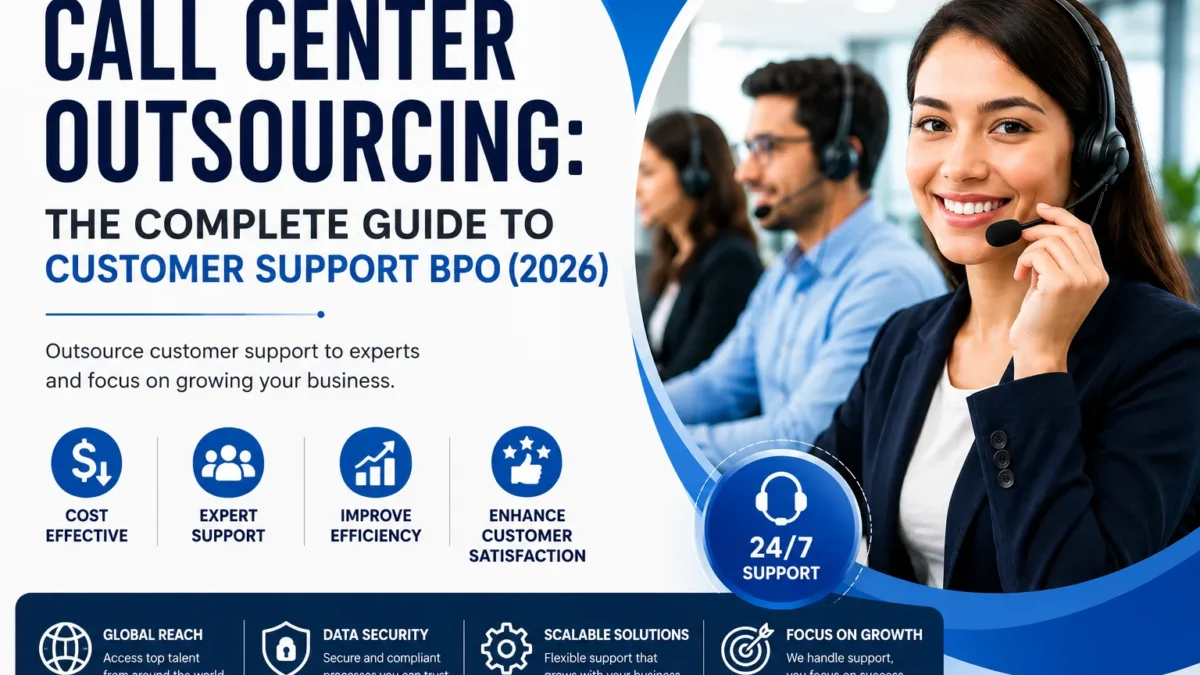
Quick Answer
Call center outsourcing means hiring an external BPO provider to manage your customer interactions—phone, email, live chat, social media, and SMS. In 2026, businesses outsource call center services to reduce costs by 40–60%, scale support without hiring overhead, and offer 24/7 omnichannel coverage. Pricing ranges from $6–$14/hr offshore (Philippines, India) to $12–$18/hr nearshore (Latin America, Caribbean) to $25–$45/hr onshore (US, Canada). The global call center outsourcing market is valued at over $80 billion, and 63% of organizations now prioritize customer experience as their primary competitive differentiator [R1][R3]. This guide covers everything from outsourcing models and cost breakdowns to vendor selection, AI integration, and a step-by-step implementation checklist.
Key Takeaways
- Call center outsourcing cuts operational costs by 40–60% compared to in-house operations, with offshore rates as low as $6/hr.
- Four main models exist: inbound, outbound, omnichannel, and hybrid (blended in-house + outsourced).
- Customer support outsourcing is the fastest-growing segment, driven by demand for 24/7 omnichannel coverage [R2].
- The top outsourcing destinations in 2026 are the Philippines, India, Latin America, and the Caribbean.
- AI and automation are transforming call center BPO services—but human agents remain essential for complex escalations.
- Hidden fees (setup, telephony, QA scoring, reporting) typically add 10–20% on top of headline rates.
- Businesses that outsource customer care services see average CSAT improvements of 12–18% within six months [R5].
- A proper vendor selection process should evaluate technology stack, agent training, compliance certifications, and cultural fit.
Related: What is BPO? The Complete Guide to Business Process Outsourcing (2026) | BPO Business Process Outsourcing Strategies (2026) | Customer Care Outsourcing Services: Advanced BPO Strategies | Virtual Assistant Services for Entrepreneurs | Outsource Your Outsourcing: How Master BPOs Work
1. What Is Call Center Outsourcing?
Call center outsourcing is the practice of contracting a third-party BPO provider to handle your company’s inbound and outbound customer interactions. These interactions include phone calls, emails, live chat, SMS, social media messaging, and video support. The outsourcing partner—often called a customer service BPO or contact center BPO—provides the infrastructure, technology, agents, and management required to deliver customer support at scale.
In 2026, call center outsourcing has evolved far beyond simple phone answering. Modern BPO providers deliver omnichannel customer support outsourcing solutions that integrate seamlessly with CRMs, ticketing systems, and AI-powered analytics platforms. The global business process outsourcing market is projected to reach $525 billion by 2030, with customer service representing the largest segment [R1].
Companies outsource call center services for three primary reasons: cost reduction (40–60% savings vs. in-house), scalability (ramp up or down based on demand), and expertise (access to trained agents, advanced technology, and established processes).
Call Center Outsourcing vs. Contact Center Outsourcing
While often used interchangeably, there’s a key difference. A call center handles voice-only interactions (phone calls). A contact center manages all communication channels—voice, email, chat, social, SMS, and self-service portals. Most BPOs now offer contact center services, which is why you’ll often see the terms blended together in the customer support outsourcing space.
2. Types of Call Center Outsourcing Models
Understanding the different call center outsourcing models is essential before choosing a provider. Each model serves a different business need:
| Model | Description | Best For | Typical Cost Range |
|---|---|---|---|
| Inbound | Agents handle incoming customer calls—support, inquiries, orders | Customer service, tech support, order management | $8–$35/hr |
| Outbound | Agents make calls for sales, lead gen, surveys, collections | Telemarketing, market research, debt collection | $10–$40/hr |
| Omnichannel | Agents manage voice + email + chat + social + SMS in one platform | Ecommerce, SaaS, fintech, healthcare | $12–$45/hr |
| Blended/Hybrid | Mix of in-house + outsourced agents under one operating model | Growing companies, seasonal spikes | Variable |
| Project-Based | Time-bound campaigns (e.g., product launch support) | Short-term needs, campaign launches | Quoted per project |
Inbound call center outsourcing is the most common model, representing roughly 65% of all outsourced call center engagements. It’s ideal for businesses that need reliable customer support without the overhead of hiring, training, and managing an in-house team [R3].
3. Customer Support Outsourcing vs. Call Center Outsourcing
While customer support outsourcing and call center outsourcing overlap significantly, they aren’t identical. Customer support outsourcing is a broader category that includes:
- Technical support — Tier 1 and Tier 2 troubleshooting for software, hardware, and digital products
- Customer success — Proactive engagement to drive product adoption and retention
- Help desk outsourcing — IT support ticketing, password resets, system access requests
- Back-office support — Order processing, billing inquiries, account management
Call center BPO services are a subset of customer support outsourcing—focused specifically on voice-based interactions. However, in 2026, most leading BPOs offer integrated solutions that blend voice, digital, and AI-powered support into a single service package.
According to a recent Zendesk report, 63% of organizations now prioritize customer experience above price or product as their primary competitive differentiator [R5]. This shift is driving demand for higher-quality outsourced support, not just cheaper alternatives.
4. Benefits of Outsourcing Call Center Services
Businesses across industries are turning to customer care outsourcing services for compelling reasons:
4.1 Cost Reduction (40–60%)
The most obvious benefit. An in-house US-based agent costs $35–$50/hr including benefits, training, and overhead. An outsourced offshore agent costs $6–$14/hr—a 60–80% reduction for comparable quality. Nearshore options in Latin America run $12–$18/hr for native English speakers on US time zones [R2].
4.2 24/7 Coverage Without Shift Management
Outsourcing partners handle staffing across time zones, so you can offer 24/7 support without managing overnight shifts, holiday schedules, or weekend coverage. This is one of the most cited benefits of call center outsourcing for ecommerce and SaaS companies.
4.3 Rapid Scaling
Need to double your support team during the holiday season? A BPO partner can ramp up 50–100 agents in 2–4 weeks. Trying to do that in-house would take 3–6 months. Call center BPO services give you elastic capacity on demand.
4.4 Access to Multilingual Support
Leading outsourcing providers offer support in 30–60+ languages from a single engagement. This makes customer support outsourcing especially valuable for companies expanding into international markets.
4.5 Technology & Analytics
Top BPOs invest millions in AI-powered call analytics, sentiment analysis, quality monitoring, and workforce management tools. When you outsource, you get access to this technology stack without capital expenditure.
4.6 Improved CSAT Scores
Studies show that businesses that outsource customer care outsourcing services see an average CSAT improvement of 12–18% within the first six months, driven by better agent training, QA processes, and management focus [R5].
5. Call Center Outsourcing Cost Breakdown (2026)
Understanding call center cost per hour requires looking beyond the headline rate. Here’s the 2026 pricing landscape:
| Location | Per-Agent Hour (Loaded) | Language | Time Zone Overlap (EST) |
|---|---|---|---|
| US Onshore | $25–$45 | Native English | 100% |
| Canada | $22–$38 | Native English/French | 100% |
| Caribbean Nearshore | $12–$18 | Native English | 100% |
| Latin America Nearshore | $10–$20 | English + Spanish | 80–100% |
| Philippines | $8–$14 | English (neutral accent) | 60–80% (night shift) |
| India | $6–$12 | English | 50–70% (night shift) |
| Eastern Europe | $12–$22 | English + EU languages | 40–60% |
Important: Hidden fees (setup, telephony, QA scoring, call recording, reporting) typically add 10–20% on top of the headline rate. Always request a fully loaded cost-per-seat quote [R2][R3].
Pricing Models in Call Center Outsourcing
- Per-Hour (Time-Based): Standard model. You pay a fixed rate per agent hour regardless of call volume.
- Per-Resolution (Performance-Based): $1–$7 per resolved ticket. Aligns incentives but can reduce quality.
- Per-Transaction (Volume-Based): Fixed fee per call, email, or chat handled.
- Fixed Monthly (Dedicated Team): A dedicated team of X agents for a flat monthly fee. Best for predictable volumes.
- Outcome-Based: Payment tied to KPIs like CSAT, FCR, or SLA compliance. Premium pricing but highest quality [R4].
6. Top Call Center Outsourcing Destinations
6.1 Philippines — The Gold Standard
The Philippines remains the world’s top destination for call center outsourcing, with over 1.3 million BPO workers. Neutral English accent, strong cultural affinity with the US, and a mature BPO ecosystem make it the default choice for American companies [R1].
6.2 India — The Cost Leader
India offers the lowest rates ($6–$12/hr) with a massive talent pool of 5+ million BPO professionals. Best for high-volume, transactional support where cost is the primary driver.
6.3 Latin America & Caribbean — The Nearshore Sweet Spot
For companies that need native English, US time zones, and cultural alignment without the cost of onshore, the Caribbean and Latin America are the fastest-growing destinations. Countries like Jamaica, Barbados, Colombia, and Mexico offer $12–$20/hr rates with full time-zone overlap [R2].
6.4 Eastern Europe — Technical & Multilingual
Eastern Europe (Poland, Romania, Bulgaria) is the go-to for technical support and multilingual European coverage at $12–$22/hr.
7. How to Choose a Call Center BPO Partner
Selecting the right customer service BPO partner is critical. Here’s a five-step evaluation framework:
Step 1: Define Your Requirements
Before evaluating call center BPO services, document your needs: expected volume, channels (voice vs. digital vs. omnichannel), hours of operation, languages, technical complexity, and compliance requirements (HIPAA, PCI DSS, GDPR, SOC 2).
Step 2: Evaluate Technology Stack
Does the provider use modern platforms like Salesforce, Zendesk, Freshdesk, or Intercom? Do they offer AI chatbots, sentiment analysis, and workforce management tools? Technology integration is a key differentiator among customer support BPO companies.
Step 3: Assess Agent Quality
Ask about hiring standards, training programs (initial + ongoing), quality assurance processes, and agent retention rates. High turnover is the #1 quality killer in call center BPO services.
Step 4: Check Compliance & Security
For regulated industries (healthcare, finance, insurance), the provider must hold relevant certifications: HIPAA, PCI DSS Level 1, SOC 2 Type II, GDPR compliance. Request audit reports.
Step 5: Request a Pilot Program
Never sign a long-term contract without a 30–60 day pilot. Run a small batch of traffic through the BPO and measure CSAT, FCR, AHT, and escalation rates before committing to scale.
8. Omnichannel Customer Support Outsourcing
Omnichannel customer support outsourcing is the dominant model in 2026. Unlike multichannel (offering multiple channels independently), omnichannel provides a seamless, connected experience across every touchpoint:
- Voice — Traditional inbound/outbound calling with IVR and smart routing
- Email — Ticket-based support with SLA-driven response times
- Live Chat — Real-time text support with chatbot escalation
- SMS/WhatsApp — Mobile-first messaging support
- Social Media — Facebook, Instagram, Twitter/X, LinkedIn support
- Self-Service — Knowledge bases, FAQ bots, community forums
Multichannel support outsourcing (offering channels separately) is being rapidly replaced by omnichannel models where a customer can start on chat, escalate to a phone call, and receive a follow-up email—all within the same conversation thread, tracked by a single ticket ID.
According to industry data, companies using omnichannel engagement retain 89% of customers, compared to 33% for those with weak omnichannel strategies [R5].
9. Help Desk Outsourcing
Help desk outsourcing is a specialized subset of call center outsourcing focused on IT support and technical troubleshooting. Typical help desk services include:
- Tier 1 support: Password resets, account access, basic troubleshooting
- Tier 2 support: Software bugs, system errors, escalated issues
- IT ticketing management (ServiceNow, Jira, Zendesk)
- Network monitoring and incident response
- Onboarding and offboarding support
Help desk outsourcing is especially popular among SaaS companies, healthcare organizations, and financial services firms that need 24/7 technical support without maintaining an internal IT team [R3].
10. AI & Technology in Call Center Outsourcing (2026 Trends)
The convergence of AI and customer support outsourcing is reshaping the industry in 2026:
AI-Powered Chatbots & Voice Agents
AI handles 60–80% of Tier-1 inquiries—password resets, order status, FAQs—freeing human agents for complex issues. Generative AI voice agents now handle full conversations with near-human quality [R6].
Sentiment Analysis & Real-Time Coaching
AI monitors live calls and surfaces real-time suggestions to agents: “Customer frustration detected—offer a discount.” This improves FCR (First Call Resolution) by 15–25%.
Workforce Management Automation
AI-powered forecasting predicts call volumes with 90%+ accuracy and automatically adjusts staffing schedules, reducing idle time by 20–30%.
Quality Assurance (QA) Automation
AI scores 100% of calls for compliance, sentiment, and script adherence—vs. the industry standard of 2–5% manual QA sampling. This dramatically improves quality consistency across call center BPO services.
11. Industries That Benefit Most from Call Center Outsourcing
| Industry | Common Use Case | Compliance Needs |
|---|---|---|
| Ecommerce & Retail | Order support, returns, tracking inquiries | PCI DSS |
| SaaS & Technology | Technical support, onboarding, account management | SOC 2, GDPR |
| Healthcare | Appointment scheduling, billing, patient support | HIPAA |
| Financial Services | Account support, fraud alerts, loan inquiries | PCI DSS, GLBA, SOC 2 |
| Insurance | Claims support, policy inquiries, agent support | HIPAA, NAIC, state regulations |
| Travel & Hospitality | Booking support, cancellations, loyalty program | PCI DSS |
| Telecommunications | Technical support, billing, service activation | SOC 2, CPNI |
12. Call Center Outsourcing Checklist
Use this checklist to ensure a smooth call center outsourcing engagement:
Pre-Deal Phase:
- [ ] Define support scope: channels, hours, volume, languages
- [ ] Set clear KPIs: CSAT target, FCR rate, AHT, SLA compliance %
- [ ] Determine required certifications (HIPAA, PCI, SOC 2)
- [ ] Research 3–5 customer support BPO companies
- [ ] Request RFPs with detailed pricing (loaded cost, not sticker rate)
- [ ] Check client references and case studies
Pilot Phase (30–60 Days):
- [ ] Start with 5–10 agents on a limited scope
- [ ] Integrate CRM, ticketing, and telephony systems
- [ ] Run agent training (product knowledge + brand voice)
- [ ] Monitor KPIs daily for first 30 days
- [ ] Conduct weekly alignment calls with BPO management
- [ ] Collect and review call recordings for quality
Scale Phase:
- [ ] Ramp from pilot to full production based on KPI results
- [ ] Implement continuous QA scoring for 100% of calls
- [ ] Set up monthly business reviews with provider leadership
- [ ] Plan for seasonal volume spikes 6–8 weeks in advance
- [ ] Evaluate AI automation opportunities for Tier-1 inquiries
13. Common Call Center Outsourcing Mistakes to Avoid
- Choosing purely on price. The cheapest offshore rate often comes with language barriers, high turnover, and quality issues. Factor in fully loaded costs and the impact of poor service on customer lifetime value.
- Skipping the pilot. A 30-day pilot reveals compatibility issues that no RFP process can predict. Never skip this step.
- No cultural alignment. If your brand voice is casual and quirky, a rigid script-based BPO will frustrate your customers. Look for a provider that matches your culture.
- Ignoring data security. Every customer care outsourcing services provider must have documented security protocols. One data breach can destroy years of brand trust.
- No exit strategy. Always maintain the ability to bring support back in-house or switch providers, even if you never plan to.
14. Case Study: Scaling Customer Support for a High-Growth Fintech
Company: US-based fintech lender (250 employees)
Challenge: Rapid growth from 500 to 5,000+ daily support inquiries in 8 months. In-house team of 12 agents couldn’t scale. Average wait times hit 45+ minutes. CSAT dropped from 85% to 68%.
Solution: Partnered with a nearshore BPO provider for inbound call center outsourcing (voice) and omnichannel customer support outsourcing (email + chat). Initial pilot of 15 agents in the Caribbean, ramped to 45 agents over 12 weeks.
Results:
- Cost per contact reduced by 55% (from $8.50 to $3.80)
- Average wait time dropped from 45 min to under 2 min
- CSAT recovered from 68% to 91% within 90 days
- Agents handle 7,000+ daily inquiries across voice, chat, and email
- 24/7 coverage achieved with two nearshore shifts
15. The Future of Call Center Outsourcing
The customer support outsourcing industry is evolving rapidly toward a human-AI hybrid model. By 2028, Gartner predicts that 80% of customer service organizations will be using generative AI in some capacity [R6]. However, human agents remain irreplaceable for complex problem-solving, empathy, and relationship building.
Key trends to watch:
- AI-first routing: AI chatbots handle Tier 1, human agents handle Tier 2+
- Hyper-personalization: Real-time data from CRM + AI creates personalized interactions at scale
- Predictive support: AI predicts issues before the customer contacts you and proactively resolves them
- Employee experience focus: BPOs investing in agent wellbeing, career paths, and better compensation to reduce industry-high turnover (30–45% annually)
FAQ — Call Center Outsourcing
What is call center outsourcing?
Call center outsourcing is contracting a third-party BPO provider to manage your company’s customer interactions—phone, email, chat, and social media. It reduces costs by 40–60% and provides 24/7 coverage without in-house staffing overhead.
How much does call center outsourcing cost in 2026?
Rates range from $6–$14/hr offshore (Philippines, India), $12–$18/hr nearshore (Caribbean, Latin America), and $25–$45/hr onshore (US, Canada). Hidden fees add 10–20% on top of headline rates. Always request a fully loaded cost-per-seat quote.
What is the difference between call center outsourcing and customer support outsourcing?
Call center outsourcing is a subset of customer support outsourcing focused on voice interactions. Customer support outsourcing is broader—including email, chat, social media, help desk, and technical support services.
Which country is best for call center outsourcing?
The Philippines is the top destination for English-language support, with over 1.3 million BPO workers and neutral English accents. India offers the lowest costs ($6–$12/hr). Latin America and the Caribbean are best for US time-zone overlap and near-native English.
What is inbound call center outsourcing?
Inbound call center outsourcing means a BPO handles incoming customer calls—service inquiries, support requests, order management, and account questions. It’s the most common outsourcing model, representing about 65% of all engagements.
How do I choose a call center outsourcing company?
Evaluate technology stack, agent quality and training, compliance certifications (HIPAA, PCI, SOC 2), pricing transparency, cultural fit, and client references. Always run a 30–60 day pilot before committing to a long-term contract.
Can AI replace outsourced call center agents?
AI handles 60–80% of Tier-1 inquiries effectively (password resets, order status, FAQs), but human agents remain essential for complex issues, empathy, escalations, and relationship building. The future is human-AI collaboration, not replacement.
What is omnichannel customer support outsourcing?
Omnichannel outsourcing means a BPO manages all customer communication channels—voice, email, chat, SMS, social media—in a single integrated platform where conversations flow seamlessly between channels without losing context.
What are the hidden costs in call center outsourcing?
Common hidden costs include setup fees, telephony infrastructure, QA scoring, call recording storage, reporting tools, project management fees, and technology integration costs. These typically add 10–20% on top of the headline per-hour rate.
Is call center outsourcing worth it for small businesses?
Yes. Small businesses benefit significantly by accessing professional customer support at a fraction of in-house cost. Start with a small pilot (3–5 agents) on a single channel (chat or email) and scale based on results.
Ready to Outsource Your Call Center?
Scale Your Customer Support Without the Overhead
Procizo Outsourcing LLC provides professional call center BPO services for businesses across the US—from inbound support to omnichannel customer care.
References
| Code | Source | Link |
|---|---|---|
| [R1] | IBISWorld — Business Process Outsourcing Services Industry Report (US) | ibisworld.com |
| [R2] | Callforce Global — Call Center Outsourcing Cost 2026: Per-Seat, Nearshore vs Onshore | callforce.global |
| [R3] | Helpware — Call Center Outsourcing Cost Comparison: Top Companies 2026 | helpware.com |
| [R4] | Crescendo — Outsourced Customer Service Call Center Pricing Guide 2026 | crescendo.ai |
| [R5] | Zendesk — Customer Experience Trends Report 2026 | zendesk.com |
| [R6] | Gartner — Predicts 2026: The Future of Customer Service and Support | gartner.com |