- Have Questions? Talk to Us
- info@procizo.com

Finance and Accounting Outsourcing: Complete Guide (2026)

Recruitment Process Outsourcing: Complete RPO Guide 2026
July 1, 2026
What Is KPO? Knowledge Process Outsourcing Guide (2026)
July 11, 2026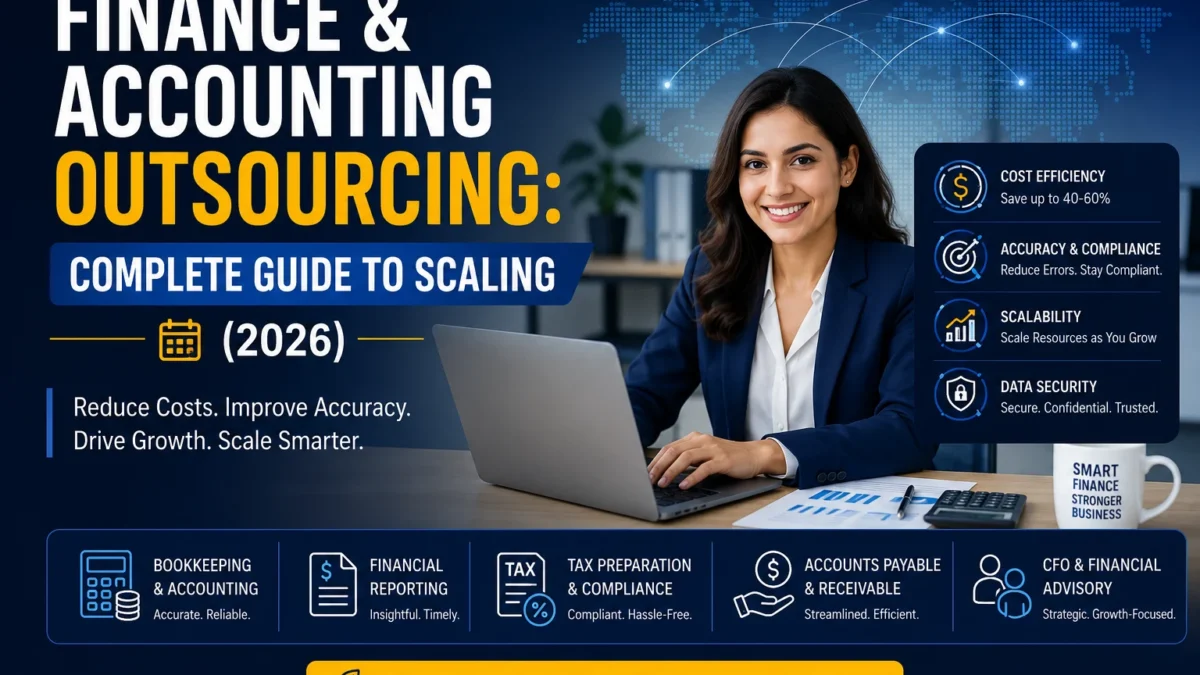
Quick Answer: Finance and Accounting Outsourcing (FAO) is the practice of delegating financial management and accounting functions – bookkeeping, payroll, AP/AR, tax compliance, financial reporting – to specialized third-party BPO providers. In 2026, the global FAO market reached $59.05 billion and is projected to hit $85.92 billion by 2031 at 7.78% CAGR [R1]. Companies using FAO save 40-60% on finance operational costs while achieving 99.5%+ accuracy rates, faster month-end closes, and stronger compliance. 96% of CFOs now rely on at least one third-party finance provider, up from 79% in 2025 [R2]. This guide covers everything – services, costs, provider selection, implementation, risks, AI trends, and how to pick the right FAO partner for your business.
1. What Is Finance & Accounting Outsourcing?
Finance and accounting outsourcing involves contracting some or all of your financial operations to a specialized external provider. These providers bring dedicated teams of CPAs, ACCA-qualified accountants, and finance professionals who handle your day-to-day financial work as an extension of your team.
Unlike hiring in-house accountants – which carries high annual cost per FTE in the US – FAO providers deliver the same or better quality at a lower, variable cost depending on the service model and location. But the value goes beyond cost: you gain access to established technology stacks, quality control frameworks, and expertise you’d struggle to build internally.
What FAO is NOT:
- ? A temp agency sending you random accountants
- ? Just data entry with a different address
- ? A way to lose control of your finances
What FAO IS:
- ? A managed service with dedicated teams, SLAs, and quality controls
- ? Technology-enabled workflows (QuickBooks, Xero, NetSuite, custom ERP integrations)
- ? A strategic partnership that scales with your business
The Evolution of FAO
FAO has transformed dramatically. In the 2000s, it was pure labor arbitrage – send data entry offshore, save 70%. By 2020, it evolved into process outsourcing with defined SLAs and domain expertise. In 2026, FAO is technology-enabled and AI-augmented: providers combine skilled accountants with automation, analytics, and AI agents to deliver faster, more accurate, and more insightful financial operations [R3].
2. Why Companies Outsource Finance in 2026
2.1 Cost Reduction (Still #1, But Not the Only Reason)
Finance & accounting functions can be delivered through offshore, nearshore, or onshore teams. Each model differs in cost structure, time-zone alignment, and management approach. Procizo scopes the right mix to your workflow and compliance requirements rather than publishing a fixed rate card.
Note: Offshore rates are India/Philippines/Sri Lanka. Nearshore is Latin America (Mexico, Colombia, Costa Rica). Onshore is US/Canada domestic. Rates vary by provider, team experience, and engagement scope.
Cost Comparison: In-House vs Outsourced (5-Person Finance Team)
| Factor | In-House Team | Outsourced FAO |
|---|---|---|
| Cost structure | High fixed payroll | Variable, lower overhead |
| Hiring time | 4–8 weeks per role | 1–2 weeks total |
| Technology investment | You license & maintain | Provider-managed |
| Compliance risk | High (self-managed) | Low (dedicated specialists) |
| Scalability | Limited by hiring cycle | Flexible – scale up/down |
| Accuracy rate | 95–98% | 99.5%+ [R5] |
| Month-end close | 10–15 days | 3–5 days [R6] |
| Manager oversight required | Heavy (day-to-day) | Light (strategy & review) |
5. Beyond Cost: 5 Hidden Benefits of FAO
5.1 Better Financial Controls
With segregation of duties, documented SOPs, and independent review layers, FAO providers often force stronger internal controls than what startups and mid-market companies maintain organically.
5.2 Disaster Recovery & Business Continuity
In-house teams have single points of failure – a key accountant quits, and your books stall. FAO providers have built-in redundancy with cross-trained teams and documented processes.
5.3 Faster Month-End Close
The average company takes 10-15 days to close the books. Best-in-class FAO providers deliver close in 3-5 days – giving leadership faster visibility into performance [R6].
5.4 Access to Best-in-Class Tech Stack
FAO providers typically maintain QuickBooks/Xero/NetSuite expertise plus data visualization and automation tools. You get enterprise-grade systems at no additional tech cost.
5.5 24/7 Operations
Offshore/nearshore teams operate during your night hours, meaning reconciliations, data entry, and transaction processing happen while you sleep.
6. Risks of Finance Outsourcing & How to Mitigate Them
| Risk | Severity | Mitigation Strategy |
|---|---|---|
| Data Security Breach | ?? High | Require SOC 2 Type II, ISO 27001, GDPR compliance. Sign strict NDAs. Limit system access to what’s needed. |
| Communication Gaps | ?? Medium | Start with nearshore (same time zones). Daily standup calls. Use collaborative tools (Slack, Teams). Assign a US-based point of contact. |
| Quality Decline | ?? Medium | Define SLAs with accuracy targets (99.5%+). Monthly quality audits. Pilot project before full rollout. |
| Loss of Control | ?? Low | Weekly reporting cadence. Maintain oversight on GL coding and approvals. Keep journal entry approval in-house. |
| Provider Dependency | ?? Medium | Maintain documentation of all processes. Ensure data portability. Have a transition-out plan. Multi-year contracts with 90-day exit clauses. |
| Cultural/Language Barriers | ?? Medium | Choose nearshore providers with bilingual teams. Schedule overlap hours. Video calls for complex discussions. |
Pro tip: Always start with a 90-day pilot on a single function (e.g., AP processing). Establish baselines, validate quality, iron out communication workflows, then expand.
7. How to Choose the Right FAO Provider – 10-Point Checklist
Choosing a finance outsourcing partner is a high-stakes decision. Here’s the evaluation framework:
? 1. Industry Experience
Does the provider have experience with your industry? Healthcare, e-commerce, real estate, professional services, and manufacturing all have different compliance requirements and accounting nuances.
? 2. Team Qualifications
What certifications do their accountants hold? CPA, ACCA, CMA, CA? How much experience does the team lead have? Request bios.
? 3. Technology Stack Compatibility
Can they work with your existing systems? QuickBooks Online, Xero, NetSuite, Sage, custom ERP? Do they have integration experience with your CRM and payment platforms?
? 4. Security Certifications
- SOC 1 Type II (financial reporting controls)
- SOC 2 Type II (data security)
- ISO 27001 (information security)
- PCI-DSS (payment card processing)
- GDPR compliance (if handling EU data)
Do not engage a provider that cannot produce current SOC reports.
? 5. Engagement Model
- Dedicated team: A full-time team works exclusively on your account
- Managed service: Defined scope, delivered by provider’s pooled team
- Co-managed: Shared responsibilities between your team and provider
Choose based on your volume and need for control.
? 6. Pricing Transparency
- Hourly rates vs fixed monthly retainers
- Volume discounts
- Hidden fees (onboarding, training, reporting)
- Contract terms and exit clauses
? 7. Client References
Ask for 3 client references in your industry or similar company size. Call them. Ask about accuracy, communication, problem resolution, and retention.
? 8. Communication & Time Zone Overlap
- What are their operating hours vs your time zone?
- How many hours of overlap?
- Communication tools and escalation paths
- Account management structure
? 9. Scalability
Can they handle 2x your current volume? What about seasonal spikes? What’s the ramp time for adding team members?
? 10. Cultural Fit
Do they understand US GAAP and business practices? Do their values align? Visit their delivery center if possible.
Recommendation: Create a weighted scorecard with these 10 criteria. Rank each provider 1-5 per criterion. Multiply by your weight. The number doesn’t lie.
8. Implementation Roadmap – How to Launch FAO Successfully
Phase 1: Planning (Weeks 1-2)
- Define scope: Which functions go first?
- Set SLAs and accuracy targets
- Establish security protocols and system access
- Document as-is processes and pain points
- Select provider and sign contract
Phase 2: Knowledge Transfer (Weeks 3-4)
- Share SOPs, process documentation, and historical data
- Onboard provider team to your systems
- Conduct training sessions (recording is key)
- Set up communication channels and reporting cadence
Phase 3: Pilot Run (Weeks 5-12)
- Start with 1 function (e.g., AP processing)
- Parallel run: Provider processes alongside your team
- Compare outputs, track accuracy, identify gaps
- Weekly review calls to refine workflows
Phase 4: Transition (Weeks 13-16)
- Shift full responsibility to provider
- Reduce internal oversight to review-only
- Establish regular audit cycle
- Begin onboarding next function
Phase 5: Optimization (Ongoing)
- Monthly performance reviews
- Quarterly business reviews (QBRs)
- Continuous process improvement
- Explore additional services (e.g., FP&A, tax)
9. The Role of AI & Automation in FAO (2026 & Beyond)
The FAO industry is experiencing a technology revolution. Here’s what’s changing how finance work gets done [R3]:
RPA (Robotic Process Automation)
Bots handle repetitive tasks: invoice data entry, bank reconciliation matching, report generation. RPA cuts processing time by 60-80%.
AI-Powered Reconciliation
Machine learning models match transactions across bank statements, invoices, and internal records – flagging only exceptions for human review. Accuracy exceeds 99.9%.
Predictive Analytics for FP&A
AI models forecast cash flow, detect anomalies, and simulate scenarios. Finance teams shift from backward-looking reporting to forward-looking strategy.
Intelligent Document Processing (IDP)
AI extracts data from invoices, receipts, contracts, and bank statements – even handwritten or scanned documents – with 95%+ accuracy.
Agentic AI in Financial Operations
The frontier in 2026: autonomous AI agents that execute routine AP/AR workflows, flag compliance risks, and generate variance explanations – all governed by human oversight [R3].
What this means for your FAO choice: Ask providers about their AI roadmap. The best providers aren’t just cheaper – they’re technologically ahead. If your provider still processes invoices manually, you’re leaving savings on the table.
10. Compliance & Security – What to Demand from Your FAO Provider
Must-Have Certifications
| Certification | What It Covers | Why It Matters |
|---|---|---|
| SOC 1 Type II | Internal controls over financial reporting | Validates financial reporting accuracy |
| SOC 2 Type II | Security, availability, processing integrity, confidentiality, privacy | Validates overall data security |
| ISO 27001 | Information security management system | Enterprise-grade infosec framework |
| PCI-DSS | Payment card data handling | Required for AP/payment processing |
| GDPR | EU personal data protection | Required if handling EU customer/vendor data |
Additional Security Measures
- Data encryption (at rest and in transit – AES-256 + TLS 1.3 minimum)
- Role-based access control (RBAC) – provider teams only access what they need
- Multi-factor authentication on all financial systems
- Background checks on all finance team members
- Cyber insurance – minimum $5M coverage
- Right to audit clause in contract
11. Industry-Specific FAO Considerations
E-Commerce / Retail
High transaction volumes, payment reconciliation complexity, sales tax across 50+ states. Look for providers with Shopify/WooCommerce/Magento integration experience.
Healthcare / Medical
HIPAA compliance required. Revenue cycle management experience. Specialized coding and billing knowledge essential.
Real Estate / Property Management
Multi-entity accounting, trust accounting (IOLTA), 1031 exchange tracking. Property-level vs corporate-level reporting complexity.
Professional Services
Project-based accounting, WIP (work-in-progress) tracking, time and billing integration. Partner/distribution accounting needs.
Manufacturing / Distribution
COGS tracking, inventory accounting, multi-currency (import/export), intercompany transactions.
SaaS / Technology
ASC 606 revenue recognition, deferred revenue schedules, subscription billing, unit economics reporting.
12. Frequently Asked Questions
What’s the difference between FAO and hiring a freelance bookkeeper?
FAO is a managed service with SLAs, dedicated teams, quality controls, and security certifications. A freelance bookkeeper is a single person with no redundancy, no oversight, and no compliance framework. FAO is for businesses that need reliability and scale; freelancers work for very small operations.
How long does it take to see ROI from FAO?
Most businesses see positive ROI within 3-4 months of full implementation. The first month typically shows 20-30% savings; by month 4, as processes stabilize, savings hit 40-60%. Source: FAO provider benchmarks [R5].
Can I outsource only one function?
Yes, and most companies start that way. AP processing is the most common entry point. Once trust is established, most businesses expand to 2-3 functions within 6 months.
How does FAO handle tax season?
Reputable providers have dedicated tax teams that ramp up for tax season (Jan-Apr). They manage extension timelines proactively. Most include tax season support in their annual contracts – confirm this during provider evaluation.
What happens if my FAO provider’s team member leaves?
In a managed FAO model, the provider is responsible for staffing continuity – not you. They maintain bench capacity and cross-trained backups. You should not experience service disruption from individual turnover. This is a key difference from hiring a freelance accountant.
How do I maintain financial control with FAO?
You retain control of approvals, journal entries, and strategic decisions. The provider handles processing and reporting. Monthly reviews, variance analysis meetings, and quarterly audits keep you firmly in control.
Is FAO suitable for startups?
Yes. Startups under $5M revenue benefit most from fractional/bookkeeper-only FAO models – keeping costs low while maintaining accurate books for fundraising. Once you hit $5M+, consider expanding to full FAO.
What software do FAO providers typically use?
QuickBooks Online is the most common (used by 70%+ of FAO providers). Others include Xero, NetSuite, Sage Intacct, Bill.com, Expensify, and custom ERP integrations. Always verify compatibility before signing.
13. Ready to Scale Your Finance Operations?
Finance and accounting outsourcing isn’t about cutting corners – it’s about building a stronger financial foundation with expert teams, better technology, and proven processes. Whether you’re scaling from $2M to $20M or managing a complex enterprise finance function, the right FAO partner accelerates your growth while reducing risk.
Why Procizo?
Procizo combines deep FAO expertise, certified accounting professionals, and technology-enabled delivery – including U.S. GAAP compliance, SOC-level security, and flexible engagement models that match your needs. From bookkeeping and AP/AR to tax compliance and financial reporting, we deliver the accuracy, speed, and scalability modern finance teams demand.
- ? 1-2 week onboarding for new engagements
- ?? 40-60% cost savings vs in-house teams
- ?? SOC 2 Type II certified security
- ?? 99.5%+ accuracy guaranteed
Contact Procizo today for a free FAO assessment and pricing estimate.
Related Resources
Looking for more? Explore these comprehensive guides from Procizo:
- Back Office Outsourcing: Complete Guide – Expand your back office capabilities across all functions
- Call Center Outsourcing Guide – Customer support and sales outsourcing strategies
- Loan Underwriting Process Guide – Specialized financial services outsourcing
- Insurance Back Office Operations Guide – Insurance-specific FAO and BPO solutions
About the Author
Vikram Singh is a Finance Operations Strategist at Procizo with 12+ years of experience in finance and accounting outsourcing. He has helped 50+ US-based businesses optimize their financial operations through FAO, reducing costs by an average of 48% while improving reporting accuracy and compliance. Vikram holds an MBA in Finance and is certified in Six Sigma process improvement.
References
| Ref | Source | Link |
|---|---|---|
| [R1] | Mordor Intelligence – Finance & Accounting Outsourcing Market Report 2026-2031 | View Report |
| [R2] | Insignia Resources – Accounting Outsourcing Statistics 2026 | View Report |
| [R3] | Auxis – 5 Finance & Accounting Outsourcing Trends Reshaping 2026 | View Article |
| [R4] | IQ BackOffice – Outsourcing Accounting in 2026: Trends, Growth Drivers | View Article |
| [R5] | Deloitte – Global Outsourcing Survey 2024 | View Survey |
| [R6] | Enterprise Apps Today – Finance Automation Statistics | View Data |
Last Updated: July 6, 2026
Disclaimer: Cost figures and market data are based on publicly available research and industry benchmarks as of July 2026. Actual pricing may vary based on scope, location, and engagement model.