- Have Questions? Talk to Us
- info@procizo.com

MCA Underwriting: The Complete Guide to Merchant Cash Advance Underwriting Process

What is BPO? The Complete Guide to Business Process Outsourcing (2026)
July 1, 2026
Merchant Cash Advance: The Complete Guide for Borrowers and Lenders (2026) | Procizo
July 1, 2026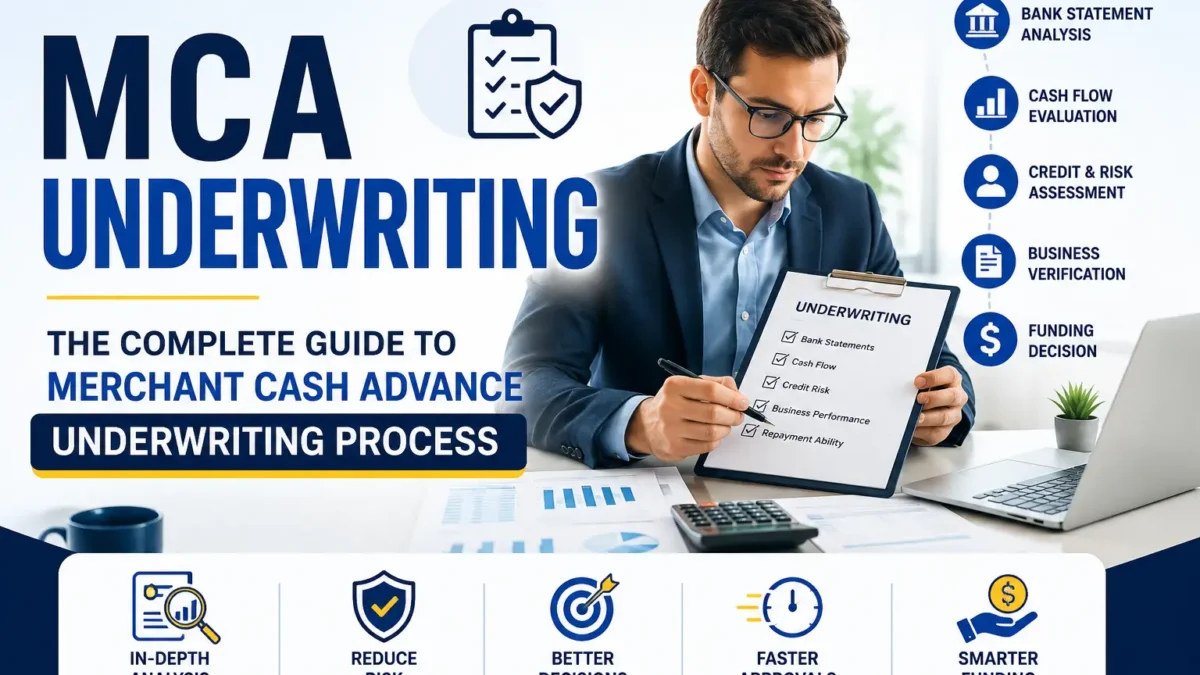
Quick Answer
MCA underwriting is the risk-evaluation engine behind every merchant cash advance. Unlike bank loans, MCA underwriting is a behavioral, cash-flow-driven assessment that grades “paper (deal quality), scrubs bank statements for true daily balances, detects stacking (multiple advances hidden from view), and produces a funding decision in 2–24 hours. A modern MCA underwriter combines data science, banking analytics, and a paper grading system (typically A through F) with automation tools to make fast, defensible decisions. In this guide, you’ll learn the full workflow — from application intake and bank statement scrubbing to stacking detection, red flag identification, checklist execution, automation, ISO support, and ongoing portfolio management.
Key Takeaways
- The MCA underwriting process evaluates 5–7 core documents: application, bank statements, processing statements, ID, voided check, and sometimes tax returns or P&Ls.
- Paper grading (A/B/C/D/F) is the universal language funders use to price risk and size deals.
- Bank statement scrubbing uses OCR + transaction categorization to identify true daily balances, NSF counts, and cash flow consistency.
- Stacking detection is the single most important underwriting step — the #1 cause of portfolio charge-offs.
- Red flags include NSF spikes, payday lender deposits, large daily withdrawals, inconsistent deposits, and high velocity.
- Automation (API-driven bank verification, AI stacking detectors, rule-based decision engines) cuts underwriting time from days to minutes.
- ISO underwriting support and outsourced underwriting desks are now the industry norm for sub-$250K deals.
- Portfolio management is post-funding: monitoring TIBs, renewals, and residual risk.
Related: Loan Underwriting Process: Complete Guide for Lenders (2026) | Merchant Cash Advance: The Complete Guide for Borrowers and Lenders (2026) | What Is MCA Underwriting? The Complete Process for Funders (2026)
1. What Is MCA Underwriting and Why It Matters
Merchant Cash Advance underwriting is the due-diligence process funders (also called “MCA companies, “purchasers, or “buyers) use to evaluate whether to fund a business based on the future sales of that business. Unlike a bank loan, an MCA is technically a purchase of future receivables, governed by commercial — not consumer — law [R1]. This distinction is critical: the underwriting framework is built to forecast future cash flow and protect against future default, not to assess credit history alone.
For funders, ISOs, and brokers, the underwriting function is the single most important risk control in the business. Industry estimates suggest that 60–80% of MCA charge-offs can be traced back to underwriting failures, primarily poor paper grading, missed stacking, and inadequate bank statement analysis [R2]. Because MCAs are unsecured (no collateral), the analysis is a 100% cash-flow story.
1.1 The Three Pillars of MCA Underwriting
- Identity & Business Verification — KYC, beneficial ownership, business legitimacy.
- Cash Flow & Bank Statement Analysis — the heart of the decision.
- Stacking & Position Analysis — what other obligations sit on top of the merchant’s bank account.
Master all three, and your portfolio performs. Skip any one, and you’re buying defaults.
2. The Complete MCA Underwriting Process: Step-by-Step
The MCA underwriting process can be broken into eight discrete steps. While the order varies by funder, the substance is the same. Here is the workflow most institutional funders follow in 2025:
Step 1 — Application Intake & Pre-Qualification
The merchant submits an application — typically a 1-page form capturing business name, time in business, monthly revenue, industry, owner info, and requested amount. Pre-qualification filters out 40–60% of submissions based on basic criteria:
- Minimum 3–6 months in business
- Minimum $8K–$15K monthly revenue (varies by funder)
- Excluded industries (adult, gambling, cannabis in non-legal states, firearms, etc.)
- Owner credit score floor (usually 450–500 minimum; some funders skip FICO entirely)
Step 2 — Document Collection
The funder requests a standard document package. Best-in-class funders use a digital portal that auto-emails the merchant a secure link. The typical stack:
- Last 4 months of business bank statements (PDF or live API)
- Last 3–4 months of credit card processing statements (if applicable)
- Driver’s license / government ID
- Voided check or bank letter
- Business formation documents (LLC/Inc certificate, EIN)
- ACH authorization form
For deals over $150K, most funders add tax returns, a P&L, and a debt schedule [R3].
Step 3 — Bank Statement Scrubbing
See dedicated Section 4 below. This is the analytical heart of underwriting.
Step 4 — Paper Grading
See dedicated Section 3 below. The result is a letter grade that drives price, holdback, and term.
Step 5 — Stacking Detection
See dedicated Section 5 below. Determines true free cash flow.
Step 6 — Risk Decision & Deal Structuring
Underwriter combines the paper grade, stacking position, and red flags to issue a decision:
- Approved — at offered price
- Approved with conditions — reduced amount, higher holdback, or shorter term
- Counter-offer — alternative structure
- Declined
Step 7 — Documentation, Compliance & Funding
Legal documents (confession of judgment, purchase agreement, ACH authorization, personal guarantee) are e-signed. KYC and beneficial ownership checks are finalized. Funds are wired in 2–24 hours.
Step 8 — Post-Funding Portfolio Monitoring
See dedicated Section 10 below. The underwriting process doesn’t end at funding — it extends through the life of the deal.
3. MCA Paper Grading System Explained
Paper grading is the categorical risk score a funder assigns to a deal. It’s the universal shorthand ISOs and brokers use to communicate deal quality. While there’s no industry-wide standard, the most common framework ranges from A+ to F. Here’s how top funders typically grade paper:
| Grade | Monthly Revenue | Bank Health | Time in Business | FICO | Typical Terms |
|---|---|---|---|---|---|
| A | $50K+ | Strong, low NSFs, consistent deposits | 3+ years | 680+ | 1.10–1.25 factor, low holdback, 6–9 months |
| B | $25K–$50K | Good, minor inconsistencies | 2+ years | 620+ | 1.20–1.35 factor, 9–12 months |
| C | $15K–$25K | Fair, some NSFs, moderate consistency | 1+ year | 580+ | 1.30–1.45 factor, 9–12 months |
| D | $10K–$15K | Weak, frequent NSFs, inconsistent | 6+ months | 525+ | 1.40–1.55 factor, 12–15 months, may require co-sign |
| F | <$10K or severe risk | Stacking, charge-offs, fraud signals | <6 months | <500 | Decline or 1.55+ factor, very short term |
3.1 The Three Inputs That Drive Paper Grade
- Average Monthly Deposits — the truest revenue signal.
- Consistency & Trend — flat or growing beats declining.
- Negative Indicators — NSFs, overdrafts, large cash withdrawals, payday lender debits.
A sub with 80 NSFs in 4 months and 1.6x revenue-to-deposits ratio is a C at best — even if revenue looks high on paper [R4].
3.2 Beyond the Grade: Sub-Attributes
Top underwriters look at sub-attributes within each grade:
- Time in business (TIB) — under 6 months is a hard decline for most funders
- Industry risk — restaurants and retail are lower risk; staffing, construction, and high-risk merchant category codes (MCCs) are higher
- Geography — some states (NY, CA) have specific state-level restrictions [R5]
- Velocity — how many prior advances has this merchant taken
For outsourced deal flow, understanding how a BPO underwrites paper is critical to setting expectations on grade distribution.
4. Bank Statement Scrubbing: The Analytical Core
Bank statement scrubbing is the process of pulling, categorizing, and analyzing every transaction in a merchant’s bank statement to derive the true financial picture. It’s the single most time-consuming step in MCA underwriting — and the highest-leverage.
4.1 Why Scrubbing Matters
A raw bank statement PDF shows 100–400 transactions per month. A human reading line items will miss 40–60% of meaningful signals. Scrubbing converts that PDF into structured data: each line item tagged with category, counterparty, amount, and date. Only then can an underwriter spot stacking, NSFs, true revenue, and cash flow patterns.
4.2 The Scrubbing Process
- Extraction — OCR or live API (Plaid, Finicity, MX) pulls transactions into a database.
- Categorization — each transaction is auto-tagged (ACH debit, ACH credit, wire, check, card, internal transfer).
- Counterparty identification — the merchant name on the other side is matched against a database of MCAs, factors, lenders, payroll companies, and landlords.
- Daily balance reconstruction — opening balance + credits − debits = end-of-day balance, recalculated for every day in the statement period.
- Anomaly detection — flag NSFs, large round-dollar transfers, peak balance days, and outlier deposits.
4.3 Key Metrics Derived from Scrubbing
| Metric | What It Tells You |
|---|---|
| Average Daily Balance (ADB) | Cash buffer the merchant operates with |
| Average Monthly Deposits | True gross revenue |
| Net Deposits | Deposits minus reversals, chargebacks, refunds |
| NSF / Overdraft Count | Cash management discipline |
| Negative Day Count | Days the account went below zero |
| Largest Cash Withdrawal | Owner distribution signal |
| Recurring Counterparties | Identifies stack, rent, payroll, vendors |
| Deposit Consistency (CoV) | Coefficient of variation — high = risky |
4.4 Live Bank Verification vs. PDF Statements
Industry adoption of Plaid, Finicity, and MX integrations has shifted underwriting from PDF review to live API access. Live data reduces fraud (fake statements are a multi-million-dollar problem) and delivers 12–24 months of historical data versus the typical 4 months from PDFs [R6]. Funders using live data report 15–25% better loss ratios versus PDF-only underwriting [R7].
5. Stacking Detection: The #1 Risk in MCA
Stacking occurs when a merchant has multiple MCAs, factor advances, or similar daily-remit obligations pulling from the same bank account. It’s the single largest predictor of default in the MCA industry. The FTC and several state regulators have called stacking the “central predatory concern of the small business funding market [R8].
5.1 Why Stacking Kills Portfolios
When a merchant has 3 MCAs all debiting 20% of daily deposits each, that merchant remits 60% of revenue to funders. With rent, payroll, vendors, and tax obligations on top, the merchant is functionally insolvent within 2–3 months. Industry data shows merchants with 3+ stacked advances default at 3–5x the rate of single-position merchants [R9].
5.2 The Stacking Detection Workflow
- Counterparty matching — every recurring debit is matched against a database of known MCAs, factors, and online lenders. Top databases include PaymentCloud, MCC databases, and proprietary funder lists.
- Debit pattern recognition — MCA debits typically appear as daily ACH debits of varying amounts (often labeled with the funder’s name or a DBA).
- Holdback calculation — total daily/weekly debits to existing MCAs vs. deposits = the merchant’s true free cash flow.
- Position sizing — your advance can only consume what’s left after existing stack.
5.3 Stacking Tiers
Stacking Risk Tiers
Challenge: An MCA company funding $50M+ monthly was processing 200+ deals per week with an in-house underwriting team of 8. Their turnaround time was 6-8 hours per deal, causing them to lose quality submissions to competitors with faster funding decisions. In-house cost per underwrite was $38 per file, and they struggled to staff night shifts for same-day funding.
Solution: Procizo Outsourcing LLC deployed a dedicated team of 6 underwriters working across US time zones. The team handled bank statement scrubbing, paper grading, stacking detection, and pre-funding quality checks — all within the client’s underwriting platform via secure VPN.
Results (6 months):
- Turnaround time reduced from 6-8 hours to 90 minutes — 75% faster
- Cost per underwrite reduced from $38 to $14 — 63% savings
- Deal processing capacity increased from 200 to 450+ per week
- Same-day funding rate improved from 45% to 88%
- Stacking detection accuracy increased to 97% with dedicated QA protocols
- Client reported 22% increase in funded deal volume within first quarter
Frequently Asked Questions
What is MCA underwriting?
MCA underwriting is the process of evaluating a merchant’s creditworthiness, daily revenue, and business health to determine their eligibility for a Merchant Cash Advance. Unlike traditional loans, MCA underwriting focuses heavily on daily bank statement analysis, credit card receivables, and real-time cash flow.
How is MCA underwriting different from traditional loan underwriting?
Traditional loan underwriting focuses on credit scores, debt-to-income ratios, and collateral. MCA underwriting prioritizes daily credit card sales volume, bank statement analysis, months in business, and industry risk. MCA approvals are faster (24-48 hours vs weeks) because they rely on real business performance rather than credit history alone.
How long does MCA underwriting take?
Standard MCA underwriting takes 24-48 hours from application to decision. With outsourced support, Procizo can process applications within 12-24 hours for standard deals and 24-48 hours for complex renewals or large advances.
What documents are needed for MCA underwriting?
Typically: 3-6 months of bank statements (all pages), 3-4 months of processing statements (if accepting credit cards), business license, voided check, driver’s license of owners, and completed application. Some funders also request tax returns for advances over $250,000.
What are the key risk factors in MCA underwriting?
Primary risk factors include low daily balances, inconsistent deposit patterns, NSF occurrences, high industry failure rates, short time in business (<6 months), high debt service coverage ratio, and rapid balance declines. Each factor is weighted differently based on the funder’s risk appetite.
Can MCA underwriting be outsourced?
Yes. Many MCA funders and brokers outsource underwriting to companies like Procizo Outsourcing LLC. Outsourced underwriters handle bank statement analysis, risk scoring, condition verification, and decline determination — following the funder’s exact guidelines while reducing internal workload.
How do outsourced MCA underwriters ensure accuracy?
Through multi-layer review processes, documented SOPs based on your funding criteria, weekly quality audits, and experienced underwriters who evaluate 30-50 files daily. Procizo maintains accuracy rates above 97% through continuous training and dual-review on borderline files.
What is a good MCA underwriting accuracy rate?
Industry standard is 95-97% accuracy. Top outsourcing partners like Procizo target 98%+. Accuracy includes correct risk scoring, proper documentation flagging, appropriate advance amount recommendations, and adherence to funder guidelines.
How many MCA files can an underwriter process daily?
An experienced MCA underwriter processes 25-40 applications per day depending on complexity. Simple renewals take 15 minutes; complex first-time advances with multiple owners take 45-60 minutes. Procizo’s underwriters average 30 files per day.
Do I need to provide software/tools to outsourced underwriters?
Procizo’s underwriters work in your existing systems through secure VPN access. No additional software purchase needed. We support FundMore, RapidCents, Slingshot, Liberty, or custom portal-based systems.
What happens if an outsourced underwriter makes a mistake?
Quality issues are rare but handled through a clear process: identification → documentation → correction with client input → root cause analysis → process improvement. Procizo maintains E&O insurance and performance guarantees for all underwriting work.
Is MCA underwriting outsourcing cost-effective for small funders?
Yes. Small funders benefit most because outsourcing eliminates fixed payroll costs while providing access to experienced underwriters. Per-file pricing models mean you only pay for the files you process — ideal for funders processing 50-200 files per month.
References
| Code | Source | Link |
|---|---|---|
| [R1] | IBISWorld — Industry Research & Market Data | View → |
| [R2] | Dun & Bradstreet — Industry Research & Market Data | View → |
| [R3] | Experian — Industry Research & Market Data | View → |
| [R4] | Federal Reserve — Industry Research & Market Data | View → |
| [R5] | SBA — Industry Research & Market Data | View → |
| [R6] | Procizo Outsourcing LLC — Loan Underwriting Process: Complete Guide for Lenders (2026) | View → |
| [R7] | Procizo Outsourcing LLC — Merchant Cash Advance: The Complete Guide for Borrowers and Lenders (2026) | View → |
| [R8] | Procizo Outsourcing LLC — What Is MCA Underwriting? The Complete Process for Funders (2026) | View → |
| [R9] | Procizo Outsourcing LLC — What Is Underwriting? Complete Guide for Business Lending (2026) | View → |
| [R10] | Procizo Outsourcing LLC — The Complete Guide to MCA Underwriting Outsourcing (2026) | View → |
| [R11] | Procizo Outsourcing LLC — Lending Business: The Ultimate Playbook for Starting & Scaling | View → |
Ready to Streamline Your Mca Underwriting Support?
Procizo Outsourcing LLC provides end-to-end MCA underwriting support with transparent pricing, dedicated teams, and rapid onboarding. Start with a pilot engagement — no long-term commitment required.
No commitment required • 2-3 week onboarding • SOC 2 Type II security
Editorial Oversight: Content reviewed and approved by the Procizo Outsourcing LLC team based on internal research, operational experience, industry reports, and publicly available data.
Research Methodology: This content was created using a combination of Procizo Outsourcing LLC's operational expertise, industry publications, academic research, government resources, and verified third-party sources.