- Have Questions? Talk to Us
- info@procizo.com

What Is KPO? Knowledge Process Outsourcing Guide (2026)

Finance and Accounting Outsourcing: Complete Guide (2026)
July 6, 2026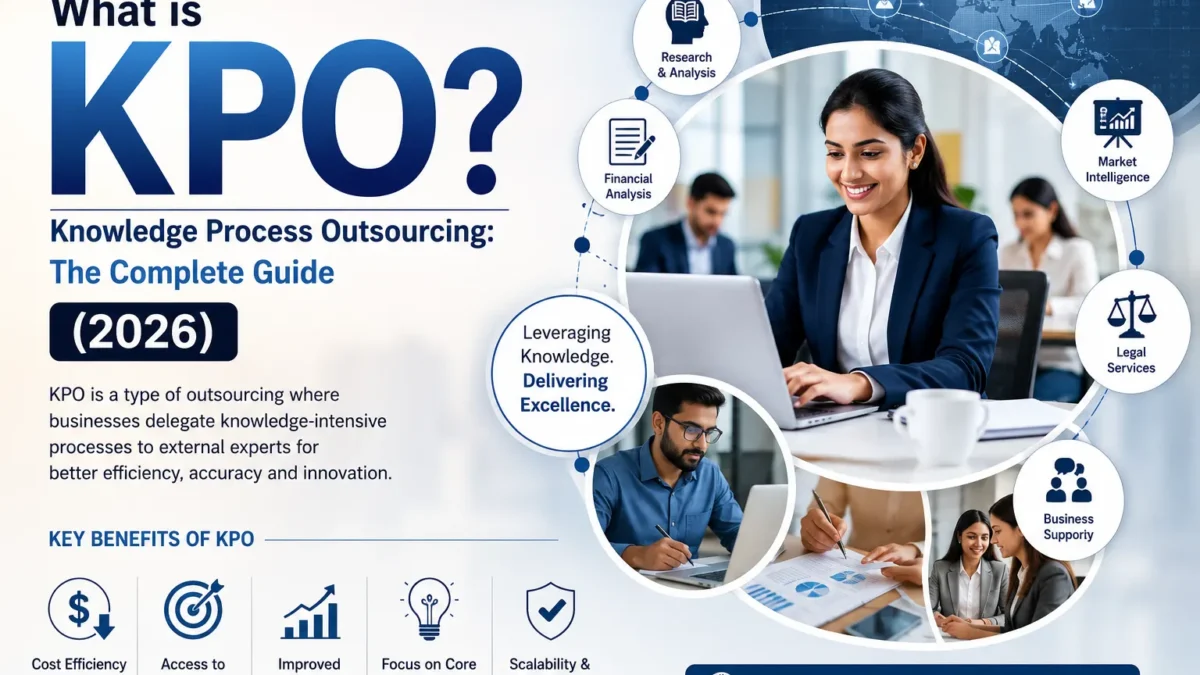
Quick Answer:
Explore more: call center outsourcing, back office outsourcing, and virtual assistant services. KPO (Knowledge Process Outsourcing) is the practice of outsourcing high-value, knowledge-intensive business processes that require specialized domain expertise, advanced analytical skills, and judgment-based decision-making. Unlike BPO (Business Process Outsourcing) which focuses on rules-based administrative tasks, KPO involves complex analysis, research, financial modeling, legal expertise, and strategic recommendations. KPO providers employ professionals with advanced degrees (MBAs, CFAs, PhDs, JDs) and command premium rates compared to standard BPO.
Key Takeaways
- KPO involves outsourcing high-value knowledge work requiring specialized expertise – research, analysis, financial modeling, legal services, and strategic consulting
- The global KPO market is valued at $58.6 billion in 2026 and growing at 12.5% annually
- KPO differs from BPO in complexity level: BPO = rules-based tasks, KPO = judgment-based decisions requiring advanced degrees and analytical skills
- Common KPO services include financial research, data analytics, legal process outsourcing, intellectual property research, and market intelligence
- KPO professionals typically command premium rates versus standard BPO, but deliver 3-5x the value per hour through specialized expertise
What Is KPO? Complete Definition
Knowledge Process Outsourcing (KPO) refers to the delegation of knowledge-intensive business processes to external service providers who possess specialized domain expertise, advanced analytical capabilities, and professional certifications. KPO is the next evolution of outsourcing – moving beyond administrative task execution to high-value knowledge work that directly impacts business strategy and decision-making.
KPO emerged in the early 2000s as companies realized that outsourcing could extend beyond back office administrative tasks. Initially focused on financial research and data analytics, the KPO industry has expanded to cover legal services, intellectual property research, patent filing, equity research, investment banking support, market research, and business intelligence. In 2026, KPO is a $58.6 billion global industry serving financial services, healthcare, legal, technology, and pharmaceutical companies across every major market [R1].
The fundamental difference between KPO and BPO is the level of thinking required. BPO tasks follow predefined rules and procedures – data entry, document processing, call center support. KPO tasks require analysis, interpretation, synthesis, and judgment – financial modeling, legal research, patent analysis, equity research, and strategic recommendations. KPO professionals typically hold advanced degrees (MBAs, CFAs, CPAs, PhDs, JDs) and undergo extensive training in their specific domain.
KPO vs BPO: Key Differences
Understanding the differences between KPO and BPO is essential for companies designing their outsourcing strategy:
| Factor | KPO (Knowledge Process Outsourcing) | BPO (Business Process Outsourcing) |
|---|---|---|
| Nature of work | Judgment-based, analytical, knowledge-intensive | Rules-based, process-driven, administrative |
| Required qualifications | Advanced degrees (MBA, CFA, PhD, JD) | Undergraduate degree, vocational training |
| Cost structure | Higher (specialized expertise) | Lower (process-driven) |
| Decision-making level | Strategic, analytical, interpretive | Operational, transactional |
| Value driver | Expertise, insight, quality of analysis | Cost savings, efficiency, scale |
| Typical engagement | Project-based or dedicated teams | Volume-based, ongoing operations |
| Examples | Financial modeling, patent research, legal analysis | Data entry, call center, document processing |
| Global market (2026) | $58.6 billion | $342 billion |
Types of KPO Services
KPO covers a wide range of knowledge-intensive services across multiple industries:
Financial KPO Services
Financial KPO is the largest segment of the KPO market, covering equity research, investment banking support, financial modeling, valuation analysis, credit analysis, and portfolio management. Financial KPO providers employ CFAs, MBAs, and financial analysts who produce research reports, build financial models, analyze company performance, and support investment decisions. A hedge fund using a financial KPO provider can access a team of 10-20 analysts – a fraction of the cost of building an equivalent in-house research team [R2].
Legal Process Outsourcing (LPO)
LPO is the second-largest KPO segment, covering legal research, contract review and management, patent filing and prosecution, intellectual property management, litigation support, document review, and regulatory compliance analysis. LPO providers employ lawyers (JDs, LLBs) and paralegals who provide legal services at 40-60% lower cost than US or UK law firms. Law firms and corporate legal departments save substantially annually per attorney by leveraging LPO for routine legal work.
Data Analytics and Business Intelligence
Data analytics KPO covers big data analysis, business intelligence, predictive modeling, customer analytics, market segmentation, and data visualization. Analytics KPO providers employ data scientists, statisticians, and business analysts who transform raw data into actionable business insights. Companies using analytics KPO report 20-40% improvement in decision-making speed and accuracy.
Intellectual Property and Patent Research
IP and patent KPO covers patent searching, patent landscape analysis, patent drafting, IP portfolio management, patentability assessments, freedom-to-operate analysis, and patent invalidity research. Patent KPO providers employ patent agents and technical experts with advanced degrees in engineering, science, and law. The global patent filing market processes 3.5 million+ patent applications annually, creating massive demand for specialized IP research and analysis services [R3].
Market Research and Competitive Intelligence
Market research KPO covers primary and secondary market research, competitive analysis, industry analysis, customer surveys, market sizing, and trend analysis. KPO providers produce detailed market intelligence reports that companies use for strategic planning, product development, and market entry decisions. A comprehensive market research project that would cost significantly more through a top-tier consulting firm costs far less through a specialized KPO provider.
Benefits of KPO Services
- Cost savings of 40-60%: KPO providers in India, Philippines, and Eastern Europe offer the same quality of knowledge work at 40-60% lower cost than in-house teams in the US, UK, or Western Europe.
- Access to specialized expertise: KPO providers maintain teams of highly qualified professionals with advanced degrees and certifications – talent that would be expensive and difficult to recruit individually.
- Scalable knowledge capacity: KPO providers quickly scale teams up or down based on project needs, eliminating the fixed costs and HR complexity of maintaining a large in-house knowledge team.
- Faster turnaround: KPO teams working across multiple time zones deliver analysis and research 24/7, compressing project timelines by 30-50% compared to in-house teams.
- Focus on core business: By outsourcing knowledge-intensive support functions, companies free their senior talent to focus on core strategic activities that directly drive revenue and growth.
- Technology and methodology access: Leading KPO providers invest in advanced analytics platforms, research databases, and proprietary methodologies that individual companies cannot justify economically.
KPO Outsourcing Locations
Three regions dominate the global KPO market:
- India: The largest KPO destination with 55-60% market share. India produces 1.5 million+ engineering graduates and 300,000+ MBA graduates annually. Major KPO hubs include Mumbai (financial services), Bangalore (analytics), Delhi-NCR (legal process outsourcing), and Pune (pharmaceutical research). Major KPO hubs include India (deep talent pool, established delivery centers), Eastern Europe (fast-growing, strong technical skills), and the Philippines (large English-speaking workforce).
- Philippines: Second-largest KPO destination with 15-20% market share. Strong in legal process outsourcing, accounting KPO, and creative services. English proficiency and US cultural alignment make the Philippines ideal for client-facing knowledge work. KPO delivery spans global hubs with varying cost structures.
- Eastern Europe: Fastest-growing KPO region with 10-15% market share. Poland, Romania, and Ukraine dominate financial KPO, IT research, and legal services. Time zone alignment with Western Europe and strong technical education systems drive growth. KPO delivery models range from offshore centers to nearshore and onshore teams, each with different cost structures and time-zone alignment.
Each region offers specific advantages, and many companies use a multi-location KPO strategy to leverage the best of each geography [R4].
How to Choose a KPO Provider
Selecting the right KPO partner is critical because knowledge work directly impacts business decisions. Key evaluation criteria include:
- Domain expertise: Does the KPO provider have deep experience in your specific industry? Review case studies, client references, and professional qualifications of the team that will work on your engagements.
- Talent quality: What qualifications do their professionals hold? Look for advanced degrees (MBAs, CFAs, CPAs, JDs, PhDs) and professional certifications relevant to your domain. Most KPO providers should have 70%+ of their team holding advanced degrees.
- Quality processes: How does the KPO provider ensure quality and accuracy of knowledge work? They should have multi-layer review processes, subject matter expert oversight, client feedback loops, and continuous improvement programs.
- Data security: Knowledge work often involves sensitive company data, financial information, and intellectual property. Verify SOC 2 Type II certification, data encryption, access controls, and confidentiality agreements.
- Track record: Request client references specifically in your industry. Ask about project outcomes, communication quality, and whether the client would recommend the provider for similar work.
- Cultural alignment: Knowledge work requires deep understanding of your business context and client expectations. Choose a KPO provider with strong cultural alignment, excellent English communication, and experience working with companies in your market.
KPO vs BPO vs RPO: What’s the Difference?
Companies often confuse these three outsourcing models. Here is the simple distinction:
- BPO (Business Process Outsourcing) handles operational, rules-based tasks – data entry, call center, document processing, payroll processing. Focus: efficiency and cost reduction. Offshore delivery generally offers the lowest cost structure; nearshore adds time-zone alignment; onshore provides the closest collaboration. Example: Outsourcing insurance claims data entry.
- KPO (Knowledge Process Outsourcing) handles analytical, judgment-based knowledge work – financial research, legal analysis, market intelligence, patent research. Focus: expertise and insight. Specialized KPO (legal, IP, equity research) sits at the premium end of the market due to required expertise. Example: Outsourcing equity research reports for an investment bank.
- RPO (Recruitment Process Outsourcing) handles recruitment and talent acquisition – job posting, candidate sourcing, screening, interviewing, offer management. Focus: hiring efficiency and quality. Rates vary by model. Example: Outsourcing recruitment for an insurance company scaling its underwriting team.
FAQs About KPO
How much does KPO cost? KPO services are priced according to complexity and location, with rates varying by engagement. Financial, legal, and specialized IP research KPO each carry different rate structures by region. This is meaningfully lower than equivalent in-house or onshore costs.
Which industries use KPO the most? Financial services (equity research, investment banking support), legal (contract review, IP management), healthcare (medical research, clinical data analysis), technology (software research, data analytics), and pharmaceuticals (drug research, clinical trials).
Is KPO growing? Yes, the global KPO market is growing at 12.5% annually and is projected to reach $102 billion by 2031. Increased demand for specialized knowledge work and cost optimization drive this growth.
What qualifications do KPO professionals have? KPO professionals typically hold MBAs, CFAs, CPAs, JDs (law degrees), PhDs, or other advanced degrees. Many have 5-15+ years of industry experience before transitioning to KPO.
KPO Services by Industry
Different industries leverage KPO services for different needs. Here is how KPO is used across major sectors:
Financial Services KPO
Financial services is the largest consumer of KPO services. Investment banks, hedge funds, private equity firms, asset managers, and insurance companies outsource equity research, financial modeling, valuation analysis, portfolio analytics, risk management, and compliance reporting. A typical engagement involves a KPO team of 5-20 analysts supporting an internal team of 1-3 senior professionals. The KPO team handles data collection, spreadsheet modeling, report drafting, and preliminary analysis while the internal team focuses on strategic decisions, client relationships, and final recommendations. Financial KPO saves banks and asset managers 50-65% on research costs while expanding their analytical capacity by 3-5x [R5].
Legal KPO Services
Legal process outsourcing (LPO) covers contract review and drafting, legal research, e-discovery, patent prosecution, trademark filing, due diligence, and regulatory compliance analysis. Law firms and corporate legal departments outsource these functions to LPO providers who employ qualified lawyers and paralegals at 40-60% lower cost. The global LPO market is valued at $12.5 billion in 2026, driven by increasing litigation volumes, complex regulatory environments, and cost pressure on law firms. Major LPO providers offer dedicated legal teams with US and UK law qualifications, ensuring work meets the highest quality and confidentiality standards.
Healthcare and Pharmaceutical KPO
Healthcare KPO covers medical coding, clinical data management, medical research analysis, pharmacovigilance, health outcomes research, and regulatory submission support. Pharmaceutical companies and healthcare providers use KPO to accelerate drug development timelines, manage clinical trial data, and ensure regulatory compliance. Medical KPO professionals include doctors, PhDs, pharmacists, and medical coders who provide specialized expertise that is expensive and difficult to recruit in-house.
Technology and IT KPO
Technology KPO covers software research, technology assessment, IT strategy consulting, cybersecurity analysis, cloud migration planning, and digital transformation support. Technology companies and enterprises undergoing digital transformation use KPO providers for specialized technology analysis and strategy support. IT KPO rates differ between offshore and onshore delivery, with onshore commanding a premium.80/hour for nearshore European teams.
KPO Outsourcing Process: How It Works
The KPO engagement model differs from BPO because knowledge work requires deeper discovery, more context, and ongoing collaboration. Here is the typical KPO process:
- Discovery and scoping: The client explains their business context, the specific knowledge work needed, quality expectations, timeline, and confidentiality requirements. The KPO provider assesses scope and assigns the right team based on domain expertise and experience.
- Team assembly and training: The KPO provider assembles a dedicated team with the right qualifications and experience. The team undergoes client-specific training covering terminology, tools, templates, quality standards, and communication protocols.
- Pilot engagement: Most KPO relationships start with a pilot project (2-6 weeks) to demonstrate quality, communication, and process alignment. The pilot includes regular feedback sessions and process refinement before scaling.
- Full engagement and governance: Once the pilot is successful, the engagement scales to full scope with ongoing governance through weekly status calls, monthly quality reviews, quarterly business reviews, and continuous improvement programs.
- Knowledge transfer and retention: KPO engagements create intellectual property and institutional knowledge. Leading KPO providers have robust knowledge management systems that ensure continuity even when team members change [R6].
Challenges in KPO Outsourcing
While KPO offers significant benefits, companies should be aware of potential challenges:
- Knowledge transfer complexity: Knowledge work requires deep context about your business, industry, and specific requirements. Effective knowledge transfer takes time and structured documentation. Companies that rush this phase typically experience quality issues in the first 4-8 weeks of engagement.
- Communication and cultural gaps: Knowledge work involves nuanced analysis and recommendations that require strong communication skills. Choose KPO providers with excellent English proficiency, cultural training, and experience working with clients in your market.
- Data security and confidentiality: KPO engagements involve sensitive business information, financial data, intellectual property, and strategic plans. Ensure your KPO provider has robust data security measures including SOC 2 Type II certification, encrypted data transmission, role-based access controls, and strict confidentiality agreements.
- Quality consistency: Maintaining consistent quality across a KPO team requires strong quality management processes – multi-layer reviews, subject matter expert oversight, client feedback loops, and continuous improvement programs. Request quality metrics and audit results during provider evaluation.
- Retention of key talent: High-quality KPO professionals are in demand. Ensure your provider has strong retention programs (career development, competitive compensation, engaging work) to maintain team stability and institutional knowledge.
Companies that address these challenges upfront through structured onboarding, clear communication protocols, and robust governance frameworks consistently report the highest satisfaction with KPO engagements.
KPO Industry Trends 2026
The KPO industry continues to evolve rapidly. Key trends shaping the sector in 2026 include:
- AI-augmented KPO: Rather than replacing KPO professionals, AI tools are augmenting their capabilities. AI handles data collection, preliminary analysis, and pattern recognition while KPO professionals focus on interpretation, strategic recommendations, and client communication. AI-augmented KPO teams deliver 30-50% faster turnaround without sacrificing quality.
- Specialized boutique KPO firms: While large KPO providers dominate the market, specialized boutique firms are growing rapidly by offering deep expertise in specific niches – fintech KPO, healthcare analytics KPO, patent research KPO, and ESG reporting KPO. Boutique firms offer higher quality at slightly higher rates for specialized work.
- Nearshoring shift: While India remains the dominant KPO destination, nearshore locations (Eastern Europe for European clients, LATAM for US clients) are growing at 18-20% annually due to time zone alignment, cultural proximity, and data residency requirements.
- Integrated KPO-BPO models: Companies increasingly prefer providers that offer both BPO and KPO capabilities under one roof, creating seamless workflows where data entry (BPO) feeds directly into analysis (KPO) without handoff friction between providers.
- Outcome-based pricing: Traditional KPO pricing is time-based (per hour/per FTE). A growing trend is outcome-based pricing where the KPO provider is paid based on deliverables completed, reports produced, or business outcomes achieved – aligning incentives between client and provider.
These trends point toward a KPO industry that is becoming more specialized, technology-enabled, and outcome-focused. Companies that select KPO providers aligned with these trends will have a competitive advantage in accessing high-quality knowledge support [R1].
KPO Market Size and Statistics (2026)
The global KPO market in 2026 presents substantial opportunities for companies leveraging external knowledge support:
- Global KPO market size: $58.6 billion in 2026, growing at 12.5% CAGR
- Expected to reach $102.3 billion by 2031
- Financial KPO represents 32% of the total market ($18.8 billion)
- Legal KPO represents 21% of the total market ($12.5 billion)
- Healthcare KPO represents 18% of the total market ($10.5 billion)
- Technology KPO represents 15% of the total market ($8.8 billion)
- India holds 55-60% of global KPO market share
- Philippines holds 15-20% of global KPO market share
- Eastern Europe holds 10-15% of global KPO market share
- Average cost savings from KPO: 40-60% vs in-house operations
- KPO industry employs 1.2+ million professionals globally
Companies leveraging KPO services report 30-50% faster project completion and 3-5x expanded analytical capacity compared to relying solely on in-house teams [R1].
KPO represents the highest-value segment of the outsourcing industry. While BPO handles the operational engine of business, KPO powers the strategic brain – delivering the research, analysis, and insights that drive informed decision-making. For companies seeking to access specialized expertise, expand analytical capacity, and reduce costs by 40-60%, KPO offers a proven model for scaling knowledge work without the overhead of building large in-house teams. The key to success is choosing the right KPO partner with deep domain expertise, rigorous quality processes, and strong cultural alignment with your organization.
References
| Ref | Source | Link |
|---|---|---|
| R1 | Grand View Research – KPO Market Report 2026 | https://www.grandviewresearch.com/industry-analysis/knowledge-process-outsourcing-market |
| R2 | NASSCOM – KPO Industry Report 2026 | https://www.nasscom.in/kpo-industry-report |
| R3 | WIPO – World Intellectual Property Indicators 2026 | https://www.wipo.int/publications/en/ |
| R4 | Deloitte – Global Outsourcing Survey 2026 | https://www.deloitte.com/global-outsourcing-survey |
| R5 | McKinsey – The Future of Knowledge Work | https://www.mckinsey.com/industries/future-of-work |
| R6 | Procizo Outsourcing LLC – KPO Services | https://procizo.com/services/ |
Need Specialized Knowledge Support?
Access expert financial research, data analytics, and knowledge process outsourcing at 40-60% less than in-house costs. Procizo Outsourcing LLC delivers quality KPO services across financial services, insurance, and legal domains.