- Have Questions? Talk to Us
- info@procizo.com

In-House vs Virtual Assistant: Cost Benefit Analysis for Startups

Virtual Assistant Services for Entrepreneurs: Scaling B2B Operations
July 25, 2025
Why I Hired a Virtual Administrative Assistant: Calculating the True ROI
July 31, 2025
In-House vs procizo.com/virtual-assistants-for-merchant-cash-advance/ target=_blank rel=noopener noreferrer>Virtual Assistant: The Definitive Cost-Benefit Analysis for Modern Businesses
You’re growing. Lead flow is up, your inbox is a warzone, and your calendar looks like a game of Tetris. The question isn’t whether you need help — it’s whether that help should sit in a dedicated desk in your office or work remotely through a structured virtual assistant program. The wrong choice can cost you $40,000 a year in unnecessary overhead. The right one can free up 20+ hours a week and let you focus on revenue.
This guide breaks down the real numbers, the hidden costs most comparison articles skip, and the operational realities of scaling with a virtual assistant service versus a traditional in-house hire. By the end, you’ll know exactly which model fits your business — and why Procizo’s BPO infrastructure changes the math for most founders.
TL;DR — The Quick Answer
An in-house employee costs 1.25× to 1.4× their base salary once you factor in benefits, payroll taxes, software licenses, office space, and management overhead. A full-time U.S. administrative assistant earning $42,000 actually costs your business between $52,500 and $58,800 annually [R1][R2]. A comparable virtual assistant from a vetted provider runs between $7,200 and $19,200 per year for full-time coverage — roughly 60–80% less.
The trade-off is not cost versus quality. It’s control versus leverage. In-house gives you physical proximity and tighter oversight; virtual assistants give you flexible scaling, specialized skill access, and the ability to redirect capital toward growth. For 80%+ of small business, startup, and real estate use cases, the math and the operational reality both favor a structured VA engagement.
Key Takeaways
- The real cost of an in-house hire is 25–40% above salary — benefits, taxes, equipment, and turnover drive the true number north of $50K for a $40K role [R2].
- Virtual assistants cost 60–80% less than equivalent U.S.-based employees, with rates ranging from $4 to $25/hour depending on region, specialization, and support model [R3][R4].
- Turnover costs employers 33% of an employee’s annual salary — for a $45K hire, that’s roughly $15,000 every time you replace them [R5].
- VAs scale up and down with demand, while in-house hires create fixed obligations that drain cash flow during slow months.
- Procizo’s BPO model removes the biggest VA downside — vetting, training, and managing the relationship yourself — by providing pre-vetted, supported, and accountable virtual professionals.
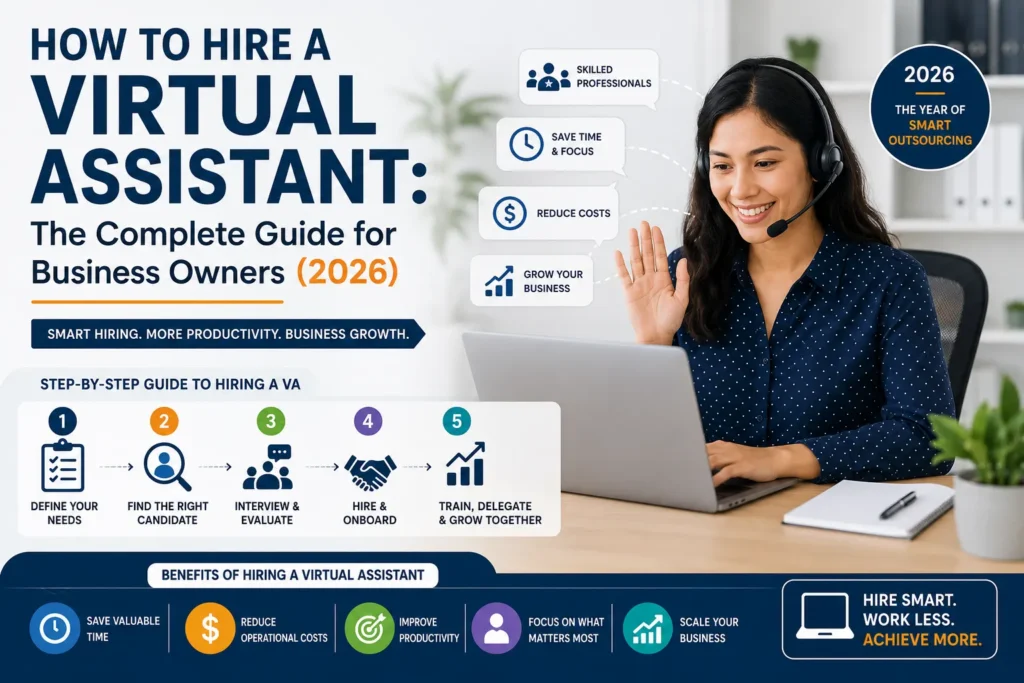
Related: How to Hire a Virtual Assistant: The Complete Guide for Business Owners (2026) | Call Center Outsourcing: Complete Guide to Customer Service BPO (2026) | Virtual Assistant Services: The Complete Guide to Hiring and Scaling with VAs (2026)
The True Cost Breakdown: In-House Employee vs. Virtual Assistant
Most cost comparisons stop at hourly rate or annual salary. That’s where the analysis breaks down. A real cost-benefit analysis must capture the fully loaded expense of each model, including the line items that quietly consume thousands of dollars every year.
In-House Employee — Fully Loaded Annual Cost
For a U.S.-based administrative or operations hire at a $42,000 base salary:
- Base salary: $42,000
- Employer payroll taxes (FICA, FUTA, SUTA): ~$3,213 (7.65% FICA + state unemployment) [R1]
- Health insurance benefits: $6,000–$15,000 depending on plan type and family coverage [R2]
- Retirement contribution (401K match, typical 3%): $1,260
- Workers’ comp + disability insurance: ~$500–$1,500
- Paid time off, holidays, sick days (effective 3–4 weeks): ~$2,400–$3,200
- Equipment (laptop, monitor, phone, software): $1,500–$3,000 one-time, ~$500/year refresh
- Office space (allocated, even in a home office setup): $1,800–$6,000
- Software licenses (CRM, project tools, communication stack): $1,200–$2,400/year
- Recruiting cost (job ads, screening, agency fees): $1,500–$5,000 per hire
- Training and onboarding (manager time + materials): $2,000–$5,000
Total realistic annual cost: $55,000 to $72,000 — and that assumes the person stays for the full year. The average administrative employee tenure is just 2.8 years [R5], meaning you’re absorbing recruitment and onboarding pain on a recurring cycle.
Virtual Assistant — Annual Cost With a Managed Provider
For a comparable full-time virtual assistant at an average of $8/hour, working 40 hours/week, 50 weeks/year (2 weeks off):
- Direct VA cost: $16,000/year
- Procizo management, vetting, and quality assurance layer: included
- Software and infrastructure: included or minimal
- PTO, sick coverage, and replacement: included
- No benefits, no payroll taxes, no office, no equipment: $0
Total annual cost: $16,000–$24,000 for full-time coverage, depending on the VA’s specialization (general admin, real estate transaction coordination, e-commerce listing, etc.). Even at $15/hour for a U.S.-based VA, you’re looking at $30,000 — still 50%+ cheaper than an in-house hire before considering the hidden costs above.
| Cost Category | In-House (U.S.) | Procizo VA |
|---|---|---|
| Base compensation | $42,000 | $16,000–$30,000 |
| Payroll taxes | $3,200 | $0 |
| Health benefits | $6,000–$15,000 | $0 |
| Retirement match | $1,260 | $0 |
| Office space / equipment | $3,000–$9,000 | $0 |
| Software licenses | $1,200–$2,400 | Included |
| Recruiting / onboarding | $3,500–$10,000 | $0 (pre-vetted) |
| Management overhead (5–8 hrs/wk at your rate) | $10,000–$20,000 | Handled by Procizo |
| Total Annual Cost | $70,000–$100,000 | $16,000–$30,000 |
Net annual savings: $40,000 to $70,000+ — capital that goes directly into marketing, product development, or sales pipeline.
The Hidden Costs of In-House Hiring Most Founders Underestimate
Salary is the visible iceberg. Below the waterline sit the costs that quietly erode margins and time. If you’ve ever made a hire and felt surprised by how much “administrative friction came with it, this section is for you.
1. The Real Cost of Turnover
The U.S. Bureau of Labor Statistics puts median employee tenure in administrative and office support roles at under 3 years [R5]. Replacing an employee costs between 16% and 213% of their annual salary depending on the role’s seniority, with a widely cited rule of thumb of 33% of annual salary for mid-level positions [R5]. For a $45,000 hire, that’s a $15,000 replacement tax — recurring every 2–3 years.
With a managed VA, turnover is the provider’s problem. Procizo maintains a bench of trained professionals ready to step in within 48–72 hours if your primary VA is unavailable, goes on leave, or isn’t the right fit.
2. Management Drag on the Founder
SHRM research suggests supervisors spend roughly 10–15% of their time on performance management, scheduling, and administrative coordination for each direct report [R2]. For a founder billing at $150/hour, that’s $7,500–$15,000 of opportunity cost per year — time that could be spent closing deals, building product, or serving customers.
3. The “Just in Case Overhead
In-house hires create fixed obligations. When a project slows down, when a season ends, or when cash flow tightens, you still owe the full salary. Virtual assistants — especially under a BPO model — let you scale hours up or down to match demand, paying only for the capacity you use.
4. Compliance, Liability, and Paperwork
W-2 employment carries a paper trail: I-9 verification, workers’ comp, ADA accommodations, state-specific leave policies, payroll processing, unemployment insurance claims. Mishandling any of these can trigger fines. With a BPO partner, the provider assumes employer-of-record responsibilities and the associated legal exposure [R6].
What You Actually Get With a Virtual Assistant (And What You Don’t)
Let’s be direct about the trade-offs. Virtual assistants aren’t a perfect substitute for every employee scenario, and pretending otherwise is how business owners end up frustrated. Here’s the honest picture.
Where VAs Excel
- Repetitive, process-driven work: email management, calendar scheduling, data entry, CRM updates, lead qualification, listing management, transaction coordination, social scheduling, customer follow-up.
- Specialized domain tasks: real estate transaction coordination, e-commerce listing optimization, book-keeping support, content scheduling, market research, cold outreach.
- Time-zone arbitrage: a VA in the Philippines, Latin America, or Eastern Europe can complete overnight work before you wake up — your day starts with a finished inbox triage and a draft report waiting for review.
- Flexible capacity: scale from 10 hours/week to 40+ as needed, without severance, recruiting, or unemployment exposure.
Where In-House Still Wins
- Highly sensitive or confidential work that requires physical access to documents or systems you don’t want exposed to remote environments.
- Roles requiring deep institutional knowledge of unwritten company culture, politics, and tribal knowledge that develops only over years of co-location.
- Creative collaboration and brainstorming that benefits from real-time, in-person energy — though this is increasingly being replicated with video-first tools.
- Customer-facing reception or physical logistics roles that require a physical presence in a specific location.
The framing that matters: for knowledge work, operations, and back-office support — which is roughly 70% of what small businesses hire for — the location of the worker is largely irrelevant. What matters is skill, reliability, communication, and accountability. That’s exactly what a structured BPO partner like Procizo is built to deliver.
When In-House Makes Sense (And When It Absolutely Doesn’t)
Let’s map the decision framework by business stage and role type.
In-House Usually Makes Sense For:
- Executive assistants to C-suite leaders managing calendars, board communications, and confidential strategy at a strategic (not task) level.
- Operations managers who need to be physically present to run a warehouse, retail floor, or service operation.
- Highly regulated roles in healthcare, legal, and finance where data residency or physical document handling is non-negotiable.
- Culture-critical early hires in a 3–10 person startup where every team member shapes the company’s DNA.
Virtual Assistants Almost Always Make Sense For:
- Lead generation and CRM management — SDR support, cold email, lead enrichment, pipeline hygiene.
- Real estate transaction coordination, listing management, and cold calling — Procizo specializes in exactly this.
- Customer support tier 1 — ticket triage, FAQ response, order status updates.
- Bookkeeping, invoicing, and accounts payable workflows — handled reliably by trained offshore VAs.
- Content operations — blog scheduling, social posting, image sourcing, transcription.
- E-commerce operations — product listing, inventory updates, review responses, supplier communication.
For most entrepreneurs, real estate agents, and small business owners reading this, your first hire should almost never be in-house. A managed VA engagement is lower risk, lower cost, and gives you the operational data to know what you actually need before you commit to a full-time W-2 role.
Real Numbers: Cost Scenarios Across Three Business Types
Let’s put concrete numbers against three common Procizo client profiles so you can see how the math plays out in your situation.
Scenario 1: Solo Real Estate Agent Doing 20–30 Deals/Year
Pain point: 15+ hours/week spent on lead follow-up, listing prep, and transaction coordination instead of selling.
- In-house solution: Part-time transaction coordinator at $25/hour × 20 hrs/week × 50 weeks = $25,000/year, plus ~$4,000 in payroll taxes and software = $29,000 total.
- Procizo VA solution: Specialized real estate VA at $7–$10/hour × 20 hrs/week × 50 weeks = $7,000–$10,000/year, fully managed.
- Net annual savings: $19,000–$22,000, equivalent to 2–3 additional closed deals at typical commission spreads.
Scenario 2: Early-Stage SaaS Startup (5–15 Employees, Post-Seed)
Pain point: Founders doing all sales ops, customer onboarding, and billing admin.
- In-house solution: Operations associate at $55,000 base. Loaded cost: $75,000–$90,000 with benefits, equipment, software, and recruiting.
- Procizo VA solution: Two part-time VAs — one for sales ops and CRM, one for customer onboarding — at combined 50 hours/week = $20,000–$25,000/year, fully managed.
- Net annual savings: $50,000–$65,000, capital that buys roughly 6–9 months of runway at typical seed-stage burn rates.
Scenario 3: E-Commerce Brand Doing $1M–$3M in Annual Revenue
Pain point: Owner spends 25+ hours/week on listing, customer service, and supplier coordination.
- In-house solution: Two full-time customer service + ops specialists at $38,000 each = $76,000 base, $100,000+ loaded.
- Procizo VA solution: Two dedicated VAs at $6–$8/hour each, 40 hours/week = $25,000–$33,000/year, fully managed with 24-hour coverage rotation.
- Net annual savings: $67,000–$75,000, which is typically 4–6% of revenue redirected from overhead to ad spend and product development.
The pattern is consistent across business types: managed VAs deliver 60–80% cost reduction with no meaningful drop in output quality, assuming the provider has real vetting, training, and accountability infrastructure [R6].
Risk Management and Quality Control With Remote Teams
The most common objection we hear from founders who have never worked with a VA: “How do I know they’re actually working? It’s a fair question, and it’s exactly the problem Procizo was built to solve. The risks of going direct to a freelancer you found on Upwork are real — but the risks of working with a structured BPO partner are minimal and well-managed.
Common Risks of Going Direct (Freelancer Marketplaces)
- Vetting is your problem: you’re reviewing résumés, running interviews, and assessing English and skill from scratch. Most freelancers are great; a meaningful percentage are not [R3].
- Time zone and communication gaps: without structured overlap hours, projects stall.
- No backup coverage: your VA gets sick, takes a holiday, or quits — and you’re back at square one.
- Data security concerns: sharing logins and access to a single unvetted individual with no oversight creates compliance exposure.
How Procizo Mitigates Each Risk
- Multi-stage vetting: applicants are filtered through skill assessments, background checks, English evaluations, and a paid trial period before they ever touch a client project.
- Account managers assigned to every client — your single point of contact who handles scheduling, escalations, and performance reviews.
- Backup and bench coverage: if your primary VA is unavailable, a trained replacement is in place within 24–72 hours.
- Time-tracking and productivity reporting: you receive regular visibility into hours worked, tasks completed, and KPIs.
- Secure infrastructure: VAs work within monitored environments with documented data-handling protocols.
The result: you get the cost advantage of remote talent without the operational drag of being a remote employer. The BPO model exists precisely to industrialize what was once a high-touch, high-friction process for individual business owners.
How to Transition From DIY to a Virtual Assistant Without Losing Productivity
One more practical concern: even if the math makes sense, how do you actually make the handoff without dropping balls? Here’s the playbook we walk every Procizo client through.
Step 1: Document Your Top 5 Time Drains
For one week, track every task you do and how long it takes. Categorize into “could a trained VA do this? vs. “only I can do this. Most founders find that 60–70% of weekly hours fall in the first bucket.
Step 2: Pick One Process to Delegate First
Don’t try to offload your entire business in week one. Pick the single most repetitive, low-judgment process — email triage, lead data entry, listing uploads, social scheduling — and start there. Procizo matches you with a VA experienced in that specific workflow.
Step 3: Create a Simple SOP
You don’t need a 40-page manual. A 1–2 page document with the steps, tools, and “definition of done is enough. Procizo’s team helps you build this during onboarding so the VA can be productive within days, not weeks.
Step 4: Review Weekly for the First Month
Schedule a 15–30 minute weekly check-in for the first 4 weeks. This is where you refine the SOP, catch misunderstandings early, and build trust. After that, most clients move to bi-weekly or monthly check-ins as the VA becomes self-sufficient.
Step 5: Scale
Once the first workflow is humming, add the next. Most Procizo clients add a second VA within 60–90 days and have a fully operational remote team within 6 months — at a cost that, in many cases, is less than one in-house hire.
The transition is not only survivable; it’s usually the moment business owners realize how much of their day was being consumed by work that didn’t require them. Freeing that time is the entire point.
Challenge: An $8M e-commerce company was spending 30+ hours/week on admin tasks — email, scheduling, data entry, customer follow-ups. The CEO was overworked and missing growth opportunities.
Solution: Procizo provided 3 dedicated VAs — executive assistant (calendar/email), operations VA (order processing/inventory), and customer support VA (ticket triage).
Results (3 months):
- CEO recovered 25 hrs/week for business development
- Admin costs reduced 55% vs in-house hiring
- Email response: 48 hrs → 4 hrs
- Order accuracy: 92% → 99.5%
- Customer satisfaction: 3.8 → 4.6/5
Frequently Asked Questions
- 1. How much does a virtual assistant actually cost per hour?
- Rates range from $4 to $25/hour depending on region, specialization, and whether you go through a managed BPO provider or hire a freelancer directly. Offshore VAs (Philippines, Latin America) typically run $4–$10/hour. U.S.-based VAs run $15–$50/hour. Specialized VAs (real estate transaction coordinators, bookkeepers with QuickBooks expertise) command premium rates even offshore. Procizo’s model bundles the VA cost, management, and quality assurance into a single predictable rate [R3][R4].
- 2. What is the true fully loaded cost of an in-house employee?
- Industry benchmarks put the fully loaded cost at 1.25× to 1.4× base salary for benefits, taxes, equipment, and overhead. SHRM’s 2023 benefits survey found health insurance alone averages $8,000–$15,000 per employee annually for employer-sponsored plans [R2]. Add payroll taxes (7.65% employer FICA), retirement matches, paid time off, recruiting costs, and software/equipment, and a $42,000 salary easily becomes a $60,000+ annual expense.
- 3. Are virtual assistants as productive as in-house employees?
- Multiple studies
Editorial Oversight: Content reviewed and approved by the Procizo Outsourcing LLC team based on internal research, operational experience, industry reports, and publicly available data.
Research Methodology: This content was created using a combination of Procizo Outsourcing LLC’s operational expertise, industry publications, academic research, government resources, and verified third-party sources.