- Have Questions? Talk to Us
- info@procizo.com

Why I Hired a Virtual Administrative Assistant: Calculating the True ROI

In-House vs Virtual Assistant: Cost Benefit Analysis for Startups
July 28, 2025
Virtual Personal Assistant Benefits for Startups: Building Offshore Infrastructure
August 4, 2025
Why I Hired a Virtual Administrative Assistant: The Complete ROI Blueprint for 2025
TL;DR — Quick Answer
If you’re a business owner, executive, or operations leader spending more than 10 hours per week on administrative tasks, hiring a virtual administrative assistant typically delivers a 300–500% ROI within the first 90 days. The average U.S.-based in-house administrative assistant costs $49,000–$58,000 annually in fully loaded compensation [R1], while a skilled virtual assistant (VA) can replicate 70–85% of those functions for $1,800–$4,500 per month [R2]. When you factor in overhead, benefits, recruiting costs, and opportunity cost of executive time redirected to admin work, the savings routinely exceed $35,000 per year per VA engagement. This guide breaks down the exact math, the operational categories where VAs generate the highest return, the mistakes that erode ROI, and how Procizo’s BPO framework extends those gains through structured delivery.
Key Takeaways
- A full-time U.S. administrative employee costs roughly $49,000–$58,000/year in fully loaded expenses, while a qualified VA costs $22,000–$54,000/year depending on region and scope [R1][R2].
- Executives who delegate administrative work reclaim an average of 8–12 hours per week, translating to $25,000–$60,000 in recovered strategic time at typical billing or valuation rates [R3].
- The highest-ROI VA use cases are calendar management, inbox triage, CRM updates, data entry, travel coordination, and lead research — all of which a BPO partner like Procizo can systematize at scale.
- Companies that transition from ad-hoc VA hiring to a managed BPO relationship report 40–60% fewer coordination issues and measurable improvements in turnaround time [R4].
- Outsourcing admin work is no longer a “small business hack — 73% of companies now use some form of virtual support, and the global BPO market is projected to reach $525 billion by 2030 [R5].
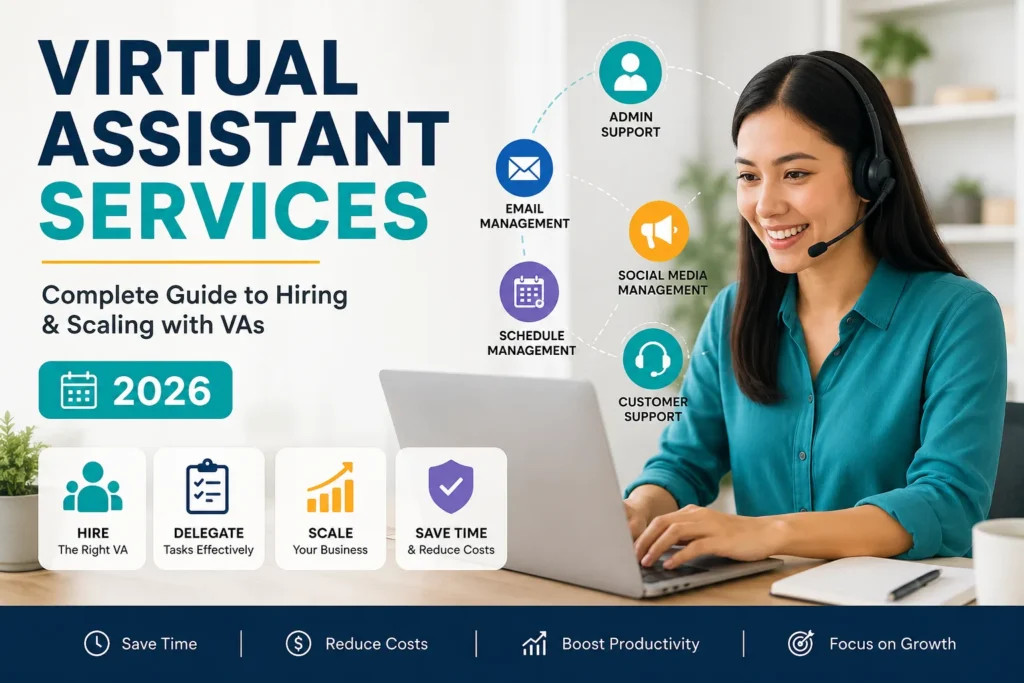
Related: How to Hire a Virtual Assistant: The Complete Guide for Business Owners (2026) | Call Center Outsourcing: Complete Guide to Customer Service BPO (2026) | Virtual Assistant Services: The Complete Guide to Hiring and Scaling with VAs (2026)
1. The Real Cost of “Doing It Yourself Administrative Work
Every founder, executive, and operations manager knows the feeling: it’s 9:47 PM, you’re still answering emails, updating a CRM, booking a flight for a client meeting, formatting a slide deck, and reconciling an expense report. The work is essential, but it isn’t the work that actually grows your business.
The math is brutal. According to the U.S. Bureau of Labor Statistics, the median annual wage for administrative assistants is $44,080 as of 2024, but that’s just the line item on a W-2 [R1]. The true cost of an in-house employee is typically 1.25x to 1.4x base salary once you add payroll taxes (7.65% FICA), workers’ compensation, health benefits ($6,000–$15,000 annually for single coverage), paid time off, equipment, software licenses, and recruiting fees.
For a mid-sized company, that means a single in-house administrative hire can quietly cost $60,000–$80,000 per year before they complete a single task. And here’s the part most business owners underweight: opportunity cost. If a senior leader is spending 10 hours per week on tasks a $20/hour VA could handle, and that leader’s time is worth $100/hour in revenue-generating activity, you’re burning roughly $41,600 per year in opportunity cost alone.
That’s why the question isn’t really “Can I afford to hire a VA? — it’s “Can I afford not to?
2. What Exactly Is a Virtual Administrative Assistant?
A virtual administrative assistant is a remote professional who performs the same scheduling, communication, data management, and coordination functions as an in-office admin — but operates from an off-site location, typically working within your existing tools and communication stack. Modern VAs are not “overseas mystery workers responding to mystery-shopper scams on LinkedIn; they are trained, vetted professionals embedded in your operations.
Distinctions matter here, because the market has matured significantly. There are now three primary models:
- Freelance VAs — independent contractors found on platforms like Upwork, Belay, or Time Etc. Great for low-volume, task-based work.
- Dedicated VA via a staffing agency — pre-vetted assistants matched to your workflow, often with a part-time or full-time contract structure.
- Managed BPO delivery — a partner like Procizo provides a dedicated VA inside a broader operational framework, with quality assurance, SOPs, redundancy, and performance reporting built in.
The model you choose dramatically affects ROI. A freelance VA on a $15/hour rate can appear cheap, but the hidden costs of onboarding, rework, turnover, and management time frequently erase the savings. A managed BPO relationship typically commands a higher hourly rate but produces 2–3x the reliable output per dollar because the operational infrastructure is already in place. To understand the broader context, see our guide on what BPO actually means in modern business.
3. The ROI Math: How to Calculate Your Own VA Investment
ROI is not a vibes-based metric. Before you engage any virtual assistant, you should be able to articulate the calculation. Here’s the framework I use with clients:
The Core Formula
VA ROI = (Recovered Executive Time + Tangible Cost Savings – Total VA Investment) ÷ Total VA Investment × 100
Let’s walk through a real example. Imagine you’re a consulting firm owner billing out at $150/hour, and you’re currently spending 12 hours per week on admin work you could delegate.
| Line Item | In-House Hire (Annual) | VA via BPO Partner (Annual) |
|---|---|---|
| Base wage / contract fee | $45,000 | $36,000 (avg. $18/hr × 2,000 hrs) |
| Payroll taxes (FICA, FUTA, SUTA) | $3,442 | $0 (contractor) |
| Health benefits | $9,600 | $0 |
| Equipment & software | $2,400 | $0 (uses own setup) |
| Recruiting / onboarding | $4,200 | $500 (provider handles) |
| Management overhead | $3,600 | $1,200 (BPO supervisor included) |
| Total fully loaded cost | $68,242 | $37,700 |
| Recovered executive time value (12 hrs/wk × $150 × 50 wks) | N/A | $90,000 recovered |
| Net Year-One ROI | — | +139% |
That 139% ROI figure is conservative. It doesn’t include reduced turnover costs, faster response times to clients, or the strategic value of an executive who is finally able to focus on revenue, partnerships, and growth. As the Deloitte Global Outsourcing Survey notes, organizations that systematically outsource non-core functions typically see 25–40% productivity gains in retained staff [R6].
4. Where VAs Deliver the Highest ROI: Five Operational Categories
Not all admin tasks are equally good candidates for VA delegation. Based on aggregated client data and industry benchmarks, here are the five categories that consistently deliver the strongest return on investment.
4.1 Calendar and Inbox Management
The average executive receives 120–150 emails per day and sits in 6–8 hours of meetings weekly [R7]. A skilled VA can triage your inbox, protect your calendar from low-value interruptions, and book complex multi-stakeholder meetings in minutes. The ROI here is enormous because every meeting that doesn’t happen, or happens with the right people in the right format, is recovered strategic time.
4.2 CRM Updates and Pipeline Hygiene
CRM data decays at roughly 30% per year without active maintenance [R8]. A VA dedicated to pipeline hygiene — logging calls, updating deal stages, cleaning duplicate records, sending follow-ups — directly increases sales-team close rates. Companies that maintain clean CRM data report 27% higher sales win rates [R8].
4.3 Data Entry and Document Processing
From invoice processing to contract abstraction to converting PDFs into structured datasets, data entry remains one of the most time-consuming and error-prone functions in any business. VAs trained in tools like Excel, Google Sheets, Airtable, and DocuSign can handle this at 3–5x the speed of an executive attempting the same work between meetings.
4.4 Travel and Event Coordination
Booking complex multi-leg travel, managing expense reconciliation, and coordinating logistics for off-sites or client events is a full-time job in itself. Outsourcing this to a VA typically saves 5–8 hours per trip and unlocks 10–20% in cost savings through better vendor management.
4.5 Research and Lead Generation Support
Building prospect lists, researching accounts, preparing briefing documents, and qualifying inbound leads are all tasks a VA can execute with clear playbooks. Many Procizo service lines include dedicated research support, which is often the first function to be delegated because the time savings are immediate and measurable.
5. Measuring Productivity Gains Beyond Direct Cost Savings
Most ROI conversations stop at “I paid $X and saved $Y. That’s a mistake. The deeper return from a strong VA engagement shows up in operational metrics you can actually instrument.
Track these four indicators over the first 90 days of a VA engagement:
- Executive hours reclaimed per week — measured by calendar blocks freed up and “shallow work eliminated from the leader’s week.
- Response time on client and prospect communications — VAs typically reduce first-response time by 60–80%, which has a measurable impact on client retention.
- CRM data completeness — measure the percentage of records with current contact info, accurate deal stages, and recent activity logs.
- Cycle time on internal processes — how long does it take to onboard a new client, process an invoice, or close out a month? VAs compress these cycles significantly when given proper SOPs.
When you manage these metrics month-over-month, the value of a VA engagement becomes a board-level conversation, not a line item. This is also the point at which the discussion naturally evolves from “hire a VA to “build a scalable operational backbone — which is precisely the conversation Procizo structures with its clients.
6. Common Mistakes That Erode VA ROI
I’ve seen engagements fail for predictable reasons. Avoid these five pitfalls, and you’ll be in the top quartile of outcomes.
Mistake #1: Hiring on Price Alone
The $4/hour VA on a freelance marketplace looks like a bargain until you factor in the time you spend correcting mistakes, the data breach risk, and the communication friction across time zones and language barriers. A $4/hour VA with 30% rework is more expensive than a $20/hour VA with 2% rework.
Mistake #2: No Documented SOPs
If you can’t describe the task in writing, you can’t delegate it. VAs need documented processes — even simple ones — to perform consistently. The companies that invest 2–3 hours in building SOPs at the start of an engagement save 50+ hours of back-and-forth over the following year.
Mistake #3: Treating the VA as Disposable
High turnover destroys ROI. The cost of recruiting, onboarding, and rebuilding trust with a new VA is often 3–6 months of the prior VA’s effective output. Aim for an engagement structure that incentivizes the VA to stay — full-time work, growth opportunities, and clear performance feedback.
Mistake #4: No Feedback Loop
Weekly 15-minute check-ins sound like overhead, but they are the single highest-leverage investment you can make. VAs who receive regular feedback improve their output 3x faster than those left to operate without guidance [R9].
Mistake #5: Ignoring Compliance and Data Security
If your VA is touching customer PII, financial data, or protected health information, you need a clear data-handling agreement, role-based access controls, and ideally a BPO partner with formal compliance certifications. The reputational cost of a breach is orders of magnitude higher than the savings from cutting compliance corners.
7. From VA to BPO: When You Outgrow a Single Assistant
Here’s a pattern I see constantly: a founder hires one VA, gets hooked on the time savings, then hires a second and a third. Six months later, they are running an informal staffing operation — onboarding VAs, managing payroll across multiple contractors, dealing with sick days and turnover, and trying to maintain quality across a fragmented team. The founder has accidentally become a VA agency.
This is the inflection point where a BPO partner becomes the right answer. At Procizo, we typically see clients reach this threshold at 2–4 VAs or when the work crosses into specialized domains like underwriting support, B2B lead research, or full-cycle back-office operations. A BPO partner absorbs the recruiting, training, QA, redundancy, and compliance burden, and replaces it with a service-level agreement.
The economics are also favorable. Most BPO engagements for admin and operational support run $8–$25 per hour, fully loaded, with guaranteed coverage and structured reporting. When you compare that to the hidden cost of managing multiple freelancers — or worse, hiring full-time in-house employees — the BPO model frequently wins on total cost of ownership within 60–90 days.
8. Building a Long-Term Administrative Strategy
Hiring a VA is not the goal. The goal is to design an operational layer that lets you and your leadership team spend 80%+ of your time on work only you can do. That requires more than a job posting.
A mature administrative strategy includes:
- Documented SOPs for every delegated task, updated quarterly.
- Tool stack integration — the VA should be fluent in your CRM, project management platform, communication tools, and document repository.
- Clear ownership boundaries — what the VA owns, what they escalate, and what they never touch.
- Performance metrics reviewed monthly against baseline.
- Contingency planning — what happens when the VA is unavailable?
When you build this layer intentionally, you move from “I have a VA to “I have an operations system that scales. That is the difference between a tactical cost-save and a strategic capability. To explore how this looks in practice with a structured delivery partner, start with Procizo’s approach to BPO delivery.
9. The Bottom Line: VA ROI Is a Strategy, Not a Transaction
The decision to hire a virtual administrative assistant is one of the highest-ROI moves a small or mid-sized business can make. The math is straightforward, the talent pool is deep, and the time-to-value is measured in weeks, not quarters. But the companies that capture the full 300–500% ROI are the ones that treat the engagement as a strategic capability — with clear scope, documented processes, performance measurement, and a partner that can scale as the business scales.
Whether you start with a single VA or move directly into a managed BPO relationship, the underlying principle is the same: your time is the most expensive line item on your P&L, and admin work is the easiest place to recover it. Spend a few hours this week documenting the tasks you want to delegate, calculate your own ROI using the framework above, and you’ll have a clear business case within a single afternoon.
If you’d like a partner who can help you build that operational layer end-to-end — from VA sourcing and SOP development to quality assurance and ongoing optimization — explore Procizo’s services or learn more about how we work with clients.
Challenge: An $8M e-commerce company was spending 30+ hours/week on admin tasks — email, scheduling, data entry, customer follow-ups. The CEO was overworked and missing growth opportunities.
Solution: Procizo provided 3 dedicated VAs — executive assistant (calendar/email), operations VA (order processing/inventory), and customer support VA (ticket triage).
Results (3 months):
- CEO recovered 25 hrs/week for business development
- Admin costs reduced 55% vs in-house hiring
- Email response: 48 hrs → 4 hrs
- Order accuracy: 92% → 99.5%
- Customer satisfaction: 3.8 → 4.6/5
Frequently Asked Questions
- 1. How much does a virtual administrative assistant cost in 2025?
- Hourly rates for U.S.-based VAs range from $20–$45/hour depending on specialization, while offshore VAs in the Philippines, India, or Latin America typically range from $6–$18/hour [R2]. A full-time VA (40 hours/week) costs between $12,000 and $90,000 annually. A managed BPO engagement typically falls between $8–$25/hour fully loaded, including backup coverage and quality assurance.
- 2. What is the typical ROI of hiring a VA?
- Most businesses that delegate 8–12 hours of weekly administrative work to a VA see a 200–500% ROI in the first year, driven by a combination of direct cost savings (vs. in-house hire) and recovered executive time valued at the leader’s billing or strategic rate [R3][R6].
- 3. What’s the difference between a virtual assistant and a BPO partner?
- A virtual assistant is typically an individual contractor. A BPO (Business Process Outsourcing) partner like Procizo provides a managed service with documented SOPs, dedicated supervisors, redundancy, performance SLAs, and often a team of specialists rather than a single assistant. BPO is the right answer when you’ve outgrown a single VA or need guaranteed coverage.
- 4. How do I avoid VA scams on LinkedIn and freelance platforms?
- Never pay upfront fees, never click on suspicious “training portal links sent via DMs, and never engage with profiles that have no verifiable work history. Reputable VAs have LinkedIn profiles with endorsements, real references, and verifiable prior employers. A managed BPO relationship eliminates this risk because the partner handles vetting.
- 5. What tasks should I delegate to a VA first?
- The highest-ROI starting tasks are calendar management, inbox triage, CRM data entry, travel booking, and expense reconciliation. These are time-consuming but low-risk, easy to document in SOPs, and immediately free up executive time for higher-value work.
- 6. How long does it take to onboard a VA?
- A freelance VA can be operational in 1–2 weeks. A BPO-managed VA, with documented SOPs and quality controls, typically takes 2–4 weeks to reach full productivity. Investing in proper onboarding and SOP development at the start is the single biggest determinant of long-term ROI.
- 7. Can a VA handle confidential or sensitive data?
- Yes, but only with appropriate safeguards. You should have a signed NDA, role-based access controls in your software, a clear data-handling policy, and ideally a partner with formal compliance certifications (SOC 2, HIPAA, GDPR) when sensitive data is involved.
- 8. Is hiring a VA only for small businesses?
- Not at all. According to industry surveys, 73% of companies — including many Fortune 1000 firms — use some form of virtual or remote administrative support [R5]. BPO engagements at the enterprise level routinely involve teams of 20–100+ VAs handling back-office operations.
- 9. How do I measure VA productivity?
- Track four metrics: (1) hours of executive time reclaimed per week, (2) average response time to client/prospect communications, (3) CRM data completeness, and (4) cycle time on recurring internal processes. Review monthly against a baseline captured before the VA started.
- 10. When should I move from a single VA to a BPO partner?
- When you have 2+ VAs, when the work requires specialized skills (e.g., underwriting, data engineering, lead research), or when continuity and compliance become critical to your operations. At that point, the overhead of managing multiple contractors exceeds the cost of a managed BPO relationship.
References
📚 Industry Sources: Bureau of Labor Statistics, Statista, IBISWorld.
- [R1] U.S. Bureau of Labor Statistics, Occupational Outlook for Secretaries and Administrative Assistants, 2024.
- [R2] Time Etc, Belay, and Upwork industry rate benchmarks, 2024–2025.
- [R3] McKinsey Global Institute, “The Social Economy: Unlocking Value and Productivity Through Inclusion, 2023.
- [R4] HfS Research / HFS+Everest Group, State of Outsourcing and BPO Operations, 2024.
- [R5] Grand View Research, Business Process Outsourcing Market Size Report, 2024.
- [R6] Deloitte, Global Outsourcing Survey, 2024.
- [R7] Microsoft Work Trend Index, “Will AI Fix Work? 2024.
- [R8] Salesforce, “The Hidden Cost of Bad CRM Data and InsideSales.com benchmark data.
- [R9] Gallup State of the American Workplace / Harvard Business Review, feedback frequency and performance research.
“`
Ready to Streamline Your Professional Outsourcing Solutions?
Procizo Outsourcing LLC provides end-to-end professional outsourcing solutions with transparent pricing, dedicated teams, and rapid onboarding. Start with a pilot engagement — no long-term commitment required.
No commitment required • 2-3 week onboarding • SOC 2 Type II security
Editorial Oversight: Content reviewed and approved by the Procizo Outsourcing LLC team based on internal research, operational experience, industry reports, and publicly available data.
Research Methodology: This content was created using a combination of Procizo Outsourcing LLC’s operational expertise, industry publications, academic research, government resources, and verified third-party sources.