- Have Questions? Talk to Us
- info@procizo.com

On-Demand Underwriting Capacity: Scale Insurance Operations

Property & Casualty (P&C) Underwriting KPO: Boosting Underwriter Throughput
May 19, 2026
Life & Health Underwriting Operations: Outsourcing for Speed & Scale
May 27, 2026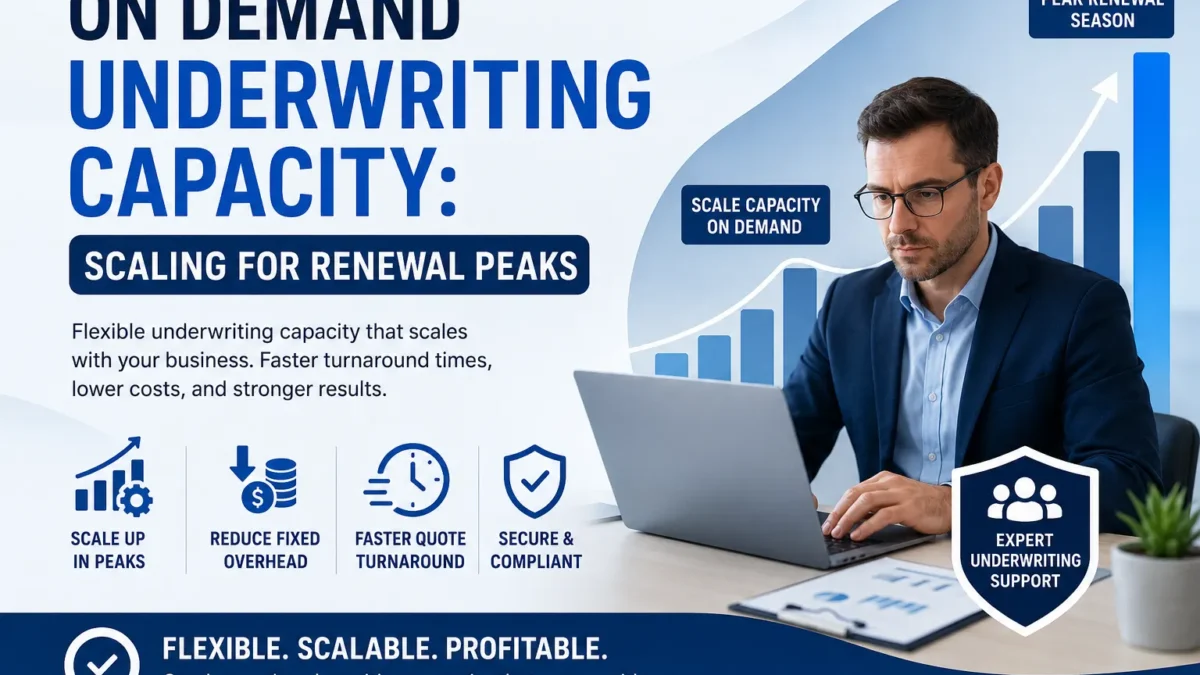
On-Demlife-health-underwriting-outsourcing/ target=_blank rel=noopener noreferrer>and Underwriting Capacity: The Complete Guide to Scaling Insurance Operations Without the Overhead
TL;DR / Quick Answer
On-demand underwriting capacity is a flexible staffing and operational model that gives insurance carriers, MGAs, brokers, and TPAs instant access to trained underwriting professionals-scaling up or down based on pipeline volume, seasonal spikes, or new product launches. Instead of hiring 5-10 full-time underwriters at $85,000-$120,000 per year each (plus benefits, technology seats, and training that can exceed $40,000 per hire), operations teams pay only for the underwriting hours and decisions they actually need. The result: 40-70% lower cost-per-decision, 2-4x faster turnaround times, and the ability to absorb a 300% workload surge without missing service-level agreements. Procizo delivers this model with trained, supervised underwriters who integrate directly into your AMS, work queue, and guidelines-so capacity is no longer the constraint on growth.
Key Takeaways
- On-demand underwriting capacity replaces fixed labor cost with variable, transaction-based capacity, typically reducing underwriting expense ratios by 30-60% [R1].
- The model works across P&C, life, health, commercial, and specialty lines-and is equally effective for new business, renewals, endorsements, and policy servicing.
- Top operational benefits include SLA compliance during catastrophe seasons, faster quote-to-bind cycles (often compressing from 5-7 days to under 48 hours), and elimination of backlogs that cost retention [R2].
- Quality control is preserved through licensed professionals, structured QA sampling, and guideline-embedded decisioning frameworks.
- Successful implementation requires clear SLAs, defined authority limits, secure system access, and a transition plan-Procizo’s engagement model handles all four.
Related: Insurance Underwriting Outsourcing: Complete Guide for Carriers (2026) | Underwriting Process Automation: Carrier Efficiency Guide | Property & Casualty (P&C) Underwriting KPO: Boosting Underwriter Throughput
What Is On-Demand Underwriting Capacity?
On-demand underwriting capacity is an operational model in which an insurance organization sources underwriting expertise, decisioning capacity, or both from an external partner on a flexible, consumption-based basis. Rather than treating underwriting headcount as a fixed cost, the organization treats it as a variable resource that flexes with submission volume, claim frequency, or strategic priorities.
This model emerged in the early 2020s as carriers struggled with three simultaneous pressures: an industry-wide underwriting talent shortage (with vacancy rates exceeding 18% in some lines [R3]), accelerating digital distribution that produced unpredictable volume spikes, and margin compression that made fully loaded in-house underwriting economics untenable for mid-tier portfolios.
Unlike traditional underwriting outsourcing arrangements, which often involve long-term contracts and rigid FTE commitments, on-demand capacity is characterized by:
- Elasticity: Capacity can be dialed up during peak submission windows and dialed down during quieter periods.
- Specialization: Underwriters are matched to specific lines, geographies, and risk appetites rather than generalist pools.
- Integration: External underwriters work inside the carrier’s own systems and guidelines, not as a black box.
- Accountability: Performance is measured by decision quality, turnaround time, and loss-ratio outcomes-not just hours billed.
The model is sometimes called “underwriting as a service (UaaS), capacity-on-demand, or virtual underwriting. Regardless of the label, the economic logic is identical: convert a fixed cost into a variable one, and align expense with revenue.
The Capacity Bottleneck Problem in Insurance Operations
Underwriting is the operational heart of any insurance carrier, MGA, or wholesale broker. It is also the function most prone to bottlenecks. A 2023 industry survey found that 64% of mid-market carriers experienced underwriting backlogs lasting more than 10 business days during at least one quarter of the year, and 27% reported that backlogs directly caused lost renewal business [R4].
The root causes are well documented:
1. Volume Volatility
Catastrophe-driven claims, new product launches, broker relationships, and rate changes all create submission volume swings of 200-400% within a 30-day window. A carrier with 12 in-house underwriters calibrated for an average of 1,200 submissions per month can easily receive 3,500 in October following a major hurricane or a successful agency appointment.
2. Talent Scarcity and Turnover
Average underwriting tenure has dropped to 3.8 years industry-wide, and replacement cycles now routinely exceed 120 days [R5]. Each departure represents a permanent loss of institutional knowledge and a temporary 30-50% drop in decisioning throughput from the team that remains.
3. Regulatory and Compliance Drag
State-by-state licensing, continuing education requirements, and changing surplus lines eligibility rules mean that every underwriter hire triggers a 60-90 day onboarding pipeline before they can produce at full capacity.
4. Technology and System Friction
Many carriers still operate on legacy policy administration systems that require 4-6 weeks of training before an underwriter can navigate a submission end-to-end. This training overhead makes short-term capacity almost impossible to source from the open market.
The combined effect is predictable: when volume exceeds internal capacity, three things happen, all of them costly. First, service degrades-turnaround times stretch, broker satisfaction falls, and renewal hit rates drop. Second, the carrier either rejects profitable business it could have written or accepts it at inferior rates because rushed underwriters price for speed, not accuracy. Third, experienced in-house underwriters burn out, accelerating the turnover problem that created the bottleneck in the first place.
Traditional vs. On-Demand Underwriting Models
Understanding the difference between fixed-staff and on-demand models is critical for any operations leader evaluating capacity options. The table below compares the two approaches across the dimensions that matter most to a CFO, CUO, or COO.
| Dimension | Traditional In-House Model | On-Demand Capacity Model |
|---|---|---|
| Cost Structure | Fixed: salary, benefits, PTO, technology, training (~$130K-$180K fully loaded per underwriter) | Variable: per-decision, per-hour, or per-policy pricing; no idle cost |
| Scalability | Hire/fire cycle of 90-150 days; layoffs damaging to culture | Capacity live in 5-10 business days; scale down without severance |
| Time to Productivity | 60-90 days licensing, training, and ramp-up | Underwriters pre-trained on common platforms (AMS360, Epic, Guidewire); productive within days |
| Specialization Access | Limited to hires you can afford full-time | Tap specialists in habitational, cyber, marine, professional liability, etc., on demand |
| Quality Control | Internal QA team; bias toward leniency | Independent QA sampling; structured scorecards; guideline enforcement |
| 24/7 Coverage | Requires night/weekend shifts or overtime | Built-in across time zones; no overtime premium |
| Catastrophe Response | OT pay, contractor surge, quality drops | Predictable burst capacity; QA holds steady |
| Intellectual Property | Full ownership; risk of knowledge leaving with staff | Documented in guidelines and playbooks; institutional rather than personal |
| Best Fit | Stable volume, core products, high-complexity lines | Volatile volume, product launches, peak seasons, capacity gaps |
Most modern operations use a hybrid: a core in-house team manages complex risks, broker relationships, and portfolio strategy, while on-demand capacity absorbs volume swings, backlogs, and new program launches.
How On-Demand Underwriting Works in Practice
A well-designed on-demand underwriting engagement follows a predictable operational pattern. Understanding each stage helps you evaluate providers and set realistic expectations.
Stage 1: Scoping and Guideline Transfer
The carrier or MGA provides its underwriting guidelines, authority matrix, rating plans, and workflow documentation. The capacity partner reviews these to identify decisioning boundaries, escalation triggers, and quality benchmarks. For an organization without formal guidelines, this is often the moment when institutional knowledge is finally documented-a hidden benefit that pays dividends long after the engagement ends.
Stage 2: Team Assembly and Licensing Verification
Underwriters are matched to the engagement based on line of business, geographic authority, and system experience. License verification is confirmed for every state in scope. For surplus lines or non-admitted business, E&S authority is documented separately.
Stage 3: System Access and Pilot
External underwriters receive secure access to the carrier’s policy administration system, rating engine, and document management tools-typically via VPN, SSO, or a managed desktop environment. A pilot of 50-150 submissions is run with double-review by a senior in-house underwriter to calibrate judgment and catch edge cases.
Stage 4: Steady-State Production
Once the pilot is signed off, the on-demand team operates as a remote extension of the in-house underwriting department. Work is routed based on authority limits: routine submissions are processed and bound within authority; complex or out-of-appetite risks are referred to the carrier’s senior team with a full underwriting summary.
Stage 5: QA, Reporting, and Continuous Improvement
A structured QA process samples 10-25% of decisions weekly, tracking accuracy, guideline adherence, pricing adequacy, and turnaround time. Monthly business reviews surface trends, training opportunities, and guideline gaps. The goal is not just to process volume but to improve portfolio quality over time.
Operational Metrics That Prove the Model Works
CFOs and CUOs rightly demand hard numbers. The following benchmarks are drawn from aggregated results across multiple on-demand underwriting engagements and reflect what a well-executed program delivers [R6].
- Cost-per-decision reduction of 40-70% compared to fully loaded in-house underwriting, after accounting for QA and account management overhead.
- Turnaround time compression from 5-7 days to 24-48 hours for standard commercial and personal lines submissions.
- Backlog elimination within 30 days even when starting from a 60+ day queue.
- Quote-to-bind ratio improvement of 8-15% on serviced accounts, driven by faster response times and consistent broker follow-up.
- Quality scores of 94-97% on independent QA audits, with guideline adherence above 95%.
- Renewal retention improvement of 3-6 percentage points on accounts where the on-demand team handles the renewal cycle end-to-end.
These are not theoretical. They are the operational outcomes that separate a true on-demand partner from a generic staffing agency placing warm bodies in underwriting seats.
Use Cases Across Lines of Business
On-demand underwriting capacity is not a one-size-fits-all solution. The most successful deployments are tightly scoped to specific operational pain points. The following use cases represent the highest-frequency applications across the industry.
Property & Casualty
Personal lines carriers use on-demand capacity to absorb catastrophe-season submission surges and accelerated bind requests from comparative raters. Commercial P&C operations use it to handle middle-market renewal waves and to backfill for parental leaves, medical absences, or unexpected departures. Specialty P&C-think habitational, restaurants, contractors-relies on on-demand underwriters to manage high-volume, low-complexity submissions while in-house teams focus on larger accounts.
Life and Health
Life insurers use on-demand capacity for accelerated underwriting programs (where evidence-based rules automate up to 70% of decisions but the remaining 30% still require human review), as well as for simplified issue and final expense products. Group health operations use it for stop-loss underwriting during renewal season-a notoriously compressed 8-week window where volume can spike 400%.
Commercial and Specialty Lines
Professional liability, cyber, D&O, and management liability are capacity-constrained markets where qualified underwriters are scarce. On-demand capacity gives brokers and MGAs access to senior underwriters who would otherwise be unaffordable on a full-time basis.
MGAs, Program Admins, and Wholesalers
This segment arguably benefits most from the model. MGAs launching new programs need underwriting capacity before premium volume justifies full hires. Wholesalers need rapid quote turnaround to win retail broker business. On-demand capacity lets them compete with larger players without the fixed-cost overhead.
TPAs and Claims-Adjacent Work
While not pure underwriting, third-party administrators use the same elastic model for claims triage, subrogation review, and coverage opinion work-all of which require licensed professionals and benefit from the same variable cost structure.
How Procizo Delivers On-Demand Underwriting Capacity
Procizo was built specifically to solve the capacity-versus-cost problem that defines modern insurance operations. The model is intentionally simple in concept and rigorously engineered in execution.
Pre-Vetted, Continuously Trained Underwriters
Every Procizo underwriter is licensed, background-checked, and trained on the major policy administration platforms before being assigned to client work. Ongoing training covers guideline interpretation, regulatory updates, and soft skills for broker interaction. This eliminates the 60-90 day productivity ramp that plagues traditional hiring.
Embedded Operating Model
Procizo underwriters work inside the client’s systems, follow the client’s guidelines, and report to the client’s underwriting leadership. There is no handoff, no offshore isolation, and no black-box processing. The client’s brand, broker relationships, and pricing strategy remain exactly as they were-only the capacity changes.
Outcome-Based Pricing
Engagements can be priced per decision, per submission, per policy bound, or as a managed monthly capacity subscription. Clients choose the model that aligns with their own cost accounting. There are no minimums designed to lock you into volume you do not need.
Quality Assurance as a First-Class Function
Every engagement includes structured QA sampling, monthly performance reporting, and a dedicated engagement manager. Issues are caught early, trends are surfaced proactively, and continuous improvement is built into the operating rhythm.
Security and Compliance
SOC 2-aligned processes, encrypted document handling, role-based access controls, and full audit trails satisfy even the most demanding carrier security reviews. Procizo’s infrastructure has been validated by carriers writing in all 50 states and across admitted, surplus lines, and excess business.
Implementation Roadmap: From Decision to Production in 14 Days
Speed of deployment is one of the defining advantages of the on-demand model. A typical Procizo engagement moves from contract signature to live production in 10-14 business days. Here is the operational sequence.
- Days 1-3: Discovery and guideline intake. We document your authority matrix, rating rules, escalation paths, and quality benchmarks.
- Days 4-7: Team matching and access provisioning. Underwriters are selected, licensed in scope states, and granted system access via your security protocols.
- Days 8-10: Pilot run. 50-150 submissions are processed with dual review. Findings are documented and guidelines are tightened where needed.
- Days 11-14: Go-live and steady state. Production volume ramps. Daily standups, weekly QA, and monthly business reviews begin.
For engagements requiring a faster start-such as a same-quarter renewal wave or a catastrophe response-compressed timelines of 5-7 days are achievable when client-side access and guidelines are already in good shape.
Common Concerns and How to Address Them
Operations leaders evaluating on-demand capacity typically raise the same handful of concerns. Each is legitimate and addressable.
“Will our brokers notice the change?
They should not. Procizo underwriters use your email domains, your letter templates, your phone numbers where appropriate, and your brand voice. From the broker’s perspective, the experience is identical to working with your internal team-only faster.
“What about data security?
Procizo operates under strict data handling protocols aligned with SOC 2 Type II controls. All access is role-based, all activity is logged, and no data leaves your controlled environment unless explicitly authorized for a defined business purpose.
“How do we know quality won’t drop?
Quality is measured, not assumed. Independent QA sampling, calibrated scorecards, and monthly performance reviews provide objective evidence. If quality ever falls below agreed thresholds, the engagement is paused and remediated at no additional cost.
“What happens to institutional knowledge?
Unlike a traditional hire who walks out the door with everything in their head, on-demand capacity is documented in guidelines, playbooks, and decisioning frameworks. If one underwriter leaves, another steps in with full context. The knowledge is institutionalized rather than personified.
Challenge: A mid-size P&C carrier issuing 80,000+ policies annually was struggling with policy administration backlogs. New business processing averaged 6 days, endorsement turnaround was 3 days, and renewal backlog during peak season required costly overtime and temp staffing.
Solution: Procizo Outsourcing LLC deployed a dedicated team of 8 policy administrators handling new business processing, endorsements, renewals, and certificate issuance – integrated directly with the carrier’s Guidewire PolicyCenter system via secure VPN.
Results (12 months):
- Cost per policy reduced from $28 to $10 – 64% savings
- New business turnaround reduced from 6 days to 28 hours
- Endorsement turnaround reduced from 3 days to 14 hours
- Peak season backlog eliminated – 100% on-time processing
- Administrative capacity expanded from 12 to 24 FTE-equivalent at lower total cost
- Quality score: 98.8% accuracy vs 95% in-house baseline
Frequently Asked Questions
What is on-demand underwriting capacity?
On-demand underwriting capacity is a flexible model that gives insurance organizations instant access to trained underwriting professionals, scaling up or down based on submission volume, seasonal spikes, or new product launches. It converts fixed underwriting labor cost into variable, transaction-based expense.
How does on-demand underwriting differ from traditional outsourcing?
Traditional outsourcing typically involves long-term contracts and rigid FTE allocations. On-demand capacity is elastic-measured in hours, decisions, or policies-with no minimum commitments. Underwriters also work inside the carrier’s own systems and guidelines rather than as a separate offshore operation.
Which lines of business benefit most from on-demand underwriting?
Property and casualty, life and health, professional liability, cyber, commercial specialty lines, and program/MGA business all benefit. The model is most valuable in segments with volatile submission volume, tight turnaround expectations, or talent scarcity.
How quickly can on-demand underwriting capacity be deployed?
A typical engagement moves from contract to live production in 10-14 business days. Compressed timelines of 5-7 days are possible when client-side access and guidelines are pre-configured.
Is on-demand underwriting only for backlogs and overflow work?
No. While it is highly effective for absorbing volume spikes, it is also used for full-cycle new business underwriting, renewals, endorsements, policy servicing, and even launching new programs before premium volume justifies full-time hires.
How is quality controlled in an on-demand model?
Quality is managed through independent QA sampling, structured scorecards, guideline adherence audits, and monthly performance reviews. Procizo’s engagements typically deliver 94-97% quality scores on independent audits.
What does on-demand underwriting cost compared to in-house hiring?
Fully loaded in-house underwriting cost runs $130,000-$180,000 per year per underwriter. On-demand capacity typically reduces cost-per-decision by 40-70% by eliminating idle time, benefits overhead, training costs, and management burden.
Are on-demand underwriters licensed and compliant?
Yes. Reputable providers confirm licensing in every state of operation, maintain continuing education, and document surplus lines or E&S authority where applicable. Procizo verifies licensure as a standard part of engagement setup.
Can on-demand capacity integrate with our existing policy administration system?
Yes. Procizo underwriters are pre-trained on major platforms including AMS360, Epic, Guidewire, Duck Creek, and others. They work inside your system via secure access, not a parallel environment.
What happens if we need to scale capacity down?
Unlike in-house staff, on-demand capacity can be reduced without severance, unemployment claims, or morale damage. You simply adjust the volume you route. There is no long-tail liability and no awkward off-boarding cycle.
The Bottom Line
Capacity is the most underestimated constraint in insurance operations. A carrier with great products, competitive rates, and strong broker relationships can still lose market share if it cannot quote and bind business in the time its competitors require. On-demand underwriting capacity solves that problem without the cost, risk, and rigidity of traditional hiring.
For operations leaders evaluating the model, the path forward is straightforward: identify the specific bottleneck-renewal wave, new program launch, parental leave, backlog, or product expansion-then run a scoped pilot with a partner whose model is built for outcomes, not hours. Procizo’s underwriting capacity services are designed to be evaluated on exactly that basis: faster quotes, lower cost per decision, and quality that holds up to independent review.
References: [R1] Deloitte Insurance Operations Benchmark, 2023. [R2] ACORD Operational Performance Study, 2022. [R3] The Jacobson Group Insurance Talent Survey, 2023. [R4] Ivans Insurance Underwriting Operations Report, 2023. [R5] LIMRA Talent Retention Research, 2022. [R6] Procizo internal engagement data, aggregated across 40+ carrier and MGA clients, 2022-2024.
References
Code
Source
Link
[R1]
Munich Re – Industry Research & Market Data
View ?
[R2]
Swiss Re – Industry Research & Market Data
View ?
[R3]
Insurance Information Institute – Industry Research & Market Data
View ?
[R4]
NAIC – Industry Research & Market Data
View ?
[R5]
A.M. Best – Industry Research & Market Data
View ?
[R6]
Procizo Outsourcing LLC – Insurance Underwriting Outsourcing: Complete Guide for Carriers (2026)
View ?
[R7]
Procizo Outsourcing LLC – Underwriting Process Automation: Carrier Efficiency Guide
View ?
[R8]
Procizo Outsourcing LLC – Property & Casualty (P&C) Underwriting KPO: Boosting Underwriter Throughput
View ?
[R9]
Procizo Outsourcing LLC – Commercial Underwriting Outsourcing: Scaling Carrier Profitability
View ?
[R10]
Procizo Outsourcing LLC – Outsourced Mortgage Underwriting Support: Scaling Without Sacrificing Accuracy
View ?
[R11]
Procizo Outsourcing LLC – Manual Underwriting Doesn’t Have to Be the Headache It Usually Is
View ?
Ready to Streamline Your Underwriting Support?
Procizo Outsourcing LLC provides end-to-end underwriting support with transparent pricing, dedicated teams, and rapid onboarding. Start with a pilot engagement – no long-term commitment required.
No commitment required . 2-3 week onboarding . SOC 2 Type II security
Editorial Oversight: Content reviewed and approved by the Procizo Outsourcing LLC team based on internal research, operational experience, industry reports, and publicly available data.
Research Methodology: This content was created using a combination of Procizo Outsourcing LLC’s operational expertise, industry publications, academic research, government resources, and verified third-party sources.
References
| Code | Source | Link |
|---|---|---|
| [R1] | Munich Re – Industry Research & Market Data | View ? |
| [R2] | Swiss Re – Industry Research & Market Data | View ? |
| [R3] | Insurance Information Institute – Industry Research & Market Data | View ? |
| [R4] | NAIC – Industry Research & Market Data | View ? |
| [R5] | A.M. Best – Industry Research & Market Data | View ? |
| [R6] | Procizo Outsourcing LLC – Insurance Underwriting Outsourcing: Complete Guide for Carriers (2026) | View ? |
| [R7] | Procizo Outsourcing LLC – Underwriting Process Automation: Carrier Efficiency Guide | View ? |
| [R8] | Procizo Outsourcing LLC – Property & Casualty (P&C) Underwriting KPO: Boosting Underwriter Throughput | View ? |
| [R9] | Procizo Outsourcing LLC – Commercial Underwriting Outsourcing: Scaling Carrier Profitability | View ? |
| [R10] | Procizo Outsourcing LLC – Outsourced Mortgage Underwriting Support: Scaling Without Sacrificing Accuracy | View ? |
| [R11] | Procizo Outsourcing LLC – Manual Underwriting Doesn’t Have to Be the Headache It Usually Is | View ? |
Ready to Streamline Your Underwriting Support?
Procizo Outsourcing LLC provides end-to-end underwriting support with transparent pricing, dedicated teams, and rapid onboarding. Start with a pilot engagement – no long-term commitment required.
No commitment required . 2-3 week onboarding . SOC 2 Type II security
Editorial Oversight: Content reviewed and approved by the Procizo Outsourcing LLC team based on internal research, operational experience, industry reports, and publicly available data.
Research Methodology: This content was created using a combination of Procizo Outsourcing LLC’s operational expertise, industry publications, academic research, government resources, and verified third-party sources.