- Have Questions? Talk to Us
- info@procizo.com

What Is a BPO Company? Choose the Right BPO Partner

The US “National Outsourcing Association” Myth & How to Vet Offshore Partners
April 11, 2026
Why Top Software Outsourcing Companies are the Key to Scaling in 2026
April 20, 2026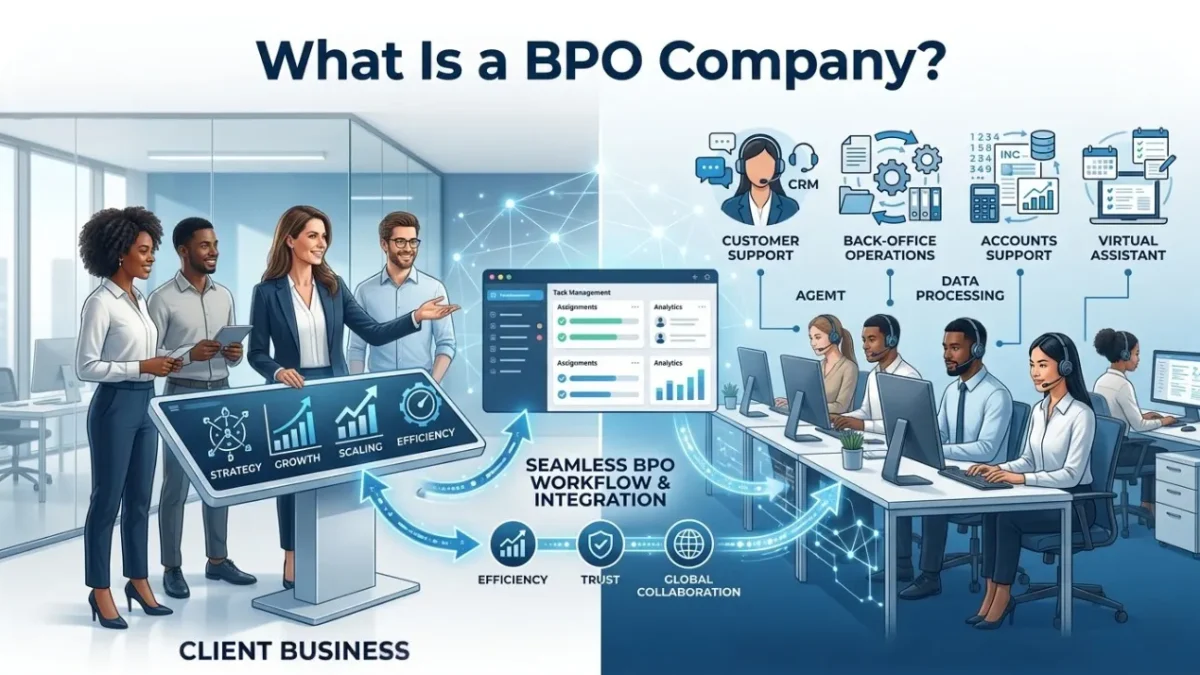
href=https://procizo.com/our-services/ target=_blank rel=noopener noreferrer>ourcing/ target=_blank rel=noopener noreferrer>What Is a BPO Company? A Complete Guide to Choosing the Right BPO Partner in 2025
TL;DR — Quick Answer
A Business Process Outsourcing (BPO) company is a third-party service provider that takes ownership of specific business functions—ranging from data entry and customer support to finance, accounting, and underwriting—on behalf of another organization. Businesses outsource these processes to reduce operating costs (typically 30–60%), gain access to specialized talent, scale capacity on demand, and refocus internal teams on revenue-generating work. The right BPO partner is not the cheapest vendor; it is the one with the deepest process discipline, the strongest security posture, and the clearest path to measurable ROI. Procizo positions itself as that partner for organizations where accuracy, compliance, and process integrity are non-negotiable—especially in financial services, lending, insurance, and data-driven back-office operations.
Key Takeaways
- The global BPO market reached $302 billion in 2024 and is projected to grow at a 9.4% CAGR through 2030 [R1].
- Outsourcing back-office functions typically cuts operational costs by 30–60% while improving accuracy by 15–25% [R2].
- Customer support outsourcing alone represents a $110+ billion global segment, with finance and accounting outsourcing close behind at $53 billion [R1].
- The most common BPO failure is not poor service—it is mismatched scope, undefined SLAs, and weak governance frameworks.
- Modern BPOs differentiate on process engineering, data security, and technology enablement—not just labor arbitrage.
What Is a BPO Company? A Working Definition
A BPO company (Business Process Outsourcing provider) is an external firm that assumes responsibility for executing defined business processes under a contractual service agreement. These processes can be as narrow as a single workflow—such as invoice data entry—or as broad as an entire department, such as a 200-seat customer support operation.
Unlike a software vendor that delivers a tool, a BPO delivers outcomes. The client defines the expected result (e.g., “process 5,000 loan files per month with 99.5% accuracy), and the BPO designs, staffs, and operates the workflow to hit that target. Pricing is typically per-transaction, per-FTE (full-time equivalent), or per-hour, depending on the engagement model.
BPO engagements are generally categorized into three tiers:
- Back-office BPO: Internal-facing processes like data entry, document processing, finance and accounting, and underwriting support.
- Front-office BPO: Customer-facing processes like contact center operations, technical support, and sales enablement.
- Knowledge process outsourcing (KPO): Higher-cognition work such as market research, financial analysis, and compliance review.
For most mid-market and growth-stage companies, back-office and front-office BPO are where the fastest, most measurable ROI lives. A well-run BPO company can absorb process volume spikes, fill skill gaps, and deliver consistency that internal teams often struggle to maintain during growth phases.
Related: How to Hire a Virtual Assistant: The Complete Guide for Business Owners (2026) | Call Center Outsourcing: Complete Guide to Customer Service BPO (2026) | Virtual Assistant Services: The Complete Guide to Hiring and Scaling with VAs (2026)
The Evolution of BPO: From Cost-Cutting to Strategic Partnership
The BPO industry has undergone three distinct phases. Understanding them helps you evaluate today’s providers against a more informed lens.
Phase 1: Labor Arbitrage (1990s–2005)
The first wave of BPO was almost entirely about cost. Companies moved call centers and data entry operations to regions with lower wage structures. The value proposition was simple: same work, lower cost. Quality was inconsistent, and the relationship was transactional.
Phase 2: Process Standardization (2006–2015)
As offshore markets matured, BPOs began investing in Six Sigma, ISO certifications, and documented process playbooks. Clients started outsourcing entire functions—not just tasks—because providers could demonstrate repeatable, auditable execution. This era introduced SLAs (Service Level Agreements) as a standard contract component.
Phase 3: Intelligent Automation Partnership (2016–Present)
Today’s BPOs integrate robotic process automation (RPA), AI-assisted quality monitoring, and cloud-based workflow platforms. The top-performing providers operate as strategic partners—co-designing processes, owning KPIs, and continuously optimizing through data. The global intelligent process automation market is expected to reach $51.6 billion by 2030, growing at 13.6% CAGR [R3].
This evolution matters because the type of BPO you choose should match your operational maturity. If you need simple, high-volume task execution, a Phase 1 or 2 provider may suffice. If you’re scaling a regulated operation and need accuracy-first delivery, you need a partner operating at Phase 3—and that’s the space where Procizo operates.
Core BPO Service Categories (And What Each One Actually Delivers)
Not all BPO services are created equal. Here is a breakdown of the most common categories, what they include, and the operational outcomes that matter.
| Service Category | Typical Functions | Primary Value Driver | Average Cost Reduction | Common Industries |
|---|---|---|---|---|
| Data Entry & Data Processing | Manual data capture, document digitization, form processing, database management | Accuracy and throughput | 40–60% | Healthcare, lending, insurance, logistics |
| Customer Support Outsourcing | Inbound/outbound calls, email support, live chat, ticket resolution | 24/7 coverage and CSAT scores | 30–50% | SaaS, e-commerce, telecom, financial services |
| Finance & Accounting Outsourcing | AP/AR, bookkeeping, payroll, reconciliation, tax prep support | Compliance and close-cycle speed | 35–55% | Mid-market companies, CPA firms, startups |
| Underwriting & Lending Support | Loan file review, MCA underwriting, credit analysis, compliance checks | Decision accuracy and turnaround time | 25–45% | Banks, MCA lenders, fintech, private credit |
| Back-Office Operations | Document management, order processing, vendor coordination, admin workflows | Operational continuity | 30–50% | All industries |
| Knowledge Process Outsourcing (KPO) | Market research, data analytics, legal research, compliance review | Specialized expertise | 20–35% | Consulting, legal, pharma, investment |
For organizations evaluating BPO services, the right starting point is identifying which category your highest-cost, lowest-differentiation work falls into. That is almost always the best first outsourcing candidate.
Top 7 Benefits of Partnering With the Right BPO Company
Cost savings are the headline, but the operational benefits run much deeper. Here is what high-performing BPO engagements actually deliver.
- Cost Predictability: Converting fixed labor costs into variable, per-transaction pricing improves margin forecasting. Most BPO engagements deliver ROI within 3–6 months [R2].
- Scalability Without Hiring Cycles: A BPO can add 50 trained operators in 2–4 weeks. Doing that internally typically takes 3–6 months when you include recruiting, onboarding, and tooling.
- Access to Specialized Talent: Top-tier BPOs employ certified accountants, trained underwriters, and experienced customer support specialists—talent that is expensive and difficult to retain in-house.
- Improved Accuracy and Compliance: Dedicated quality assurance teams, layered review workflows, and audit trails drive 15–25% accuracy improvements over typical internal operations [R2].
- 24/7 Operational Coverage: For customer-facing functions, offshore or nearshore BPOs provide round-the-clock service without the cost of a distributed internal team.
- Technology Without the Build Cost: Leading BPOs come equipped with RPA tools, workflow platforms, and analytics dashboards—saving clients $500K–$2M in platform investment.
- Focus on Core Competencies: Leadership teams reclaim 20–30% of their bandwidth when back-office operations are externally managed, allowing focus on growth, product, and strategy.
How to Evaluate a BPO Partner: 9 Operational Criteria That Actually Matter
Most BPO selection processes over-index on price and under-index on the criteria that determine long-term success. Here is the framework we recommend.
1. Domain Experience
Have they operated in your industry for at least 3 years? Ask for case studies with named metrics—not just logos. A BPO that excels in e-commerce may struggle in regulated lending. MCA underwriting support, for example, requires specific familiarity with stacking analysis, bank statement parsing, and compliance documentation that a generic BPO simply will not have.
2. Security and Compliance Posture
Demand SOC 2 Type II, ISO 27001, or industry-specific certifications (HIPAA for healthcare, PCI-DSS for payments). Ask about their data handling protocols, access controls, and breach response procedures. The average cost of a data breach reached $4.88 million in 2024 [R4]—security is not optional.
3. Technology Stack
What workflow management platform do they use? Do they offer real-time dashboards? Can they integrate with your existing systems via API, SFTP, or direct database connections? Avoid providers whose primary technology is email and Excel.
4. Quality Assurance Methodology
How many layers of review exist? What is their sampling methodology for QA? What is their historical accuracy rate, and how is it measured? Best-in-class BPOs maintain 99%+ accuracy with statistical process control charts.
5. Transition and Onboarding Plan
A well-run BPO transition takes 4–8 weeks. If a provider promises immediate production without a documented knowledge transfer plan, that is a red flag. Ask for a sample transition timeline and references from clients who onboarded in the last 12 months.
6. Pricing Transparency
The pricing model should be clearly defined with no hidden costs. See the next section for a full breakdown of BPO pricing models.
7. Scalability and Flexibility
What happens when your volume doubles? Can they flex down during seasonal lulls? Contract terms should allow volume adjustments within a defined band (typically ±25%) without renegotiation.
8. Communication and Governance
Who is your day-to-day point of contact? How often do they report? What escalation path exists when something goes wrong? Governance cadence should include weekly operational reviews, monthly business reviews, and quarterly strategic alignment.
9. Cultural and Geographic Fit
Time zone overlap, language fluency, and cultural alignment matter more than most buyers assume. A 4–6 hour overlap with your headquarters is typically the minimum for smooth collaboration.
Common BPO Pitfalls and How to Avoid Them
Industry data suggests that 30–40% of BPO engagements underperform or fail within the first 18 months [R5]. The reasons are remarkably consistent.
Pitfall 1: Outsourcing a Broken Process
BPOs optimize, they do not fix. If your internal process is undocumented, inefficient, or dependent on tribal knowledge, outsourcing it will simply multiply the dysfunction. Document and stabilize the process first.
Pitfall 2: Choosing on Price Alone
The lowest bidder is rarely the lowest total cost. Poor accuracy creates rework, rework creates cost, and rework destroys client relationships. Evaluate on cost-per-successful-outcome, not cost-per-hour.
Pitfall 3: Vague SLAs
“High quality and “fast turnaround are not SLAs. Demand specific, measurable targets: 99.5% accuracy on data entry, 4-hour response time on customer tickets, 48-hour close on monthly books. Tie a portion of fees to SLA performance.
Pitfall 4: Underinvesting in Transition
Clients who dedicate 2–3 internal subject matter experts to the transition phase see 40% faster time-to-value than those who treat onboarding as a vendor-only responsibility.
Pitfall 5: Set-and-Forget Governance
BPOs require active management. The most successful clients treat the BPO relationship as a partnership with continuous improvement, not a vendor contract that runs on autopilot.
BPO Pricing Models Decoded
Understanding pricing structure is critical for accurate ROI modeling. Here are the four most common BPO pricing models.
| Pricing Model | How It Works | Best For | Risk Profile |
|---|---|---|---|
| Per-FTE (Full-Time Equivalent) | Fixed monthly fee per dedicated resource | Stable, ongoing workloads | Low for client; moderate for BPO if volume drops |
| Per-Transaction | Fee per unit processed (e.g., per invoice, per loan file) | Variable volume, clearly defined outputs | Low for client; BPO exposed to inefficiency |
| Per-Hour | Hourly billing for actual time worked | Project-based or unpredictable work | Moderate; requires time-tracking discipline |
| Hybrid / Tiered | Base management fee + per-transaction variable component | Complex, multi-workflow engagements | Balanced; aligns both parties to efficiency |
For most mid-market and growth-stage clients, a per-transaction or hybrid model delivers the best alignment because it ties the BPO’s revenue directly to your operational output. If accuracy drops, your cost-per-correct-output rises, creating a natural incentive for the BPO to maintain quality.
Why Procizo Is the BPO Partner Built for Accuracy-First Operations
Not every BPO engagement is the same. If your operation requires decision-grade accuracy—where an error costs money, violates compliance, or damages a customer relationship—you need more than a staffing vendor. You need a partner that treats process integrity as a core deliverable.
Procizo was built for exactly that. Our model combines trained, domain-specific operators with layered quality assurance, real-time workflow visibility, and security protocols that meet the standards of regulated industries. We work with lenders, financial service providers, insurance carriers, and growth-stage companies where the cost of a mistake is too high to tolerate the “close enough approach common in commodity BPO.
Whether you need back-office support, finance and accounting outsourcing, customer support operations, or specialized process execution like MCA underwriting, our engagement model is designed to deliver measurable accuracy from week one—not after a six-month ramp.
Learn more about our approach and the team behind Procizo, or explore our BPO service overview to see how we can support your specific operation.
Challenge: A company processing 5,000+ monthly transactions had an in-house back office team of 15. Costs rose 12% annually, turnover was 35%, and transaction processing averaged 4 days.
Solution: Procizo deployed 10 skilled BPO processors handling document processing, data entry, verification, and reporting — integrated within 2 weeks.
Results (6 months):
- Cost per transaction: $8.50 → $3.80 (55% savings)
- Turnaround: 4 days → 12 hours (87% faster)
- Monthly capacity: 5,000 → 9,000+
- Accuracy: 94% → 99.2%
- Client retention: 98%
Frequently Asked Questions About BPO Companies
- 1. What does BPO stand for?
- BPO stands for Business Process Outsourcing. It refers to the practice of contracting a third-party provider to manage and execute one or more business functions that would otherwise be handled internally.
- 2. How much does it cost to outsource to a BPO company?
- BPO pricing varies widely based on geography, complexity, and engagement model. Offshore BPOs typically charge $6–$12 per hour per FTE for data entry and customer support, while nearshore and onshore providers range from $15–$45 per hour. Per-transaction pricing for specialized work (like underwriting or accounting) can range from $2 to $50+ per unit depending on complexity. Most engagements achieve 30–60% cost savings compared to fully-loaded internal costs [R2].
- 3. What is the difference between BPO and outsourcing?
- Outsourcing is a broad term covering any external contracting of work—including IT outsourcing (ITO) and knowledge process outsourcing (KPO). BPO specifically refers to outsourcing of business processes—recurring operational workflows like customer service, accounting, and data processing. ITO, by contrast, focuses on technology infrastructure and software development.
- 4. Which industries benefit most from BPO services?
- The largest BPO adopters include banking and financial services, healthcare, insurance, telecommunications, e-commerce, and retail. Financial services and lending are among the fastest-growing BPO segments, driven by regulatory complexity and the need for accurate, auditable back-office processing. The lending BPO segment alone is projected to reach $32.8 billion by 2028 [R6].
- 5. How long does it take to onboard with a BPO company?
- A typical BPO onboarding takes 4–8 weeks for a well-defined process, and 8–16 weeks for complex, regulated workflows. The timeline depends on process documentation quality, integration requirements, and training scope. Clients who invest heavily in the first two weeks of knowledge transfer typically achieve production-ready operations 30–40% faster [R2].
- 6. What are the biggest risks of BPO?
- The most common risks include: data security breaches, quality inconsistency, cultural and communication misalignment, vendor over-dependence, and contract lock-in. These are all mitigable through rigorous vendor selection, strong SLAs, defined governance cadences, and clear exit clauses in the master service agreement.
- 7. How do you measure BPO performance?
- Performance is measured against SLAs, which typically include: accuracy rate (target 99%+ for data-sensitive work), turnaround time, throughput volume, customer satisfaction scores (CSAT), first-call resolution rates, and compliance adherence. Best-in-class BPOs provide real-time dashboards and monthly business reviews with actionable performance data.
- 8. Can small businesses use BPO services?
- Absolutely. Small and mid-sized businesses often benefit the most from BPO because they lack the scale to build specialized internal teams. Many BPOs now offer modular, scalable engagement models designed for businesses with as few as 1–5 outsourced roles. Cloud-based BPO platforms have made even single-process outsourcing economically viable for companies with under $5M in revenue.
- 9. What is the difference between onshore, nearshore, and offshore BPO?
- Onshore BPO operates in the same country as the client. Nearshore BPO operates in a nearby country with similar time zones (e.g., U.S. clients using providers in Mexico, Colombia, or Central America). Offshore BPO operates in distant regions (e.g., the Philippines, India, Eastern Europe) with significant time zone differences. Each model has tradeoffs in cost, communication ease, and cultural alignment.
- 10. How do I know if my company is ready for BPO?
- You are ready for BPO if: (1) you have a clearly documented process with defined inputs and outputs, (2) the work is repeatable and measurable, (3) the cost or complexity of running it internally is limiting your growth, and (4) you have internal leadership capacity to manage the vendor relationship. If your process is not yet documented, invest in that first—BPO success depends on a stable foundation.
References
| Code | Source | Link |
|---|---|---|
| [R1] | IBISWorld — Industry Research & Market Data | View → |
| [R2] | Deloitte — Industry Research & Market Data | View → |
| [R3] | Statista — Industry Research & Market Data | View → |
| [R4] | Grand View Research — Industry Research & Market Data | View → |
| [R5] | Everest Group — Industry Research & Market Data | View → |
| [R6] | Procizo Outsourcing LLC — How to Hire a Virtual Assistant: The Complete Guide for Business Owners (2026) | View → |
| [R7] | Procizo Outsourcing LLC — Call Center Outsourcing: Complete Guide to Customer Service BPO (2026) | View → |
| [R8] | Procizo Outsourcing LLC — Virtual Assistant Services: The Complete Guide to Hiring and Scaling with VAs (2026) | View → |
| [R9] | Procizo Outsourcing LLC — Back Office Outsourcing: The Complete Guide to Streamlining Operations (2026) | View → |
| [R10] | Procizo Outsourcing LLC — BPO Services: The Complete Guide to Types, Costs & How to Choose | View → |
| [R11] | Procizo Outsourcing LLC — What is BPO? The Complete Guide to Business Process Outsourcing (2026) | View → |
Ready to Streamline Your Business Process Outsourcing?
Procizo Outsourcing LLC provides end-to-end business process outsourcing with transparent pricing, dedicated teams, and rapid onboarding. Start with a pilot engagement — no long-term commitment required.
No commitment required • 2-3 week onboarding • SOC 2 Type II security
Editorial Oversight: Content reviewed and approved by the Procizo Outsourcing LLC team based on internal research, operational experience, industry reports, and publicly available data.
Research Methodology: This content was created using a combination of Procizo Outsourcing LLC’s operational expertise, industry publications, academic research, government resources, and verified third-party sources.
Ready to Streamline Your Business Process Outsourcing?
Procizo Outsourcing LLC provides end-to-end business process outsourcing with transparent pricing, dedicated teams, and rapid onboarding. Start with a pilot engagement — no long-term commitment required.
No commitment required • 2-3 week onboarding • SOC 2 Type II security
Editorial Oversight: Content reviewed and approved by the Procizo Outsourcing LLC team based on internal research, operational experience, industry reports, and publicly available data.
Research Methodology: This content was created using a combination of Procizo Outsourcing LLC’s operational expertise, industry publications, academic research, government resources, and verified third-party sources.