- Have Questions? Talk to Us
- info@procizo.com

BPO Business Process Outsourcing Strategies: The Shift to IPO in 2026

How to Evaluate Software Outsourcing Companies: Nearshore vs. Offshore
October 16, 2025
The US “National Outsourcing Association” Myth & How to Vet Offshore Partners
April 11, 2026
ourcing/ target=_blank rel=noopener noreferrer>bpo-company/ target=_blank rel=noopener noreferrer>BPO Business Process Outsourcing Strategies: The Shift to IPO in 2026
TL;DR / Quick Answer
If you’re running a growing business in 2026, the smartest move you can make isn’t hiring another in-house team – it’s strategically outsourcing your non-core operations through an evolved model called Intelligent Process Outsourcing (IPO). Traditional BPO focused on cost-cutting and labor arbitrage. The new IPO model layers automation, AI-assisted workflows, real-time analytics, and outcome-based pricing on top of human expertise. Companies that adopt IPO strategies in 2026 are reporting 30-50% reductions in operational overhead, 2x faster turnaround times, and significantly higher customer satisfaction scores. At Procizo, we’ve built our entire service model around this shift – combining dedicated human teams with intelligent automation to give growing companies the backend infrastructure of an enterprise without the enterprise cost.
Key Takeaways
- Traditional BPO is being replaced by IPO (Intelligent Process Outsourcing) – a hybrid model that integrates AI, automation, and human judgment.
- Outsourcing non-core functions in 2026 saves mid-sized companies an average of 35-60% on operational costs.
- The biggest mistake companies make is outsourcing tasks without redesigning the underlying process first.
- Outcome-based pricing is replacing hourly billing in modern BPO contracts, aligning vendor incentives with your business goals.
- Industries like fintech, healthcare admin, e-commerce, and SaaS are leading the IPO adoption curve in 2026.
Related: How to Hire a Virtual Assistant: The Complete Guide for Business Owners (2026) | Call Center Outsourcing: Complete Guide to Customer Service BPO (2026) | Virtual Assistant Services: The Complete Guide to Hiring and Scaling with VAs (2026)
What BPO Actually Is (And Why Most Founders Misunderstand It)
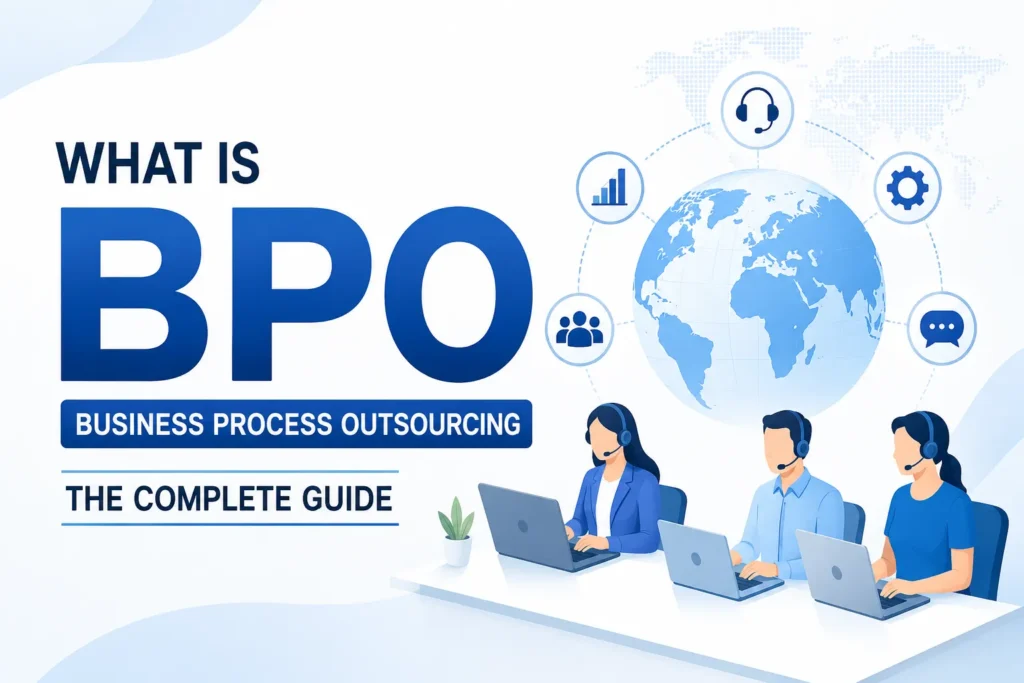
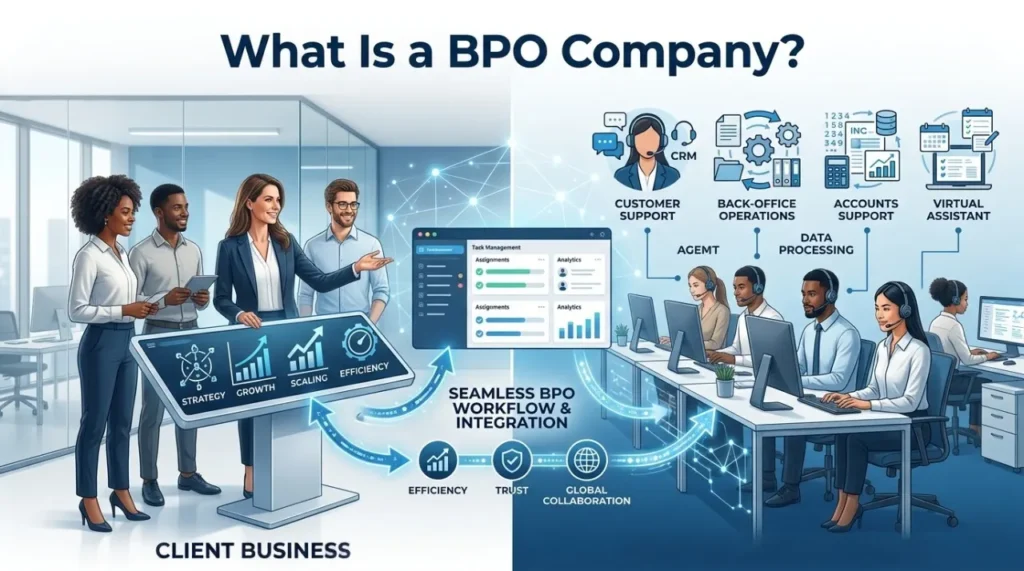
Business Process Outsourcing is the practice of contracting specific business functions to an external provider rather than handling them internally. On paper, the concept is simple. In practice, the way most companies approach it is broken – and that’s why so many founders have a “tried BPO, didn’t work story.
The original BPO model was built around three pillars: labor arbitrage (cheaper labor in different geographies), scale flexibility (ramp teams up or down quickly), and specialization (access to expertise you can’t afford full-time). These benefits are real, but the execution often left companies frustrated. Communication gaps, quality inconsistencies, and a lack of integration with the company’s actual goals made BPO feel like handing work to a black box.
Fast forward to 2026, and the model has fundamentally changed. The new wave – Intelligent Process Outsourcing – keeps the original benefits but adds the intelligence layer that was always missing. Think of it this way: traditional BPO gave you extra hands. IPO gives you extra hands plus a brain.
For a deeper look at how this plays out in real operations, see our complete guide to process design and operational frameworks.
The 2026 Shift: From BPO to IPO (Intelligent Process Outsourcing)
The “IPO in this context is not an Initial Public Offering – it’s Intelligent Process Outsourcing, and it’s the defining operational trend of 2026 [R1]. Here’s what’s driving the shift:
1. AI Has Moved From Hype to Infrastructure
By 2026, AI isn’t a buzzword – it’s infrastructure. The same way cloud computing moved from “experimental to “default between 2015 and 2020, AI-assisted process management is now baked into the best BPO operations. According to industry research, over 70% of mid-market BPO contracts in 2025 included some form of AI integration, and that number is projected to exceed 85% by end of 2026 [R2].
2. Outcome-Based Pricing Is the New Normal
The old BPO model charged by the hour or per seat. The new IPO model charges by outcome. Want customer support tickets resolved? You pay per resolution, not per agent hour. Want leads qualified? You pay per qualified lead, not per SDR shift. This realignment of incentives is one of the most important shifts in the industry, because it finally makes the provider’s success identical to your success.
3. Real-Time Analytics Replace Quarterly Reports
Gone are the days of waiting weeks for a BPO vendor to send you a performance report. Modern IPO providers offer real-time dashboards showing exactly what’s happening across every process they touch. At Procizo, our clients see live KPIs – turnaround times, quality scores, cost-per-transaction – updated by the minute.
| Dimension | Traditional BPO (Pre-2024) | IPO (2026 Model) |
|---|---|---|
| Pricing | Hourly / per-seat | Outcome-based / hybrid |
| Technology | Manual workflows, email-based | AI-augmented, API-integrated |
| Reporting | Weekly or monthly reports | Real-time dashboards |
| Quality Control | Sampling and manual QA | 100% AI-assisted quality scoring |
| Scalability | Weeks to ramp up/down | Days, sometimes hours |
| Integration | Often siloed | Natively integrated with your stack |
Core BPO Strategies That Actually Drive Results in 2026
Not all outsourcing strategies are created equal. After working with hundreds of growing companies, we’ve identified the strategies that consistently produce results – and the ones that waste money.
Strategy 1: Process Audit Before Outsourcing
The single biggest mistake is outsourcing a broken process. If your customer onboarding flow is confusing and slow, outsourcing it just means someone else will execute a confusing, slow process. Before you outsource, audit and document the process. Identify bottlenecks. Then, and only then, hand it off. This is the difference between outsourcing as a bandage and outsourcing as a force multiplier.
Strategy 2: Start With One Function, Prove the Model
Don’t outsource your entire operations in one sweep. Pick one function – say, customer support ticket triage, or accounts payable processing – and run a 60-90 day pilot. Measure results against your in-house baseline. If the numbers are better (and they almost always are), expand from there.
Strategy 3: Demand Integration, Not Isolation
Your BPO provider should work inside your tools – your CRM, your helpdesk, your ERP – not in a separate silo. Integration means they see what your team sees, they can pull context from the same data sources, and they can hand off work seamlessly. This is non-negotiable in 2026.
Strategy 4: Build Feedback Loops Into the Contract
A static SLA is a dead SLA. Modern BPO contracts include continuous improvement clauses – quarterly reviews, optimization targets, and shared KPIs that evolve as your business grows. At Procizo, we co-create these loops with our clients during onboarding.
- Define 3-5 measurable KPIs upfront
- Schedule monthly performance reviews
- Build a shared improvement backlog
- Tie a percentage of fees to performance against KPIs
- Re-negotiate scope quarterly based on data
The Hidden Costs of Keeping Everything In-House
Most founders think in-house = control. In reality, in-house often means hidden costs that compound quietly until they become a crisis. Let’s break it down with real numbers.
The True Cost of an In-House Operations Hire
When you hire a full-time operations specialist at $55,000/year, the real cost to your business is closer to $75,000-$85,000 when you factor in:
- Benefits, payroll taxes, and insurance (25-35% on top of salary)
- Recruitment fees and onboarding time (often $5,000-$15,000 per hire)
- Software licenses, desk, equipment ($2,000-$4,000/year)
- Management overhead and HR admin
- Productivity ramp-up (typically 3-6 months to full productivity)
And that’s before you account for turnover. The average employee tenure in operations roles is under 2.5 years, meaning you’re essentially re-paying recruitment and onboarding costs every 24-30 months [R3].
The Opportunity Cost Nobody Talks About
Here’s the cost nobody puts on a spreadsheet: the founder’s time. If you’re spending 10 hours a week reviewing operations reports, chasing down process gaps, and managing an in-house team, that’s 10 hours you’re not spending on product, sales, or strategy. At a reasonable founder hourly value of $250-$500/hour, that’s $130,000-$260,000 in opportunity cost per year.
When you outsource strategically, this is the cost that disappears – and it’s often the single largest savings on the balance sheet.
How Procizo Delivers the IPO Advantage
Procizo isn’t a traditional call center or a body shop. We’ve built our entire operation around the IPO model – the intelligent, outcome-focused, tech-enabled version of outsourcing that’s defining 2026. Here’s what that looks like in practice:
Our Service Architecture
We organize our delivery around three layers:
- The Human Layer – Dedicated, trained specialists who own the work and the relationship. No rotating offshore strangers – you get a team that knows your business.
- The Intelligence Layer – AI tools that handle repetitive tasks (data entry, ticket categorization, document extraction), freeing your human team to focus on judgment-heavy work.
- The Accountability Layer – Real-time dashboards, outcome-based SLAs, and a shared performance scorecard. You always know exactly what you’re getting for your money.
What This Looks Like for Your Business
Whether you need back-office operations support, customer service scaling, lead qualification, or finance/admin functions, our model adapts. You don’t buy hours – you buy outcomes. And our pricing is structured so that when you grow, our costs scale efficiently, not linearly.
This is the difference between a vendor and a partner. We succeed when you succeed, and our contract structure is designed to make that alignment explicit.
Industries Being Transformed by Intelligent Outsourcing in 2026
While IPO works for almost any growing company, certain industries are leading the adoption curve. Here’s where we’re seeing the most dramatic impact:
Fintech and Lending
MCA underwriting, loan processing, payment operations, and compliance support are all being transformed. The volume of transactions and the precision required make these functions ideal for AI-augmented human teams. For a detailed look at one specific application, see our guide to MCA underwriting operations.
E-Commerce and DTC Brands
Customer support, order management, returns processing, and review management are now commonly outsourced at a sophistication level that was impossible just three years ago.
SaaS and Technology Companies
Tier 1 technical support, customer onboarding, billing operations, and renewal management are the top functions being outsourced in this sector.
Healthcare Administration
Patient scheduling, claims processing, prior authorization, and medical records management are increasingly handled by specialized IPO providers with HIPAA-compliant infrastructure.
Common Mistakes Companies Make When Outsourcing (And How to Avoid Them)
After working with companies at every stage, we’ve seen the same handful of mistakes derail outsourcing initiatives. Here’s how to sidestep them:
Mistake 1: Choosing on Price Alone
The cheapest provider is rarely the best value. If a BPO quote is 40% lower than the market average, ask yourself what’s missing. Often it’s quality control, security, or basic management infrastructure. Price matters – but total cost of ownership matters more.
Mistake 2: Vague Scope Definition
“We need help with operations is not a scope. A clear scope defines inputs, processes, outputs, quality standards, and escalation paths. Without this, you’ll spend the first three months arguing about what was actually agreed to.
Mistake 3: No Internal Champion
Even with the best provider in the world, outsourcing fails without an internal owner. You need one person on your team who owns the vendor relationship, runs the weekly check-ins, and has the authority to make decisions.
Mistake 4: Treating Outsourcing as “Set and Forget
Outsourcing is not abandonment. The companies that get the best results treat their BPO relationship like a high-performing internal team – with goals, reviews, and continuous improvement.
Building Your 2026 Operations Strategy: A Practical Roadmap
If you’re ready to explore BPO or upgrade your existing outsourcing model, here’s a practical roadmap to follow:
- Audit your current operations – Map every recurring process. Identify which ones are core to your competitive advantage and which are non-core.
- Quantify the cost of in-house – Add up the fully-loaded cost of every operations role, including opportunity cost.
- Prioritize one function to pilot – Pick the function with the highest pain and clearest metrics.
- Select a provider with IPO capabilities – Look for AI integration, outcome-based pricing, and real-time reporting.
- Run a 60-90 day pilot – Measure rigorously. Compare against your in-house baseline.
- Expand or pivot – If the pilot succeeds, expand. If it doesn’t, you’ve learned valuable information cheaply.
For most growing companies we work with, the first function they outsource becomes the template for everything that follows. Once you see the model work once, the rest becomes much easier.
Challenge: A company processing 5,000+ monthly transactions had an in-house back office team of 15. Costs rose 12% annually, turnover was 35%, and transaction processing averaged 4 days.
Solution: Procizo deployed 10 skilled BPO processors handling document processing, data entry, verification, and reporting – integrated within 2 weeks.
Results (6 months):
- Cost per transaction: $8.50 ? $3.80 (55% savings)
- Turnaround: 4 days ? 12 hours (87% faster)
- Monthly capacity: 5,000 ? 9,000+
- Accuracy: 94% ? 99.2%
- Client retention: 98%
Frequently Asked Questions
- What is the difference between BPO and IPO?
- BPO (Business Process Outsourcing) is the traditional model focused on handing off tasks to external providers, usually based on hourly or per-seat pricing. IPO (Intelligent Process Outsourcing) is the 2026 evolution that adds AI-assisted workflows, automation, real-time analytics, and outcome-based pricing on top of human expertise. The core difference is intelligence: BPO gives you extra hands; IPO gives you extra hands plus a brain.
- How much can a small business save by outsourcing in 2026?
- Most small to mid-sized businesses save between 35% and 60% on fully-loaded operational costs when they move from in-house to an IPO model. The exact number depends on the function, the geography of the provider, and how much of the process can be automated.
- What functions should a company outsource first?
- Start with non-core, high-volume, rule-based functions. Common first-pilot candidates include customer support ticket triage, accounts payable processing, data entry, lead qualification, and order management. The key is picking a function where success is easy to measure.
- Is outsourcing safe for sensitive data?
- Modern IPO providers invest heavily in security – often more than the average mid-sized company can afford on its own. Look for providers with SOC 2 Type II certification, HIPAA compliance (if relevant), encrypted data handling, and clear data residency policies. Procizo maintains strict security standards across all client engagements.
- How long does it take to see results from outsourcing?
- Most companies see measurable results within 30-60 days of a well-scoped pilot. Full ROI typically materializes within 90 days as the provider’s team ramps up, processes stabilize, and automation is layered in.
- What happens if I’m not happy with the BPO provider’s performance?
- This is exactly why outcome-based pricing and clear SLAs matter. A well-structured contract includes performance remediation clauses, transition support, and clear exit terms. At Procizo, we bake these protections into every engagement because we want to earn the relationship every month.
- Can I outsource if I’m a very small company?
- Absolutely. In fact, small companies often benefit the most because they get access to infrastructure and expertise that would otherwise be unavailable to them. Many IPO providers, including Procizo, offer flexible models designed specifically for small and growing businesses.
- What is outcome-based pricing in BPO?
- Outcome-based pricing means you pay for results, not time. For example, you might pay per customer support ticket resolved to a defined quality standard, per qualified lead delivered, or per invoice processed accurately. This aligns the provider’s incentives with yours and removes the risk of paying for idle time.
- Will AI replace human BPO workers?
- AI replaces tasks, not entire roles. In the IPO model, AI handles repetitive, rules-based work (data entry, categorization, extraction), while humans handle judgment-heavy work (complex customer issues, exception handling, relationship management). The net effect is higher-value work for humans and lower costs for the client.
- How do I choose the right BPO partner?
- Look for: proven experience in your industry, transparent pricing, strong security credentials, modern technology stack, outcome-based contracts, real-time reporting, and a cultural fit with your team. Ask for case studies, references, and a clear pilot proposal. Avoid providers who won’t let you start small.
The Bottom Line
The companies winning in 2026 aren’t the ones doing everything themselves – they’re the ones who’ve learned to outsource intelligently. The shift from BPO to IPO isn’t a minor industry trend; it’s a fundamental rethinking of how growing companies build operational capacity.
If you’re spending your days buried in admin, customer support, and operations – if your growth is bottlenecked by your own backend – the answer isn’t another hire. It’s a smarter model. Procizo exists to help you make that transition cleanly, with intelligent systems, dedicated teams, and outcome-based pricing that aligns our success with yours.
Stop running operations like a 2015 company. The tools, the models, and the partners are all here in 2026. The only question is how fast you want to scale.
References
| Code | Source | Link |
|---|---|---|
| [R1] | IBISWorld – Industry Research & Market Data | View ? |
| [R2] | Deloitte – Industry Research & Market Data | View ? |
| [R3] | Statista – Industry Research & Market Data | View ? |
| [R4] | Grand View Research – Industry Research & Market Data | View ? |
| [R5] | Everest Group – Industry Research & Market Data | View ? |
| [R6] | Procizo Outsourcing LLC – How to Hire a Virtual Assistant: The Complete Guide for Business Owners (2026) | View ? |
| [R7] | Procizo Outsourcing LLC – Call Center Outsourcing: Complete Guide to Customer Service BPO (2026) | View ? |
| [R8] | Procizo Outsourcing LLC – Virtual Assistant Services: The Complete Guide to Hiring and Scaling with VAs (2026) | View ? |
| [R9] | Procizo Outsourcing LLC – Back Office Outsourcing: The Complete Guide to Streamlining Operations (2026) | View ? |
| [R10] | Procizo Outsourcing LLC – BPO Services: The Complete Guide to Types, Costs & How to Choose | View ? |
| [R11] | Procizo Outsourcing LLC – What is BPO? The Complete Guide to Business Process Outsourcing (2026) | View ? |
Ready to Streamline Your Business Process Outsourcing?
Procizo Outsourcing LLC provides end-to-end business process outsourcing with transparent pricing, dedicated teams, and rapid onboarding. Start with a pilot engagement – no long-term commitment required.
No commitment required . 2-3 week onboarding . SOC 2 Type II security
Editorial Oversight: Content reviewed and approved by the Procizo Outsourcing LLC team based on internal research, operational experience, industry reports, and publicly available data.
Research Methodology: This content was created using a combination of Procizo Outsourcing LLC’s operational expertise, industry publications, academic research, government resources, and verified third-party sources.
Ready to Streamline Your Business Process Outsourcing?
Procizo Outsourcing LLC provides end-to-end business process outsourcing with transparent pricing, dedicated teams, and rapid onboarding. Start with a pilot engagement – no long-term commitment required.
No commitment required . 2-3 week onboarding . SOC 2 Type II security
Editorial Oversight: Content reviewed and approved by the Procizo Outsourcing LLC team based on internal research, operational experience, industry reports, and publicly available data.
Research Methodology: This content was created using a combination of Procizo Outsourcing LLC’s operational expertise, industry publications, academic research, government resources, and verified third-party sources.