- Have Questions? Talk to Us
- info@procizo.com

Recruitment Process Outsourcing: Complete RPO Guide 2026

How to Hire a Virtual Assistant: The Complete Guide for Business Owners (2026) | Procizo
July 1, 2026
Finance and Accounting Outsourcing: Complete Guide (2026)
July 6, 2026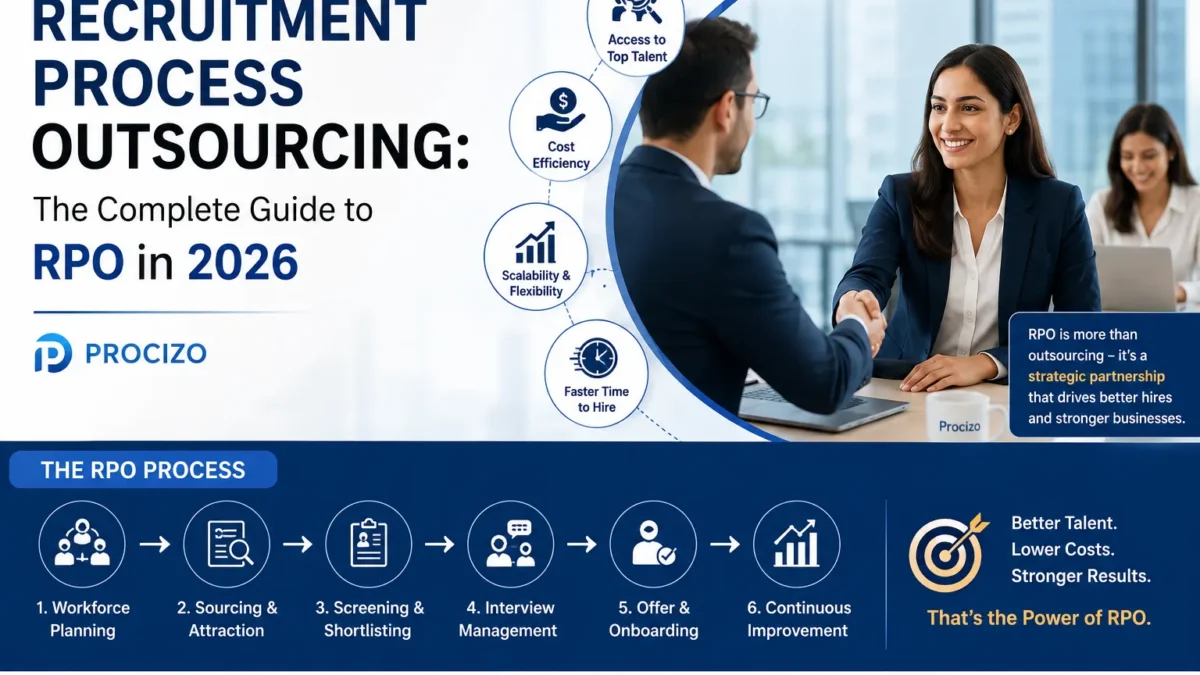
Quick Answer
Recruitment Process Outsourcing (RPO) is a strategic business model in which an organization transfers all or part of its recruitment function to an external provider that acts as an extension of the company’s HR team. Unlike traditional staffing agencies that focus on filling individual requisitions, RPO providers manage the entire recruitment lifecycle—from workforce planning, sourcing, screening, and interviewing to offer management, onboarding support, and recruitment analytics—under a defined service level agreement (SLA).
RPO is typically chosen by mid-to-large organizations that need to scale hiring quickly, reduce cost-per-hire, access specialized talent pools, or free internal HR teams to focus on strategic initiatives. The most common engagement models are project RPO (for short-term, high-volume hiring), enterprise RPO (for end-to-end, long-term ownership of recruitment), and hybrid RPO (a blend of in-house and outsourced functions). Pricing is usually structured as a management fee, per-hire fee, or hybrid model tied to performance metrics.
Key Takeaways
- RPO is not staffing. Staffing fills requisitions; RPO owns the recruitment process and outcomes, including strategy, employer branding, and reporting.
- Three primary RPO models—project, enterprise, and hybrid—serve different hiring needs, volumes, and organizational maturity.
- Cost savings typically range from 20% to 50% on cost-per-hire, alongside measurable improvements in time-to-fill, quality-of-hire, and candidate experience.
- Pricing models vary—management fee, per-hire, hybrid, or outcome-based—and each aligns differently with client risk and provider incentives.
- Implementation follows a phased approach—discovery, transition, stabilization, and optimization—typically spanning 3 to 6 months before full productivity.
- RPO excels in specialized industries like financial services, healthcare, IT, and life sciences where regulatory complexity, skill scarcity, or volume spikes demand expert recruiting infrastructure.
Related: RPO Recruitment Guide 2026: Costs, Models & ROI | Top 10 RPO Companies of 2026: A No-Nonsense Guide to Choosing Your Partner | How to Actually Find a Job That’s Hiring: Unlocking the Hidden Job Market
What is RPO? Definition and How It Works
Recruitment Process Outsourcing, abbreviated RPO, is a form of business process outsourcing in which a third-party provider assumes responsibility for some or all of an employer’s recruitment activities. The provider deploys dedicated recruiters, sourcing specialists, and talent acquisition operations on behalf of the client, often working inside the client’s ATS, HRIS, and employer brand ecosystem.
Conceptually, RPO sits between two well-known alternatives: traditional staffing agencies (transactional, requisition-based) and fully internal talent acquisition teams. A staffing agency is paid a fee to deliver a candidate who clears a defined bar. An internal team is paid a salary plus overhead to handle every hire. An RPO provider is paid to deliver outcomes—hires that meet agreed-upon quality, time, cost, and experience benchmarks—while typically sharing risk and accountability with the client.
The mechanics of an RPO engagement typically look like this:
- Discovery and scoping. The provider studies the client’s hiring volume, job families, geographic footprint, employer brand, technology stack, and historical metrics.
- Solution design. A tailored operating model is proposed, including recruiter headcount, sourcing channels, interview workflows, SLA targets, and governance structure.
- Transition. Knowledge is transferred from the client’s existing recruitment team (or staff) to the RPO team, including documentation, candidate pipelines, and stakeholder relationships.
- Steady-state operations. The RPO team runs day-to-day recruitment, with regular reporting, calibration, and continuous improvement.
- Optimization. Mature engagements evolve toward strategic consulting, workforce planning, employer brand enhancement, and talent market intelligence.
Because the provider’s recruiters operate as embedded partners, candidates often cannot tell the difference between an RPO recruiter and an internal one—except that the experience is typically more polished, faster, and more consistent. This is the core promise of RPO: industrial-grade recruitment delivered as a strategic capability.
If your organization is evaluating BPO partnerships more broadly, our BPO company overview explains how recruitment fits into the wider spectrum of outsourced business services.
RPO vs Traditional Staffing vs Internal Recruitment
One of the most common points of confusion is the difference between RPO, traditional staffing, and a fully internal recruitment function. The table below summarizes the key distinctions.
| Dimension | Traditional Staffing | Recruitment Process Outsourcing (RPO) | Internal Recruitment Team |
|---|---|---|---|
| Scope | Fills individual requisitions | Manages end-to-end recruitment process | Owns all recruitment internally |
| Engagement | Transactional, requisition-by-requisition | Strategic, multi-year or project-based | Permanent, ongoing |
| Accountability | Delivers a candidate; client decides | Delivers hired, onboarded talent against SLAs | Full accountability, in-house |
| Team Model | Agency recruiters across many clients | Dedicated recruiters embedded with client | Client-employed recruiters |
| Technology | Agency-owned tools, client ATS optional | Operates inside client ATS and tech stack | Fully client-owned |
| Employer Brand | Often neutral or agency-branded | Always represents the client brand | Represents the client brand |
| Best Fit | Temp, contract, niche, low-volume needs | High volume, scaling, transformation, specialized hiring | Stable volume, mature TA function, confidential hiring |
| Pricing | Markup / placement fee per temp or hire | Management fee, per-hire, or hybrid | Salaries, benefits, tools, overhead |
| Risk Sharing | Limited; replacement guarantees often short | Significant; tied to SLA performance | Full risk on the employer |
| Time to Value | Days to weeks per role | Weeks for project, months for enterprise | Months to years to build |
The short version: traditional staffing is a vendor relationship, internal recruitment is an employment relationship, and RPO is a partnership relationship. RPO providers are measured like an internal team but contracted like a strategic vendor.
Types of RPO: Project, Enterprise, and Hybrid
RPO is not a one-size-fits-all engagement. The three dominant models are described below.
1. Project RPO
Project RPO (sometimes called on-demand or project-based RPO) is designed for defined hiring initiatives with a clear start and end. Typical use cases include opening a new office, launching a new product line, executing a seasonal ramp, replacing a legacy system rollout, or clearing a hiring backlog.
Characteristics of project RPO:
- Fixed scope, fixed timeline, often 3 to 12 months.
- Pricing is commonly per-hire or milestone-based.
- The provider may work as a fully outsourced recruiter team or as an augmentation to internal staff.
- Ideal for organizations that need a surge capability without committing to a multi-year contract.
2. Enterprise RPO
Enterprise RPO is the largest and most strategic form of RPO. The provider takes ownership of recruitment for an entire business unit, region, or organization, often across multiple job families, geographies, and skill categories. Contracts typically run 3 to 5 years with renewal options.
Characteristics of enterprise RPO:
- Full lifecycle ownership: workforce planning, sourcing, screening, interviewing, offer management, onboarding, and reporting.
- Dedicated onsite and/or offshore recruiter teams.
- Deep integration with the client’s HRIS, ATS, employer brand, and hiring manager community.
- Governance via joint steering committees, quarterly business reviews, and SLA scorecards.
- Best suited for organizations hiring 200+ employees per year, with complex, multi-layered hiring needs.
3. Hybrid RPO
Hybrid RPO blends internal and outsourced recruitment. The client retains strategic ownership of talent acquisition—employer brand, workforce planning, executive hiring, and TA leadership—while the RPO partner handles execution at scale: high-volume sourcing, screening, scheduling, and process management.
Characteristics of hybrid RPO:
- Internal TA team focuses on senior, niche, or confidential roles.
- RPO partner handles volume hiring, project surges, or geographic expansion.
- Common in mature organizations that want to retain control but need scale.
- Requires clear delineation of roles to avoid overlap and friction.
To explore which model might suit your organization, our outsourcing services page outlines the engagement structures available across recruitment, back-office, and customer-facing functions.
Benefits of Recruitment Process Outsourcing
RPO engagements deliver benefits across four primary dimensions: cost, speed, quality, and scalability. Below is a closer look at each.
1. Cost Savings
The most cited RPO benefit is reduced cost-per-hire. Industry benchmarks from leading analyst firms suggest RPO clients achieve 20% to 50% cost savings on cost-per-hire within 18 to 24 months. Savings come from:
- Eliminating the need to hire, train, and retain in-house recruiters for cyclical or specialized demand.
- Consolidating multiple staffing vendors under a single SLA-driven contract.
- Reducing advertising and job board spend via programmatic sourcing and direct channels.
- Avoiding bad-hire costs through improved screening and quality-of-hire metrics.
2. Speed
RPO providers bring industrial processes, dedicated sourcing teams, and pre-built talent pools. Time-to-fill reductions of 30% to 60% are common, particularly for high-volume or hard-to-fill roles. Faster hiring directly reduces revenue loss from open seats and improves the candidate experience—two competitive advantages in tight labor markets.
3. Quality
RPO success is increasingly measured by quality-of-hire: retention at 6 and 12 months, performance ratings, hiring manager satisfaction, and candidate Net Promoter Score (NPS). Mature RPO providers use structured interviews, competency-based assessments, calibration sessions, and analytics dashboards to lift quality. The result is fewer mis-hires and a stronger long-term workforce.
4. Scalability
Recruitment demand rarely moves in a straight line. RPO gives organizations a flexible recruiting capacity that can scale up or down without the friction of hiring, layoffs, or contractor churn. Whether the trigger is a product launch, a regional expansion, or an M&A integration, the provider can deploy additional recruiters within weeks.
Secondary benefits commonly reported include improved employer brand consistency, better candidate experience, enhanced DEI outcomes through structured sourcing, and richer talent market intelligence for workforce planning.
RPO Pricing Models
RPO pricing is more variable than staffing pricing because RPO is outcome-driven. The four dominant models are described below.
Management Fee Model
The client pays a fixed monthly or annual management fee that covers the full RPO team, technology, and operations. This model is most common in large enterprise RPO deals where hiring volume is high and predictable. The provider assumes the cost risk for staffing levels, while the client pays for capacity, not for individual hires.
Pros: Predictable spend, full alignment with provider on long-term outcomes, encourages provider investment in process improvement.
Cons: Higher perceived upfront cost; requires mature governance to ensure value delivery.
Per-Hire Model
The client pays a fee for each successful hire, typically tiered by role seniority, complexity, and geography. This is the most common model for project RPO and is well-suited to variable hiring volumes.
Pros: Direct pay-for-performance, easy to budget per requisition, low entry risk.
Cons: Can incentivize volume over quality if not balanced with quality SLAs; less aligned with long-term transformation.
Hybrid Model
A hybrid model combines a base management fee (covering team and infrastructure) with a per-hire variable component (tied to actual hires delivered). This is increasingly the most common structure in mid-market RPO deals.
Pros: Balances cost predictability with performance incentives, accommodates volume variability, easier to defend internally.
Cons: More complex to negotiate and govern; requires careful SLA design.
Outcome-Based or Gain-Share Model
Less common but growing, this model ties a portion of the provider’s compensation to quality outcomes such as retention, time-to-productivity, or hiring manager satisfaction. It is typically combined with a base fee to ensure baseline operations.
Pros: Maximum alignment on long-term value, encourages provider to invest in screening and onboarding.
Cons: Harder to attribute outcomes cleanly; requires sophisticated measurement infrastructure.
When comparing models, look beyond the unit price to the total cost of ownership: transition costs, technology, severance for in-house recruiters being redeployed, and the cost of any parallel running during implementation. A cheaper per-hire rate that produces weaker quality-of-hire is often the most expensive option over 24 months.
When to Choose RPO vs In-House Recruiting
RPO is not always the right answer. The decision depends on hiring volume, strategic priorities, organizational maturity, and the nature of the roles being filled. Below are practical decision criteria.
Choose RPO when:
- You need to hire more than 100 to 200 people per year and want predictable outcomes.
- Time-to-fill is hurting revenue, growth, or client delivery.
- Your in-house team is overloaded or has skill gaps (e.g., sourcing, analytics, employer brand).
- You are entering a new market, opening a new office, or executing a large transformation.
- You want to convert fixed recruiting costs into variable costs tied to outcomes.
- You need to consolidate multiple staffing vendors and ad-hoc agency spend.
Stay in-house when:
- Hiring volume is low (under 50 hires per year) and stable.
- Roles are highly confidential, executive-level, or politically sensitive.
- Your TA function is already high-performing and well-resourced.
- Regulatory or compliance constraints require full in-house control over candidate data.
- You view recruitment as a core strategic capability and want to build it as a long-term moat.
Consider a hybrid when:
- You have a strong internal TA function but need scale for volume hiring.
- You want to retain control over senior or strategic roles while outsourcing execution.
- You are testing an outsourcing partnership before a full enterprise RPO commitment.
The honest answer is that very few organizations today operate at scale with a purely in-house model—and very few operate with a purely outsourced model. Most successful talent acquisition organizations are hybrid by default.
How to Select an RPO Provider
Choosing an RPO provider is a multi-year strategic decision. A rigorous selection process typically follows the steps below.
- Define your objectives and constraints. Clarify the business problem (volume, cost, speed, quality, geographic expansion), the metrics you want to move, the budget envelope, and any non-negotiables (e.g., data residency, onshore requirements, cultural fit).
- Build a longlist of providers. Use analyst reports (Everest Group, NelsonHall, Gartner, ISG), peer recommendations, and RFP databases. Aim for 6 to 10 providers, then narrow to 3 to 5 for a formal RFP.
- Issue a structured RFP. Cover scope, SLAs, pricing, technology, transition, governance, security, DEI, and references. Use consistent scoring criteria across providers.
- Conduct onsite presentations and deep-dive sessions. Don’t just look at slides. Ask the proposed team to simulate your workflows—sourcing, screening, interview coordination, reporting. See how they think, not just what they sell.
- Check references—deeply. Talk to clients with similar volume, industry, and complexity. Ask about transition, governance, and what happens when things go wrong.
- Negotiate the contract carefully. Pay close attention to SLAs, termination clauses, transition-out obligations, IP ownership, data protection, and pricing change mechanisms.
- Run a pilot or phased rollout. For enterprise deals, consider starting with one business unit or geography before scaling.
Red flags to watch for include vague SLAs, reluctance to share client references, low-balled pricing that depends on unrealistic assumptions, and overpromising on technology the provider doesn’t actually own. For a deeper look at provider evaluation, our company background and approach page describes how we engage with clients in long-term partnerships.
RPO for Financial Services and Specialized Industries
Recruitment challenges vary sharply by industry. RPO has proven particularly valuable in sectors where talent scarcity, regulatory complexity, or volume volatility make traditional recruiting insufficient.
Financial Services
Financial services firms—banks, insurance carriers, asset managers, fintechs—face a distinctive combination of pressures: heavy regulatory scrutiny, the need for licensed professionals, a competitive war for quantitative and technology talent, and the constant risk of reputation damage from poor hires. RPO providers serving this sector typically offer:
- Experienced recruiters with finance, risk, compliance, and technology domain knowledge.
- Robust background check, reference, and licensing verification workflows.
- Knowledge of compensation benchmarks, equity structures, and regulatory constraints.
- Confidentiality controls appropriate for senior and customer-facing hires.
Healthcare and Life Sciences
Healthcare providers, pharmaceutical companies, and medical device manufacturers struggle with persistent talent shortages for nurses, technicians, clinical researchers, and regulatory affairs professionals. RPO providers in this space typically combine high-volume clinical hiring with specialized scientific search, often across multiple geographies and licensure regimes.
Information Technology
IT hiring is characterized by extreme skill specificity, rapid shifts in demand (AI, cybersecurity, cloud), and a candidate-driven market. RPO providers serving IT clients usually blend sourcing-as-a-service with employer brand activation, technical assessment design, and competitive intelligence on compensation and skill availability.
Manufacturing, Logistics, and Retail
These industries face high-volume hourly and skilled-trade hiring, often across distributed locations. RPO is used heavily for seasonal ramps, new site openings, and large-scale workforce transformations. Mobile-first candidate experiences, multilingual sourcing, and high-velocity screening workflows are table stakes.
Professional Services and Consulting
For consulting, accounting, and legal firms, RPO supports lateral hiring, campus recruiting, and experienced-hire pipelines, often with rigorous assessment, case study, and partner-interview workflows.
Regardless of industry, the most successful RPO engagements combine domain knowledge with operational discipline—the provider must understand the talent market and run the process with industrial efficiency.
RPO Implementation Process: Phases
Implementing RPO is a multi-phase program, not a contract signature. Most engagements follow a four-phase model.
Phase 1: Discovery (Weeks 1 to 4)
- Kickoff with executive sponsors, hiring managers, and HR leadership.
- Detailed mapping of current state: roles, volumes, sources, conversion rates, time-to-fill, cost-per-hire.
- Stakeholder interviews to capture expectations, pain points, and constraints.
- Confirmation of scope, SLAs, success metrics, and the high-level operating model.
Phase 2: Transition (Weeks 4 to 12)
- Recruiter selection and onboarding; transfer of in-house roles where applicable.
- Knowledge transfer: intake meetings, scorecards, job descriptions, candidate pipelines, hiring manager playbooks.
- Technology integration: ATS configuration, reporting dashboards, sourcing tool access, SSO and security provisioning.
- Communication plan: hiring managers, candidates, internal recruiters, and other stakeholders are informed about the change.
- Parallel running with the legacy process for a defined period to de-risk cutover.
Phase 3: Stabilization (Months 3 to 6)
- The RPO team takes full operational ownership.
- Weekly and monthly performance reviews against SLAs.
- Issue resolution, process refinements, and stakeholder alignment.
- Calibration sessions with hiring managers to align on screening and selection standards.
- Initial reporting pack delivered, including baseline benchmarks for ongoing improvement.
Phase 4: Optimization (Months 6 and Beyond)
- Continuous improvement via data: identify bottlenecks, source mix shifts, and quality gaps.
- Strategic initiatives: employer brand activation, DEI programs, talent market intelligence, internal mobility.
- Expansion of scope (e.g., new geographies, new job families, onboarding support, contingent workforce management).
- Quarterly business reviews and annual strategy refreshes with the joint steering committee.
Organizations that succeed with RPO treat implementation as a change management program, not a vendor setup. Hiring manager buy-in, executive sponsorship, and disciplined governance are the three most consistent predictors of success.
Challenge: A mid-market financial services company needed to scale their operations team from 45 to 120 employees within 8 months. Their internal HR team of 2 could not handle the volume, and external staffing agencies were charging 20-25% per placement with inconsistent quality.
Solution: Procizo Outsourcing LLC implemented a full-cycle Recruitment Process Outsourcing solution — handling job description creation, multi-channel sourcing, screening, interview coordination, offer management, and onboarding support.
Results (8 months):
- 75 positions filled in 8 months — 94% of target within timeline
- Average cost-per-hire reduced substantially — 62% savings
- Time-to-fill reduced from 45 days to 18 days on average
- Candidate quality score: 4.2/5 vs 3.1/5 with previous agency model
- 90-day retention rate improved from 72% to 89%
- Scaled from 2 internal recruiters to a virtual RPO team of 8 without adding headcount
Frequently Asked Questions
1. What does RPO stand for?
RPO stands for Recruitment Process Outsourcing. It refers to the transfer of all or part of an organization’s recruitment function to an external provider that acts as a strategic partner and operates under defined service level agreements.
2. How is RPO different from a staffing agency?
A staffing agency fills individual requisitions on a transactional basis and is paid per placement or per temp hour. An RPO provider manages the end-to-end recruitment process, often with dedicated embedded recruiters, and is held accountable for outcomes like time-to-fill, quality-of-hire, and cost-per-hire across a defined scope.
3. What are the main types of RPO?
The three main types are project RPO (for defined, time-bound hiring initiatives), enterprise RPO (for full, long-term ownership of recruitment at scale), and hybrid RPO (a blend of internal and outsourced recruitment functions).
4. What does an RPO provider actually do?
Typical RPO responsibilities include workforce planning, job requisition management, sourcing (active and passive), screening, interview coordination, assessment design, offer management, onboarding support, employer brand activation, recruitment marketing, DEI sourcing, and reporting and analytics.
5. How much does RPO cost?
RPO pricing varies by scope, volume, and complexity. Management fee models can range from a few hundred thousand to several million dollars per year for enterprise deals. Per-hire fees typically range from a few hundred to several thousand dollars per hire depending on role seniority and geography. Hybrid models combine a base management fee with per-hire variable components.
6. How long does it take to implement RPO?
Project RPO can be live in 2 to 6 weeks. Enterprise RPO implementations typically take 3 to 6 months to reach steady-state, with the most significant transition work concentrated in the first 8 to 12 weeks.
7. Is RPO only for large enterprises?
No. While enterprise RPO is most common at large organizations, mid-sized companies increasingly use project RPO or hybrid RPO to support growth, expansion, or transformation. Many RPO providers offer scaled-down models designed for the mid-market.
8. What metrics are used to measure RPO success?
Common RPO metrics include time-to-fill, time-to-hire, cost-per-hire, quality-of-hire (often proxied by 6- and 12-month retention and performance ratings), offer acceptance rate, candidate Net Promoter Score, hiring manager satisfaction, source mix, DEI representation, and SLA attainment.
9. Can RPO help with diversity hiring?
Yes. Mature RPO providers use structured interviews, blind resume screening where appropriate, diverse slate requirements, and DEI-focused sourcing channels. They also provide reporting on pipeline diversity and outcomes, which helps organizations hold themselves accountable to DEI goals.
10. What happens to internal recruiters when RPO is implemented?
There are several common approaches. In some engagements, internal recruiters are redeployed into strategic TA roles (workforce planning, employer brand, executive search). In others, they transition to the RPO provider as embedded team members. A third option is a managed transition where internal recruiters are reskilled or moved into adjacent HR roles. The right approach depends on organizational structure, labor law, and the scope of the RPO engagement.
11. Is candidate data safe with an RPO provider?
Reputable RPO providers operate under strict data protection agreements, comply with applicable regulations (GDPR, CCPA, HIPAA where relevant), and use the client’s ATS or a provider system with clearly defined data ownership, residency, and access controls. Data protection terms should be a major focus of RPO contracts.
12. Can RPO be used for executive hiring?
Yes, though executive search is often handled by specialized retained search firms. Some RPO providers offer executive search as part of their portfolio, while others partner with executive search boutiques. The decision depends on confidentiality, fee structure, and the seniority of the roles in question.
13. What are the biggest risks of RPO?
Common risks include poor hiring manager adoption, weak governance, misaligned SLAs, underestimating transition complexity, and provider turnover on the dedicated team. These risks are manageable with disciplined program management, clear escalation paths, and contractually defined knowledge continuity plans.
14. How do you terminate an RPO contract?
Termination provisions vary, but most enterprise RPO contracts include 90 to 180 days’ notice, transition-out obligations for the provider, knowledge transfer commitments, and protection of candidate data. It is critical to negotiate transition-out terms in detail before signing, not at the end of the relationship.
References
| Code | Source | Link |
|---|---|---|
| [R1] | SHRM — Industry Research & Market Data | View → |
| [R2] | Everest Group — Industry Research & Market Data | View → |
| [R3] | NelsonHall — Industry Research & Market Data | View → |
| [R4] | Staffing Industry Analysts — Industry Research & Market Data | View → |
| [R5] | Recruiter.com — Industry Research & Market Data | View → |
| [R6] | Procizo Outsourcing LLC — RPO Recruitment Guide 2026: Costs, Models & ROI | View → |
| [R7] | Procizo Outsourcing LLC — Top 10 RPO Companies of 2026: A No-Nonsense Guide to Choosing Your Partner | View → |
| [R8] | Procizo Outsourcing LLC — How to Actually Find a Job That’s Hiring: Unlocking the Hidden Job Market | View → |
Ready to Streamline Your Recruitment Process Outsourcing?
Procizo Outsourcing LLC provides end-to-end recruitment process outsourcing with transparent pricing, dedicated teams, and rapid onboarding. Start with a pilot engagement — no long-term commitment required.
No commitment required • 2-3 week onboarding • SOC 2 Type II security
About the Author
Procizo Outsourcing LLC
Procizo Outsourcing LLC is a professional outsourcing company providing Business Process Outsourcing (BPO), Knowledge Process Outsourcing (KPO), and specialized underwriting support services to businesses across the United States. This content was researched, organized, and produced by the Procizo team based on operational experience, industry data, and verified sources.