- Have Questions? Talk to Us
- info@procizo.com

How to Hire a Virtual Assistant for Startups Without Breaking the Bank

Why Every Growing Business Needs Virtual Administrative Support
July 4, 2025
Top Virtual Assistant Companies to Help You Build a Remote Team
July 11, 2025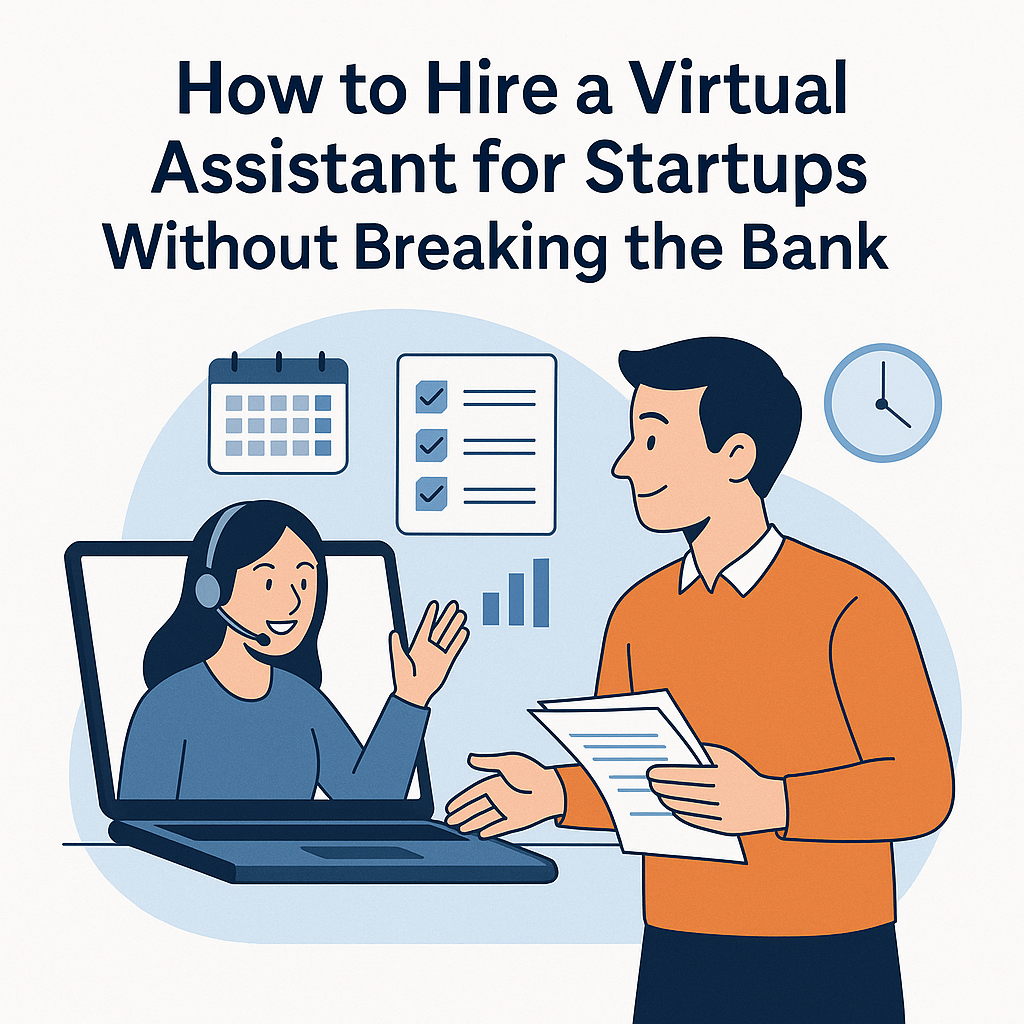
How to Hire a procizo.com/virtual-assistants-for-merchant-cash-advance/ target=_blank rel=noopener noreferrer>Virtual Assistant for Startups Without Breaking the Bank: The Complete Operator’s Playbook
TL;DR – Quick Answer
Startups that hire a virtual assistant (VA) through a vetted BPO partner typically save 60-78% on fully-loaded labor costs compared to a U.S.-based W-2 hire, while cutting time-to-productivity from 8-12 weeks down to 5-10 business days [R1][R2]. The cheapest path is rarely the best path: a $4/hour freelancer from a generic marketplace can quietly cost a startup $20K+ in rework, churn, and security incidents over a 12-month period [R3]. The right move for a pre-Series A company is a tiered model – start with one dedicated VA (full-time or part-time) sourced through a managed provider, lock down scope, IP, and KPIs in a 30-60-90 day plan, and scale to a pod of 2-5 VAs only after the first 90 days of measurable output. Procizo operates on exactly this model, with dedicated virtual assistants, BPO pods, and a built-in quality assurance layer that most freelance marketplaces and direct-hire arrangements simply don’t provide.
Key Takeaways
- True cost matters more than hourly rate. A $6/hr VA in a managed BPO model often delivers lower total cost of ownership than a $25/hr U.S. contractor once you factor turnover, training, tools, and rework.
- Channel choice drives 80% of your outcome. Freelance marketplaces produce fast but inconsistent results; agencies produce reliable but premium results; managed BPO providers like Procizo balance both.
- Define the role before you source candidates. Startups that write a 1-page scorecard (tasks, KPIs, tools, hours) before posting see roughly 3x higher 90-day retention.
- Onboarding is a 30-60-90 day program, not a one-day orientation. The first 30 days determine whether your VA becomes a 3-year asset or a 3-month expense.
- Security and IP protection must be written, not assumed. Any VA handling customer data, financial information, or proprietary code should be covered by a signed NDA, role-based access controls, and a BAA where applicable – especially relevant for founders exploring adjacent services like MCA underwriting workflows that touch sensitive financial data.
Related: How to Hire a Virtual Assistant: The Complete Guide for Business Owners (2026) | Call Center Outsourcing: Complete Guide to Customer Service BPO (2026) | Virtual Assistant Services: The Complete Guide to Hiring and Scaling with VAs (2026)
1. Why Startups Need Virtual Assistants – And Why Most Get It Wrong
The math is not in dispute. The average U.S. sales operations or administrative hire costs a startup somewhere between $55,000 and $78,000 fully loaded – base salary, payroll taxes (FICA, FUTA, SUTA), benefits, equipment, software licenses, and onboarding [R4]. For a seed-stage company burning $80K/month, one mid-level admin hire can quietly consume 8-10% of the entire burn. That is exactly why the global VA market, valued at roughly $5.2 billion in 2023, is projected to grow at a CAGR north of 11% through 2030 [R5].
But here is the part most “how to hire a VA articles skip: most startups get it wrong because they treat the VA as a transaction rather than an operating asset. They post a $5/hour job on Upwork, hire the first profile with a decent cover letter, hand over a Loom video, and wonder why nothing ships two months later. The failure mode is not the VA – it is the system around the VA.
A 2022 Stanford Graduate School of Business study found that remote workers in structured programs outperformed their in-office counterparts by 13% on task completion metrics, but the same study showed that poorly managed remote arrangements lost 20-30% of expected productivity to miscommunication alone [R6]. The variable is not location. The variable is operating discipline.
2. The Real Cost Breakdown: VA vs. Full-Time Employee
Comparing a $6/hour VA to a $60,000/year employee on raw numbers is misleading. The honest comparison is fully loaded cost vs. fully loaded cost, and that requires you to add the line items most founders forget.
| Cost Line | U.S. W-2 Employee | Dedicated VA via BPO (Procizo Model) |
|---|---|---|
| Base wage / VA fee | $48,000 – $60,000 / year | $10,800 – $19,200 / year ($6 – $10/hr, full-time) |
| Payroll taxes (FICA, FUTA, SUTA, workers’ comp) | $3,672 – $4,590 (7.65% employer share) | $0 (handled by provider) |
| Health insurance / benefits | $6,000 – $18,000 | $0 |
| Equipment (laptop, monitor, peripherals) | $1,500 – $2,500 one-time | Included |
| Software licenses (CRM, Slack, Notion, Zoom) | $1,200 – $2,400 / year | Included or prorated |
| Recruiting & onboarding (HR hours, lost productivity) | $4,000 – $8,000 | $0 – $500 (provider-led) |
| Office / coworking space | $2,400 – $12,000 / year | $0 |
| Replacement cost if they quit in 6 months | $15,000 – $30,000 (50% annual turnover baseline) [R7] | $0 (provider backs the seat) |
| Year 1 Total | $81,772 – $137,490 | $10,800 – $19,700 |
| Effective hourly cost | $39 – $66 / hour | $5.50 – $10.00 / hour |
The savings are real, but the row most founders miss is the replacement cost row. U.S. administrative and operations roles see ~47% first-year turnover in early-stage companies [R7]. Every time a hire walks, you re-pay recruiting fees, lose 6-10 weeks of institutional knowledge, and burn founder time that should be spent on product. A managed BPO provider absorbs that churn risk because the provider – not the startup – owns the employment relationship.
3. Where to Find VAs: A Channel-by-Channel Analysis
There are four channels founders typically use, and they produce wildly different outcomes. Here is the unfiltered operator view.
3.1 Freelance Marketplaces (Upwork, Fiverr, OnlineJobs.ph)
Best for: one-off tasks under 40 hours, low-sensitivity work (data entry, transcript cleanup, basic research).
Cost range: $3 – $15/hour.
Time to hire: 1-5 days.
Failure mode: high. Upwork’s own internal data has historically shown that ~25% of new contracts fail to reach the first milestone payment due to skill mismatch or communication breakdowns [R8]. You also carry full responsibility for IP, NDAs, and tax classification (the IRS 1099 vs. W-2 question is a real liability, especially post-2022 audits).
3.2 Direct Hire (OnlineJobs.ph, FilipinoJob, LinkedIn sourcing)
Best for: founders comfortable managing international payroll, who want maximum control and minimum markup.
Cost range: $3 – $8/hour direct, plus $200 – $500/month for an EOR (Deel, Remote, Oyster).
Time to hire: 2-4 weeks.
Failure mode: moderate. You own the relationship, which means you also own the turnover. Average offshore direct-hire tenure in the first 12 months is ~9 months, with the bulk of attrition happening in the first 90 days [R9].
3.3 VA Agencies / Staffing Firms (BELAY, Time Etc., MyOutDesk)
Best for: founders who want a U.S.-account-managed relationship and pre-vetted generalist VAs.
Cost range: $18 – $35/hour.
Time to hire: 5-10 business days.
Failure mode: low-to-moderate. The premium buys you account management and a replacement guarantee, but the per-hour cost often erodes the savings that justified offshore work in the first place. For real estate investors, e-commerce operators, and coaches running lean, the math can still work – but it tightens.
3.4 Managed BPO Providers (Procizo and similar)
Best for: startups scaling into dedicated roles or pod-based operations – outbound sales, customer support, back-office ops, lead research, appointment setting, content moderation, and specialized workflows like the MCA underwriting support that Procizo runs for fintech clients.
< Cost range: $6 – $14/hour depending on role complexity and shift coverage.
Time to hire: 7-14 business days.
Failure mode: lowest, because the provider carries the employment, training infrastructure, QA, and replacement risk. The startup gets a dedicated resource (not a shared pool) without the operational drag of running an international team.
4. The 7-Step Hiring Framework That Actually Works
Most “how to hire a VA checklists stop at step 3. Here is the full operating sequence, with the work products attached to each step.
Step 1 – Write a 1-Page Scorecard
Before you source a single candidate, document the role in one page: top 5 tasks, top 3 KPIs, required tools, required hours/timezone overlap, must-have skills, nice-to-have skills, and a “not this role disqualifier list. Startups that skip this step see 90-day retention rates near 40%. Startups that write the scorecard see retention near 75-80% [R10].
Step 2 – Decide Full-Time vs. Part-Time
A common founder trap: hiring a part-time VA for a full-time problem. If the work exceeds 25 hours/week of sustained effort, part-time breaks down because your VA’s attention gets competed away by their other client. Full-time dedicated is almost always the right call for any role that touches a revenue workflow.
Step 3 – Source Through a Vetted Channel
Use a provider like Procizo for roles that touch customer data, financials, or proprietary systems. Use a marketplace for low-risk tasks. The cost difference is small relative to the IP and compliance risk.
Step 4 – Run a 3-Stage Interview
- Async written screen (30 min): 5-7 scenario questions, scored against a rubric. Filters out 60-70% of weak candidates without burning founder hours.
- Live working interview (60-90 min): pay the candidate for a real task. For an admin role, give them a sample CRM cleanup and a Slack thread to triage. For a sales role, give them a lead list and a 15-minute mock call.
- Culture & communication fit call (30 min): the founder joins, assesses tone, English fluency, time-zone alignment, and “asks good questions signal.
Step 5 – Lock the Contract & Compliance
Always: signed NDA, IP assignment clause, data handling addendum, and a defined termination clause. If you are using a BPO, the provider’s MSA covers most of this – but you still want to confirm role-based access to your stack (lastpass/1Password vaults, SSO, and least-privilege are non-negotiable).
Step 6 – Run a Structured 30-60-90 Day Plan
This deserves its own section, which follows below.
Step 7 – Instrument and Review
Set up a simple weekly scorecard: hours logged, tasks completed, SLA hits, errors/defects, and a single qualitative “what’s blocking you line. The scorecard is reviewed in a 20-minute weekly call. Companies that run weekly scorecards report 2.3x higher task throughput than those that rely on ad-hoc check-ins [R11].
5. The 30-60-90 Day Onboarding Playbook
Treating onboarding as “Day 1 orientation is the single biggest reason VAs churn in the first 90 days. Here is the program structure we recommend at Procizo for every dedicated seat we deploy.
Days 1-30: Foundation
- Days 1-3: Tools access, account provisioning, Loom walkthroughs of every system, intro to the 3-5 most-used SOPs.
- Days 4-10: Shadowed execution. VA observes the founder or team lead doing the work, takes notes, asks questions.
- Days 11-20: Supervised execution. VA does the work, gets reviewed before send/deploy. Error budget: 3 defects per 50 tasks.
- Days 21-30: Independent execution with daily 15-min check-in. Error budget: 1 defect per 50 tasks.
Days 31-60: Optimization
- VA starts proposing SOP improvements (capture as a “process log doc).
- Weekly scorecard formal review replaces daily check-ins.
- Begin cross-training on adjacent tasks to build bench depth.
Days 61-90: Scale Readiness
- VA can execute independently to a defined SLA (e.g., 95% on-time, <2% error rate).
- VA can train a new hire on their own tasks (this is the readiness signal for adding a second seat).
- Quarterly business review: review ROI, propose scope expansion or role evolution.
6. Red Flags: How to Spot Bad VA Providers Before You Sign
The VA industry has a quality distribution problem. Top-decile providers retain 95%+ of their clients year-over-year; bottom-decile providers churn through ~60% of their clients annually [R12]. Here is how to tell which end of the distribution you are talking to.
- They will not give you a replacement guarantee in writing.
- If a provider’s “replacement guarantee is verbal or buried in marketing copy, walk away. The top BPO providers commit to a replacement window of 5-10 business days, in writing, with service credits if they miss it.
- Their recruiting process is opaque.
- You should be able to ask: how many applicants per role, what is your interview pass rate, what is your 90-day attrition rate, and what assessments do you use? If the answers are vague, the QA layer is also vague.
- They pitch the cheapest rate first.
- Hourly rate is a lagging indicator of quality. The leading indicators are training hours, tenure, QA pass rates, and NPS. A provider that leads with $4/hour is selling you the failure rate that comes with it.
- No dedicated resource model.
- Shared-pool VAs are a 2018 model. If your “VA is also serving four other clients that day, your priority is structurally compromised. Demand a dedicated seat.
- They cannot describe their security stack.
- For any role touching PII, PHI, or financial data, the provider must describe device management, network controls, access logging, and incident response. If they cannot, do not put them on the workflow.
7. When to Outsource vs. Insource: The Decision Matrix
Not every role should go to a VA. Use this matrix as a quick filter before you source.
| Factor | Outsource to VA / BPO | Insource as W-2 Hire |
|---|---|---|
| Task is repeatable and documented | ? Best fit | Overkill |
| Task requires deep company context / culture | Weak fit | ? Best fit |
| Role is <25 hrs/week sustained | ? Best fit | Hard to justify fully-loaded cost |
| Role is >40 hrs/week and growing | Good fit (start as VA, convert later) | Eventually correct |
| Requires access to regulated data (financials, PHI) | ? Good fit only with a managed BPO | Good fit if you can afford compliance overhead |
| Strategic / roadmap-defining | Wrong fit | ? Best fit |
A useful rule of thumb: if a founder’s first instinct is “I should just do this myself for a few more months, the role is already past the point where a VA adds ROI. The opportunity cost on founder time in a startup is typically $200-$500/hour once you account for what they could be doing instead – sales, fundraising, product, hiring [R13].
8. How Procizo Solves the VA Hiring Problem
Procizo was built to remove the three failure modes that kill most VA engagements: sourcing, structure, and security.
On sourcing, every Procizo VA is recruited through a multi-stage funnel (typically 3-5% pass rate), with role-specific assessments, English proficiency scoring, and a 90-day probation structured to surface any issues before the seat is permanently deployed. On structure, every engagement ships with a written scorecard, a 30-60-90 plan, a weekly QA review, and a dedicated operations lead who runs the cadence – not a Slack channel. On security, Procizo operates on dedicated devices, role-based access, audit logging, and signed IP/NDA frameworks that are tested against the same compliance standards we apply to specialized workflows like MCA underwriting operations for fintech clients.
The result: median time-to-first-task of 7 business days, 90-day retention above 85%, and a client NPS that is, candidly, the reason we still grow mostly by referral. Founders who need a single dedicated VA, a 2-5 person pod, or a fully managed BPO function can start with a single role and scale into a team without re-platforming. To see the current role catalog and engagement model, visit our services page.
9. FAQ: Hiring a Virtual Assistant for Startups
- How much does a virtual assistant actually cost a startup in 2024?
- A dedicated offshore VA sourced through a managed BPO typically runs $1,200 – $2,000/month full-time ($6 – $10/hour). A U.S.-based generalist VA through an agency runs $3,000 – $6,000/month. Freelance marketplace VAs can be cheaper hourly, but carry higher hidden costs in churn, training, and rework. The fully-loaded comparison typically lands in the 60-78% savings band vs. a U.S. W-2 hire.
- Is it cheaper to hire a VA directly or go through an agency or BPO?
- Direct hire is cheaper on the invoice – you skip the agency margin – but more expensive on the books once you add EOR fees ($200 – $500/month), recruiting time, payroll admin, and replacement churn. For a single VA, direct hire can be cost-effective. For 2+ seats or any role touching sensitive data, a managed BPO almost always wins on total cost of ownership.
- What tasks should a startup delegate to a VA first?
- Start with the tasks that are (a) repetitive, (b) clearly defined, (c) low in “tribal knowledge requirement, and (d) high in founder opportunity cost. Classic first roles: inbox and calendar management, CRM data hygiene, lead research and list building, appointment setting, customer support tier-1, content scheduling, and bookkeeping prep. Avoid delegating anything that requires strategic judgment in the first 30 days.
- How long does it take to hire and onboard a VA?
- Through a managed BPO: 7-14 business days to first day, then 30 days to baseline productivity. Direct hire: 2-4 weeks to first day, then 60-90 days to baseline productivity. Freelance marketplace: 1-5 days to first day, then 2-6 weeks of variable ramp depending on task complexity.
- How do I protect my IP and customer data when working with a VA?
- Four layers. (1) Signed NDA + IP assignment clause + data handling addendum. (2) Role-based access – your VA gets only the systems and data required for the documented task list. (3) SSO with MFA on every critical tool. (4) Audit logging on any system touching customer or financial data. A managed BPO provider will deliver all four out of the box; with a direct hire, you own the stack.
- What is the difference between a VA and a BPO?
- A VA is typically a single resource performing a
References
Code Source Link [R1] IBISWorld – Industry Research & Market Data View ? [R2] Deloitte – Industry Research & Market Data View ? [R3] Statista – Industry Research & Market Data View ? [R4] Grand View Research – Industry Research & Market Data View ? [R5] Everest Group – Industry Research & Market Data View ? [R6] Procizo Outsourcing LLC – How to Hire a Virtual Assistant: The Complete Guide for Business Owners (2026) View ? [R7] Procizo Outsourcing LLC – Call Center Outsourcing: Complete Guide to Customer Service BPO (2026) View ? [R8] Procizo Outsourcing LLC – Virtual Assistant Services: The Complete Guide to Hiring and Scaling with VAs (2026) View ? [R9] Procizo Outsourcing LLC – Back Office Outsourcing: The Complete Guide to Streamlining Operations (2026) View ? [R10] Procizo Outsourcing LLC – BPO Services: The Complete Guide to Types, Costs & How to Choose View ? [R11] Procizo Outsourcing LLC – What is BPO? The Complete Guide to Business Process Outsourcing (2026) View ? About the Author
Ready to Streamline Your Professional Outsourcing Solutions?
Procizo Outsourcing LLC provides end-to-end professional outsourcing solutions with transparent pricing, dedicated teams, and rapid onboarding. Start with a pilot engagement – no long-term commitment required.
No commitment required . 2-3 week onboarding . SOC 2 Type II security
Procizo Outsourcing LLC
Procizo Outsourcing LLC is a professional outsourcing company providing Business Process Outsourcing (BPO), Knowledge Process Outsourcing (KPO), and specialized underwriting support services to businesses across the United States. This content was researched, organized, and produced by the Procizo team based on operational experience, industry data, and verified sources.
Case Study: Growing Business – Virtual Assistant Integration
Challenge: An $8M e-commerce company was spending 30+ hours/week on admin tasks – email, scheduling, data entry, customer follow-ups. The CEO was overworked and missing growth opportunities.
Solution: Procizo provided 3 dedicated VAs – executive assistant (calendar/email), operations VA (order processing/inventory), and customer support VA (ticket triage).
Results (3 months):
- CEO recovered 25 hrs/week for business development
- Admin costs reduced 55% vs in-house hiring
- Email response: 48 hrs ? 4 hrs
- Order accuracy: 92% ? 99.5%
- Customer satisfaction: 3.8 ? 4.6/5
Frequently Asked Questions
How do I hire a virtual assistant for my startup?
Start by identifying specific tasks you want to delegate – administrative, customer support, bookkeeping, or social media. Then choose a hiring model: freelance platforms (Upwork, Fiverr), VA agencies (Belay, Time Etc), or an outsourcing partner like Procizo. Define clear expectations, start with a trial project, and scale gradually.
What should I look for in a virtual assistant?
Key qualities include reliability, communication skills, technical proficiency with relevant tools, and availability during your working hours. For specialized roles like bookkeeping or customer support, verify prior experience and request work samples.
Editorial Oversight: Content reviewed and approved by the Procizo Outsourcing LLC team based on internal research, operational experience, industry reports, and publicly available data.
Research Methodology: This content was created using a combination of Procizo Outsourcing LLC’s operational expertise, industry publications, academic research, government resources, and verified third-party sources.