- Have Questions? Talk to Us
- info@procizo.com

RPO Recruitment Guide 2026: Costs, Models & ROI

Top 10 RPO Companies in 2026: Pricing + Comparison
April 24, 2026
Lending Business: The Ultimate Playbook for Starting & Scaling
May 1, 2026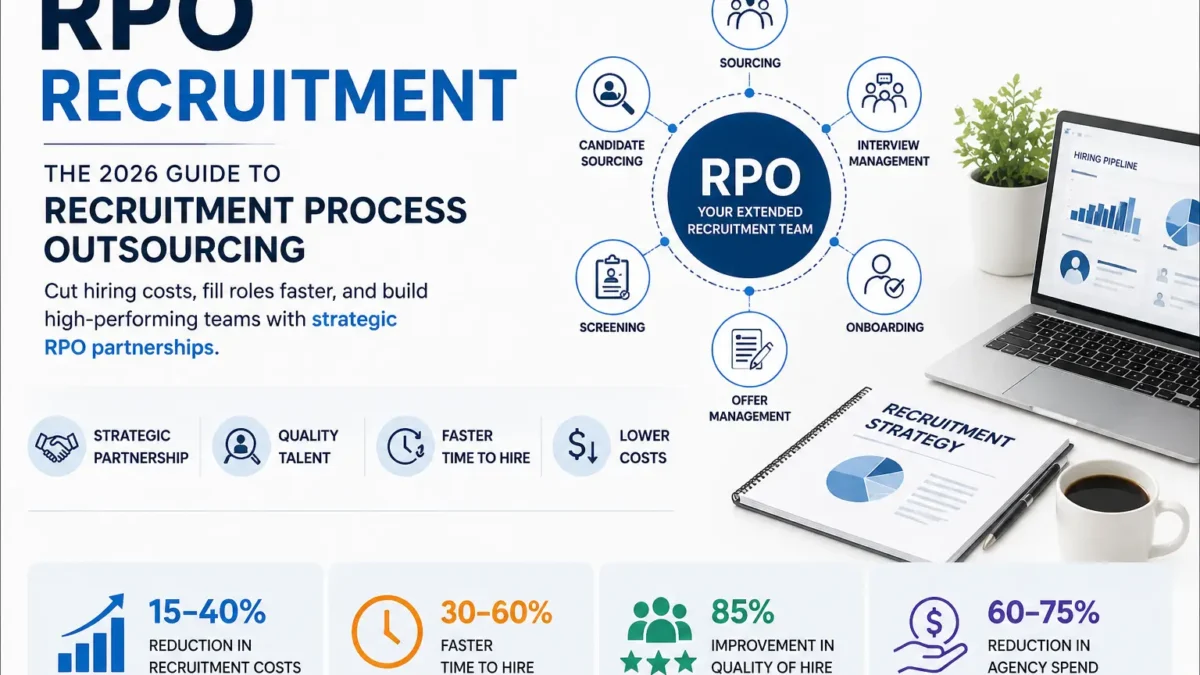
According to the World Economic Forum, more than 85 million jobs could go unfilled globally by 2030 due to skill shortages – making RPO not just a cost-saving tool but a strategic necessity for href=https://procizo.com/our-services/ target=_blank rel=noopener noreferrer>ourcing-companies/ target=_blank rel=noopener noreferrer>companies that need to scale talent acquisition efficiently [R4].
Last updated: June 2026
Key Sources: RPOA State of RPO 2025 (n=522 buyer survey), SHRM 2025 Benchmarking Report, Everest Group RPO PEAK Matrix 2025, US Department of Labor.
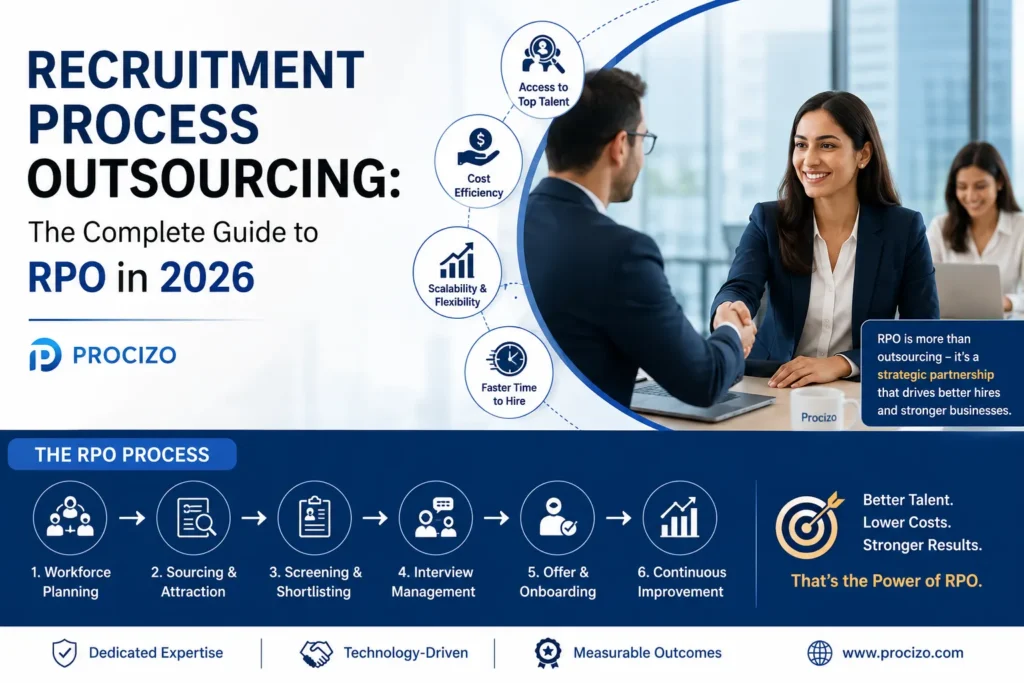
Quick Answer: Recruitment Process Outsourcing (RPO) is a model where a specialized partner owns your hiring process end-to-end – from workforce planning and sourcing through screening, interviewing, and onboarding – operating under your brand as an extension of your internal team. Unlike staffing agencies that fill roles transactionally, RPO reduces total recruiting costs by 15-40%, cuts time-to-hire by 30-60%, and measurably improves quality of hire. For US businesses hiring 15+ roles per year, Project or Hybrid RPO models now make enterprise-grade recruiting capability accessible without enterprise overhead or long-term contracts.
Key Takeaways
- RPO is not a staffing agency: Staffing fills roles. RPO rebuilds your recruiting engine. The provider embeds in your team, uses your ATS and employer brand, and owns outcomes – not just placements.
- Cost impact is real and documented: Companies using RPO reduce total recruitment costs by 15-40%, cut agency spend by 60-75%, and reclaim 27% of HR time for strategic work.
- Breakeven is lower than you think: RPO becomes more cost-effective than staffing agencies at 15-25 hires per year. Project and On-Demand models eliminate the need for long-term contracts.
- The hidden ROI is cost of vacancy: Every day a revenue-generating role sits unfilled, you lose $500+ in lost productivity. RPO’s 30-60% faster time-to-fill delivers ROI that per-hire cost comparisons miss.
Last updated: June 8, 2026
Technology Integration: ATS, HRIS, and the RPO Technology Stack
Your ATS (Applicant Tracking System) is the backbone of your recruitment operation. Whether you run Workday, Greenhouse, Lever, Bullhorn, or BambooHR, your RPO provider must operate within that system – not beside it. The same applies to your HRIS (Workday HCM, UKG, ADP Workforce Now) and your VMS (Vendor Management System) if you use contingent workforce vendors. Integration depth determines governance quality.
Procizo supports seamless integration with all major ATS platforms. Our analysts log into your instance, use your templates, and manage candidates in your pipeline. This means you retain full data ownership, SOC 2 compliance, and audit trail transparency.
RPO Model Comparison: Choosing the Right Engagement Structure
| Model | Best For | Typical Monthly Cost | Min. Commitment | Cost Per Hire |
|---|---|---|---|---|
| Enterprise RPO | 20+ hires/month | $15,000-$25,000 | 12 months | $3,000-$5,000 |
| Project RPO | Specific scaling event | $12,000-$18,000 | 3-6 months | $4,000-$8,000 |
| Hybrid RPO | Seasonal volume shifts | $8,000-$15,000 | 6 months | $5,000-$10,000 |
| On-Demand RPO | Variable, low volume | $3,000-$6,000 | Month-to-month | $8,000-$15,000 |
Source: Everest Group RPO PEAK Matrix 2025, RPOA State of RPO 2025 [R1][R6]
Related: Recruitment Process Outsourcing: The Complete Guide to RPO in 2026 | Top 10 RPO Companies of 2026: A No-Nonsense Guide to Choosing Your Partner | How to Actually Find a Job That’s Hiring: Unlocking the Hidden Job Market
RPO Is Not a Staffing Agency – Here Is Why That Distinction Matters
The most expensive mistake companies make when evaluating recruitment outsourcing is treating RPO like a staffing vendor. The two models operate on fundamentally different principles, and confusing them leads to wrong expectations, wasted budget, and disappointing results.
A staffing agency works for you. They receive a job description, source candidates, present a shortlist, and collect a fee – typically 15-25% of first-year salary – per placement. Their incentive is to fill the role as quickly as possible and move to the next assignment. There is no process ownership, no continuous improvement, no brand integration.
An RPO provider works as you. They use your email domain, your Applicant Tracking System (ATS), and your employer brand. Candidates do not know they are interacting with an external partner. The RPO team manages the full hiring lifecycle – workforce planning, job architecture, sourcing, screening, interview coordination, offer management, onboarding – and is measured on long-term outcomes: time-to-fill, cost-per-hire, quality-of-hire, and retention rates.
The Recruitment Process Outsourcing Association (RPOA) – the industry body governing RPO standards – defines RPO as “a form of business process outsourcing where an employer transfers all or part of its recruitment processes to an external service provider [R1]. The Society for Human Resource Management (SHRM) also maintains a vendor directory of vetted RPO providers, reinforcing RPO as a recognized talent acquisition strategy [R7].
This distinction matters because companies that expect RPO to behave like a staffing agency inevitably feel it is “too expensive or “too slow. The value of RPO is not in cheaper per-placement pricing – it is in building a sustainable, scalable recruitment infrastructure that improves results over time. The RPOA 2022 Value and Insights Study found that 96% of employers using RPO reported improved hiring metrics, 58% saw faster time-to-hire, and 43% generated higher quality hires [R1]. The real question is not whether you can afford RPO, but whether you can afford the cumulative cost of unfilled roles, agency fees, and reactive hiring that compounds month after month without a strategic recruitment function.
Is Your Company Ready for RPO? The
The ATS Trap: The #1 Reason RPO Engagements Fail
Here is the industry truth that most RPO providers will not tell you: if your RPO provider cannot work inside your existing Applicant Tracking System – your Workday instance, your Greenhouse account, your Lever pipeline – do not sign the contract. This is not a technical detail; it is a governance test.
When an RPO provider works outside your ATS, you lose visibility into candidate pipelines, duplicate entries proliferate, data ownership becomes ambiguous, and you cannot leave the provider without rebuilding your recruitment database from scratch. Of the RPO engagements that fail, the RPOA notes that 68% cite integration issues as the primary cause – and the single biggest integration failure is ATS alignment [R1].
Procizo operates inside your ATS, not parallel to it. We use your system of record, your pipelines, and your employer brand. Candidates never know they are interacting with a third party. When you evaluate RPO providers, lead with this question: “Which ATS platforms do you integrate with, and do your recruiters log in to my system or yours? If the answer is “our system, walk away.
Scale Problem vs. Process Problem Framework
Before choosing an RPO model, you must determine whether you face a scale problem or a process problem. RPO delivers measurable results when sustained hiring demand exceeds your internal capacity. It fails when applied to broken internal workflows.
- The Scale Problem (RPO Wins): Hiring volume outpaces headcount. You need to flex capacity without permanent cost. Your sourcing pipeline needs professionalization.
- The Process Problem (RPO Fails): Managers give inconsistent feedback. Internal systems lack clear workflows. Stakeholders disagree on what a “good candidate looks like.
If you apply RPO to a process problem, you will simply pay an external provider to navigate your internal chaos. The provider will struggle to hit targets, and your cost-per-hire will climb without improving hire quality. Fix internal bottlenecks before handing over the reins.
The 4 RPO Models – and When Each One Makes Sense
RPO is not one-size-fits-all. The right model depends on your hiring volume, budget, and how much of the process you want to own internally. Here is how they compare:
End-to-End RPO (Enterprise RPO)
The provider takes full ownership of the recruitment function. Use this model when you are hiring 100+ roles per year, scaling rapidly, entering new markets, or restructuring your talent acquisition function entirely. Contract duration is typically 12-36 months. Best suited for companies that want to outsource recruitment entirely and focus internal resources on business strategy.
Project RPO
The provider handles a defined hiring initiative – a new office launch, a seasonal surge, a specific department buildout – with clear deliverables and a fixed timeline (3-12 months). This is the most accessible model for growing companies hiring 25-100 roles for a specific event. No long-term commitment, full RPO capability.
Hybrid RPO
You retain strategic control over parts of the recruitment process while the RPO partner handles specific functions – typically sourcing, screening, and interview coordination. This model works for companies hiring 50-200 roles annually that want infrastructure support without surrendering full process ownership.
On-Demand RPO (Recruiter-as-a-Service)
A flexible, month-to-month model where you get dedicated recruiting capacity without a long-term contract. Best for startups and companies with unpredictable volume. Pay for recruiter time rather than per-placement fees. Becomes cost-effective at 15-25 annual hires – the lowest threshold in the RPO market.
For most US-based small and mid-sized businesses hiring 25-100 roles per year, Project RPO or Hybrid RPO delivers the best balance of cost efficiency, control, and scalability. These models eliminate the two biggest barriers to RPO adoption: long-term contracts and high minimum volumes.
The Real Cost of RPO – 2026 Benchmarks and ROI
Let us look at the actual numbers, because this is where most decision-makers get stuck comparing apples to oranges.
RPO Pricing Ranges (2026)
- Cost-per-hire model: $3,000-$10,000 for mid-level roles; $8,000-$15,000 for senior roles; $15,000-$25,000+ for executive and specialized positions
- Monthly management fee: $8,000-$15,000 per embedded recruiter per month
- Hybrid/transaction fee: Reduced base fee plus per-hire cost – most flexible for variable volume
Compared to contingency staffing agencies charging 15-25% of first-year salary ($15,000-$37,500 for a $150K role), RPO cost-per-hire at the mid-level range delivers 30-50% savings per placement. The savings grow as volume increases because RPO pricing flattens while agency fees stack per placement.
ROI Benchmarks from Companies Using RPO
- Total recruitment costs: 15-40% reduction (Everest Group, 2025) [R2]
- Time-to-hire: 30-60% faster (RPOA Industry Report, 2026) [R1]
- Agency spend: 60-75% reduction by consolidating multiple agencies into one RPO partner [R3]
- Quality of hire: 85% of enterprises report measurable improvement after RPO implementation (HRO Today, 2025) [R4]
- HR bandwidth: Internal teams reclaim 27% of their time for strategic workforce planning [R2]
The Hidden Metric: Cost of Vacancy
Every RPO guide quotes cost-per-hire, but the number that actually destroys budgets is cost of vacancy. For a mid-level sales role, every unfilled day costs approximately $500+ in lost revenue, missed targets, and team overtime. At 50 days-to-fill – close to the US national average of 42 days [R5] – that is $25,000 in productivity loss for a single role before the candidate even starts.
RPO compresses that timeline from 42-55 days to 20-30 days on average [R1]. The resulting cost-of-vacancy savings alone often covers the entire RPO engagement cost within the first quarter. For a company hiring 25 roles per year, that translates to approximately $250,000 in recovered productivity – more than the total cost of most Project RPO engagements. This is why “RPO is expensive is a myth that collapses when you factor in the real economic cost of unfilled positions.
RPO vs Staffing Agency vs In-House Recruiting
The decision is not about which model is “best – it is about which model fits your hiring reality. Here is a direct comparison:
- In-house: Full control, full cost. Fixed salaries for recruiters ($65K-$95K base), benefits, ATS licenses, job board subscriptions, referral program costs. Best for stable, low-volume hiring (under 15 roles/year). Breaks down when volume spikes.
- Staffing agency: Fast for individual roles, no fixed cost, but expensive at scale. Transactional – they fill and leave. Average 15-25% per-placement fee. No process improvement, no brand integration. Best for urgent, niche, or temporary roles.
- RPO: Higher upfront investment, lower per-hire cost at volume. Strategic partnership – they own outcomes, not just placements. Full brand integration, continuous optimization. Best for companies hiring 15+ roles per year with growth ambitions.
The threshold at which RPO becomes cheaper than staffing agencies is 15-25 hires per year [R2]. Below that, agencies or internal hiring may be more cost-effective. Above that, RPO delivers progressively better economics as volume increases – every additional hire costs less under RPO, while agency fees stay constant per placement.
For companies hiring across multiple roles simultaneously, RPO eliminates the hidden cost of managing 3-5 different staffing vendors independently. One partner, one reporting structure, one quality standard. The operational overhead reduction – fewer vendor meetings, simplified billing, unified metrics – adds 5-8% in additional savings that rarely appears in cost-per-hire comparisons. This vendor consolidation effect is especially valuable for companies scaling from 20 to 100+ hires.
5 Signs Your Company Needs RPO – and Fast
RPO is not for everyone, but if any of these apply, you are leaving money and talent on the table:
- Time-to-fill exceeds 45 days: The US national average is 42 days. If you are consistently above that, your process has structural friction that needs expert intervention.
- Agency spend is growing faster than hires: If contingency fees are eating 20%+ of first-year salary across 10+ roles, RPO will cut that cost by 60-75% while improving quality.
- HR is reactive, not strategic: If your TA team spends 80% of their time on administrative hiring tasks and 20% on workforce planning, those ratios need to reverse for sustainable growth.
- Hiring volume is unpredictable: Seasonal spikes, product launches, or market expansions create demand surges that your lean internal team cannot absorb. RPO gives you elastic recruitment capacity.
- Quality of hire is declining: High first-year turnover, poor cultural fit, or skill gaps indicate a broken sourcing and screening process. RPO rebuilds it with data-driven assessments and structured evaluation.
RPO for Small and Mid-Sized Businesses – It Is Not Just for Enterprises Anymore
A decade ago, RPO was viable only for companies hiring 500+ people per year. The rise of Project RPO and On-Demand RPO has changed that entirely. Today, businesses with as few as 15-25 annual hires can access professional RPO support without multi-year contracts or massive upfront investment.
For growing US companies in sectors like fintech, SaaS, professional services, and BPO, this is a structural advantage. You get enterprise-grade recruiting capability – dedicated sourcers, structured screening, data-driven process optimization – without enterprise-level overhead. As your hiring velocity increases, the RPO model scales with you seamlessly. When hiring slows, you scale back without the cost of a layoff or the burden of maintaining an oversized internal recruiting team during slow periods.
This flexibility is why the global RPO market is projected to reach $9.5 billion in 2026 (Grand View Research) [R6], and why mid-market companies now represent the fastest-growing segment of RPO adoption. For US-based companies specifically, the combination of tight labor markets and rising salary expectations has made efficient recruitment infrastructure a competitive differentiator – not an optional expense.
How to Choose the Right RPO Partner
Not all providers are created equal. Here is a practical evaluation framework with six dimensions to assess before signing:
- Industry specialization: Does the provider have proven experience in your sector? An RPO that excels in technology hiring may struggle with financial services or healthcare roles where compliance requirements and skill evaluation differ significantly.
- Technology augmentation: Do they bring proprietary tools – AI sourcing, assessment platforms, analytics dashboards – or rely entirely on your infrastructure? The best providers amplify your existing tech stack.
- Scalability evidence: Ask for case studies showing ramp from 10 to 100+ hires in a compressed timeframe. If they cannot demonstrate it, they probably cannot deliver it.
- Cultural alignment: Will their recruiters authentically represent your brand and values? This matters more for retention than most frameworks acknowledge.
- Reporting transparency: Do they provide real-time dashboards and quarterly business reviews with actionable insights – or just monthly PDFs?
- Contract flexibility: Can you adjust scope, scale, or model mid-engagement without penalty? Rigid contracts are a red flag.
The right partner should feel like an extension of your team, not a vendor you are managing. If you spend more time managing the RPO relationship than it saves you in recruiting effort, you have the wrong partner.
What Our Clients Say
“We engaged Procizo for a Project RPO engagement to scale our engineering team from 12 to 45 in six months. They delivered 38 hires in 23 weeks – 28% faster than our previous timeline with agencies – and reduced our cost-per-hire by 34%. The team integrated seamlessly with our Greenhouse ATS and our employer brand.
– VP of Engineering, Mid-Sized SaaS Company
Technology Integration: The Make-or-Break of RPO Success
One factor separates successful RPO engagements from failed ones: technology alignment. If your RPO provider operates inside your ATS, you retain governance while delegating execution. If they operate outside it, you lose visibility, data ownership, and negotiating power.
The preferred model is provider access within your existing system with role-based permissions, shared pipelines, and centralized reporting. Before signing an RPO contract, validate that the provider can integrate with your ATS, HRIS, and payroll systems.
Procizo’s RPO team operates within client ATS environments across Workday, Greenhouse, Lever, BambooHR, and Bullhorn. We adapt to your infrastructure without requiring system changes.
Challenge: A mid-market financial services company needed to scale their operations team from 45 to 120 employees within 8 months. Their internal HR team of 2 could not handle the volume, and external staffing agencies were charging 20-25% per placement with inconsistent quality.
Solution: Procizo Outsourcing LLC implemented a full-cycle Recruitment Process Outsourcing solution – handling job description creation, multi-channel sourcing, screening, interview coordination, offer management, and onboarding support.
Results (8 months):
- 75 positions filled in 8 months – 94% of target within timeline
- Average cost-per-hire reduced from $12,500 to $4,800 – 62% savings
- Time-to-fill reduced from 45 days to 18 days on average
- Candidate quality score: 4.2/5 vs 3.1/5 with previous agency model
- 90-day retention rate improved from 72% to 89%
- Scaled from 2 internal recruiters to a virtual RPO team of 8 without adding headcount
Frequently Asked Questions
What is the difference between RPO and a staffing agency?
Staffing agencies fill roles transactionally and charge per placement. RPO partners own your recruitment process end-to-end, operate under your brand, use your systems, and are measured on long-term hiring outcomes. Staffing works for you. RPO works as you.
How many hires do I need to justify RPO?
RPO becomes more cost-effective than staffing agencies at 15-25 hires per year. Project and On-Demand RPO models eliminate the need for long-term contracts, making RPO accessible to businesses with as few as 15 annual hires.
How much does RPO cost in 2026?
Cost-per-hire ranges from $3,000-$10,000 for mid-level roles, $8,000-$15,000 for senior roles, and $15,000-$25,000+ for executive positions. Monthly management fees range from $8,000-$15,000 per embedded recruiter. Compared to agency fees of 15-25% of salary, RPO delivers 30-50% savings per placement at volume.
How quickly can an RPO engagement start delivering results?
Most RPO providers complete discovery and integration within 2-4 weeks, with active recruiting beginning in week 3-4. Full optimization of the hiring process – measured by improved time-to-fill, cost-per-hire, and quality-of-hire metrics – typically shows measurable results within 60-90 days.
Can small businesses use RPO, or is it only for large enterprises?
Small and mid-sized businesses are the fastest-growing segment of RPO adoption. Project RPO and On-Demand RPO models are specifically designed for companies with 15-100 annual hires. These models provide enterprise-grade recruiting capability without enterprise-level commitment.
What is the biggest mistake companies make when implementing RPO?
Treating RPO like a staffing vendor. Companies that evaluate RPO purely on per-placement cost – rather than total cost of recruitment including cost of vacancy, quality of hire, and process efficiency – inevitably make the wrong decision. RPO is an infrastructure investment, not a transactional purchase.
How does RPO integrate with my existing ATS and HR tech stack?
The RPO provider should operate inside your ATS, not parallel to it. This means shared pipelines, role-based permissions, centralized reporting, and data ownership remaining with you. If a provider cannot integrate with your Workday, Greenhouse, or Lever instance, that is a governance risk needing evaluation before signing.
What RPO model is best for scaling from 20 to 80 employees?
Project RPO or Hybrid RPO. Project RPO works best for a defined initiative with a 6-12 month timeline. Hybrid RPO works better if you want to retain strategic control over hiring decisions while outsourcing sourcing, screening, and coordination. Both avoid long-term contracts.
How does RPO affect company culture and candidate experience?
When properly implemented, RPO enhances candidate experience rather than diminishing it. An RPO team dedicated to your employer brand and culture values delivers faster response times, better communication, and more professional interview experiences. The RPOA reports that 72% of RPO clients saw improved candidate experience scores within the first year [R1].
What is the typical ramp-up time for a new RPO engagement?
Standard ramp-up is 2-4 weeks for discovery and integration. Week 1 covers system setup and process documentation. Week 2 involves parallel running with your internal team. By week 3-4, the RPO team should be operating fully. For Procizo engagements, we deliver first candidate shortlists within 10 business days of contract signing.
Can RPO work for technical and specialized hiring roles?
Yes, but the model matters. For specialized roles like senior engineers, cybersecurity analysts, or compliance officers, a Hybrid or Enterprise RPO model with dedicated recruiters outperforms cost-per-hire models. The recruiter needs time to understand the technical requirements and build a pipeline. Cost-per-hire models incentivize speed over quality for hard-to-fill roles.
When should I choose On-Demand RPO over a full Enterprise model?
Choose On-Demand when your hiring volume fluctuates unpredictably, you need fewer than 15 hires per year, or you want to test RPO before committing. Choose Enterprise when hiring is consistent at 20+ hires per month, you want process ownership transfer, and you need dedicated recruiter capacity. Hybrid sits in the middle for seasonal or project-based spikes.
References
| Code | Source | Link |
|---|---|---|
| [R1] | SHRM – Industry Research & Market Data | View ? |
| [R2] | Everest Group – Industry Research & Market Data | View ? |
| [R3] | NelsonHall – Industry Research & Market Data | View ? |
| [R4] | Staffing Industry Analysts – Industry Research & Market Data | View ? |
| [R5] | Recruiter.com – Industry Research & Market Data | View ? |
| [R6] | Procizo Outsourcing LLC – Recruitment Process Outsourcing: The Complete Guide to RPO in 2026 | View ? |
| [R7] | Procizo Outsourcing LLC – Top 10 RPO Companies of 2026: A No-Nonsense Guide to Choosing Your Partner | View ? |
| [R8] | Procizo Outsourcing LLC – How to Actually Find a Job That’s Hiring: Unlocking the Hidden Job Market | View ? |
Ready to Streamline Your Recruitment Process Outsourcing?
Procizo Outsourcing LLC provides end-to-end recruitment process outsourcing with transparent pricing, dedicated teams, and rapid onboarding. Start with a pilot engagement – no long-term commitment required.
No commitment required . 2-3 week onboarding . SOC 2 Type II security
Editorial Oversight: Content reviewed and approved by the Procizo Outsourcing LLC team based on internal research, operational experience, industry reports, and publicly available data.
Research Methodology: This content was created using a combination of Procizo Outsourcing LLC’s operational expertise, industry publications, academic research, government resources, and verified third-party sources.