- Have Questions? Talk to Us
- info@procizo.com

The US “National Outsourcing Association” Myth & How to Vet Offshore Partners

BPO Business Process Outsourcing Strategies: The Shift to IPO in 2026
October 20, 2025
What Is a BPO Company? Choose the Right BPO Partner
April 14, 2026
Trust signals matter when choosing outsourcing partners. US teams often find the “national outsourcing association” unclear. This guide explains the term in the US and how outsourcing standards help select providers.
Key Takeaways
- The term “National Outsourcing Association” generally refers to a now-defunct UK trade group, not a US-based association. US readers should note this difference when researching or comparing outsourcing vendors.
- US businesses can view outsourcing associations as credibility markers, but membership alone does not prove provider quality.
- An effective vendor review requires assessing association signals, SLAs, compliance, references, and governance maturity.
- IAOP is one of the most relevant industry organizations for outsourcing buyers who want structured recognition programs and sourcing resources.
- Modern outsourcing decisions increasingly focus on value, agility, AI readiness, and governance—not just cost reduction.
- Start by clarifying what the keyword refers to, then offer practical advice on evaluating outsourcing options.
What Is a National Outsourcing Association?
If you are a US-based executive searching for the ‘National Outsourcing Association’ to help vet a potential BPO partner, you are chasing a ghost. The National Outsourcing Association (NOA) was exclusively a UK-based organization that rebranded to the Global Sourcing Association (GSA) in 2016. There is no central, government-sanctioned ‘National Outsourcing Association’ in the United States that certifies offshore vendors. Instead of relying on a non-existent US badge of approval, modern CTOs and Operations Directors must evaluate offshore partners using a strict, fragmented framework of industry-standard credentials, such as the International Association of Outsourcing Professionals (IAOP) recognition and rigorous cybersecurity audits.
This difference matters for US readers because the keyword may seem to refer to a major American association. For example, a US buyer could think that a national body certifies BPO vendors in the US. But there is no prominent US group named “National Outsourcing Association”; that is actually a UK-based entity.
Outsourcing is a broad business model. It means companies hire outside providers to do work that would normally be done in-house. For example, a healthcare company might outsource customer support, claims processing, or IT help desk services to a specialist.
Related: How to Hire a Virtual Assistant: The Complete Guide for Business Owners (2026) | Call Center Outsourcing: Complete Guide to Customer Service BPO (2026) | Virtual Assistant Services: The Complete Guide to Hiring and Scaling with VAs (2026)
Why Does the National Outsourcing Association Matter?
The National Outsourcing Association was the previous name of the UK-based Global Sourcing Association, which is not a US organization. Understanding this distinction helps US readers avoid confusion around relevant UK and US industry groups.
The keyword “national outsourcing association” matters because businesses use association signals to lower risk when choosing partners. Buyers want to know which groups set standards, show credibility, and recommend providers for their shortlist.
The outsourcing market is massive. Buyers must filter options effectively. The global IT and business services market reached $28.8 billion ACV in Q1 2025, with managed services at $10.5 billion and 713 contracts awarded (Source: ISG, 2025).
At the same time, buyer behavior is changing. More than 500 executives participated in Deloitte’s 2024 Global Outsourcing Survey, giving the report broad relevance for enterprise sourcing decisions (Source: Deloitte, 2024).
Outsourcing is now more strategic. Deloitte reports that 80% of executives plan to maintain or increase third-party outsourcing (Source: Deloitte). This means buyers are not only asking, “Can this vendor do the work?” They are also asking:
- Does this provider follow recognized standards?
- Does this firm demonstrate governance maturity?
- Can this partner support long-term transformation, not just labor arbitrage?
Association membership adds credibility, but diligent checks on security, performance, compliance, and governance are always necessary.

What Does an Industry Association Actually Do?
An outsourcing association sets standards, offers recognition, provides education, and fosters a community. They help buyers find credible providers, not just those with a sales pitch.
The best associations create clear trust signals. For example, they may offer:
- membership programs
- directories
- award frameworks
- training and certification
- events and peer networks
- sourcing methodologies or best-practice content
For example, IAOP’s Global Outsourcing 100 Program is an annual list of top outsourcing providers and advisors across industries and regions, selected through a formal evaluation process (View IAOP Global Outsourcing 100).
How associations support provider credibility
Providers join associations for visibility. IAOP’s Global 100 helps outsourcing seekers. Appearances provide credibility and access to buyer communities. However, association recognition does not guarantee quality. Investigate using references, case studies, and delivery metrics.
Quick comparison of what to look for
| Attribute | Strong signal | Weak signal |
|---|---|---|
| Recognition program | Published methodology | Vague “award-winning” claim |
| Membership visibility | Public member directory or program page | Badge only, no proof |
| Education | Training, academy, certification | No learning resources |
| Buyer value | Clear evaluation criteria | Pure marketing language |
| Relevance | Active recent programs | Outdated or inactive site |
Does the United States Have an Equivalent to the National Outsourcing Association?
There is currently no US association called the “National Outsourcing Association.” Instead, US buyers rely on a mix of industry groups, analyst reports, frameworks, and recognition programs.
First, this is why the keyword is awkward in US SEO. A user may be looking for:
- a trade association
- a certification body
- a ranking list
- a procurement framework
- a recognized provider directory
For example, IAOP is often more relevant for US outsourcing buyers than the exact keyword itself because it offers:
- The Global 100 Program
- outsourcing awards
- training and certification
- directories and member resources
- events focused on sourcing and collaboration
In practice, there is no single US brand that serves as an equivalent. Instead, buyers use a combination of:
- Industry recognition (such as IAOP)
- Analyst/advisory validation
- Security and compliance evidence
- References and case studies
- SLA and governance maturity
Within the US, the term “national outsourcing association” is ambiguous and needs explanation to align with local search intent. It is useful for content, but not a direct match for US commercial needs.
How Should US Companies Evaluate Outsourcing Standards and Vendor Claims?
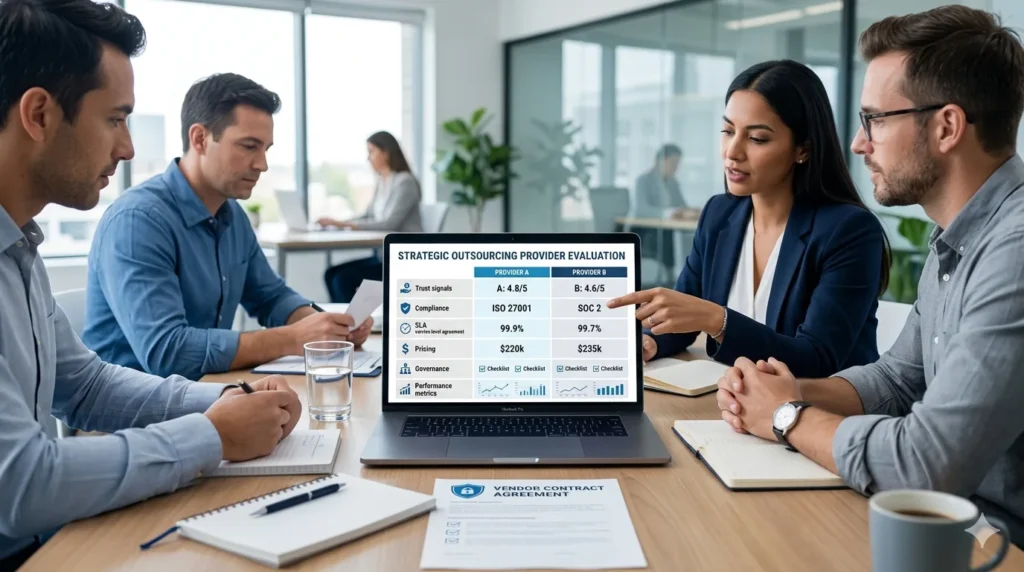
US companies should evaluate outsourcing standards using association signals and operational evidence. Relying only on logos or awards can inflate a vendor’s perceived quality.
What to check:
Association or industry recognition
Make sure any badge or award is up to date and publicly listed.
Security and compliance
Check SOC 2, ISO 27001, HIPAA readiness, PCI, or other relevant controls.
Delivery model
Confirm location mix, escalation paths, staffing model, and business continuity.
Commercial structure
Review SLAs, KPIs, penalties, pricing transparency, and terms for changes.
Operational proof
Request case studies, references, transition plans, and quality metrics.
A provider may claim “industry-recognized excellence,” but without public listing, methodology, or validation, this is a weak signal.
Current Realities of Outsourcing Oversight
The market has changed. Deloitte reports that 83% of surveyed executives are leveraging AI as part of outsourced services, while 20% are already developing strategies to manage digital workers (Source: Deloitte, 2024).
In addition, governance maturity remains a challenge. Deloitte also reports that 70% of executives say their VMO function is not fully mature (Source: Deloitte, 2024).
That means buyers should now assess:
- AI governance
- automation accountability
- vendor management maturity
- outcome-based pricing readiness
- risk ownership across retained and outsourced teams
US outsourcing buyers should pair association signals with SLAs, references, certifications, and operational fit checks. This reduces risk without slowing decisions.
What Tools and Sources Help You Evaluate Outsourcing Providers?
The best evaluation tools are simple frameworks that make it easy to measure your decision criteria. You do not need expensive software, but you do need a process you can use again and again.
- capability
- compliance
- pricing
- governance
Useful tools include:
- RFP matrix for structured side-by-side comparison
- SLA checklist for response time, accuracy, uptime, and penalties
- Transition-readiness checklist for knowledge transfer and ramp-up
- Risk register for data privacy, concentration risk, and escalation paths
For example, you can create a weighted vendor scorecard in a spreadsheet and assign scores for each criterion, like innovation and AI readiness.
If you’re actively comparing providers and want a practical, execution-focused partner, you can also review Procizo’s MCA outsourcing service provider in USA to see how service structure, operational ownership, and delivery support are positioned.
For businesses evaluating underwriting-heavy workflows, this related resource on underwriting outsourcing services in the USA can help align vendor fit with process requirements.
You can also explore more outsourcing insights and related articles in the Procizo blog.
What Should US Businesses Do Next?
US businesses should treat the “National Outsourcing Association” search as a starting point, then use a structured process to evaluate vendors. The keyword is secondary; sound decisions are the real goal.
Action plan:
Clarify the entity
Confirm whether the search refers to the former UK NOA/GSA or a general outsourcing association concept.
Identify relevant US-facing signals
Review organizations and programs that actually matter to buyers, such as IAOP’s recognition and sourcing resources.
Build a vendor shortlist
Use no more than 3–5 providers for serious evaluation.
Validate every trust signal
Check awards, memberships, security claims, and client references.
Run a governance-first review
Confirm escalation, KPI ownership, reporting cadence, and change management.
For example, if two vendors look similar on price, the winner is often the one with stronger governance, cleaner transition planning, and clearer accountability—not the one with the lowest headline rate.
Need Help Shortlisting the Right Outsourcing Partner?
If you want a provider that focuses on operational ownership, scalable BPO support, and specialized outsourcing workflows, talk to Procizo to discuss your business needs and compare delivery options before you choose a vendor.
Conclusion
The term “National Outsourcing Association” is really a legacy or unclear keyword, not a clear destination for US buyers. For American businesses, it is smarter to use keywords to learn about outsourcing standards, recognition programs, and governance frameworks.
The best outsourcing decisions come from evidence-based vetting. If you combine association signals with real proof—SLAs, references, compliance controls, and delivery maturity—you will make stronger partner choices and avoid the common trap of trusting marketing over operations.
Written by Editorial Team, SEO & B2B Content Strategy Specialists with experience in outsourcing, SaaS, and service-based content marketing.
Reviewed by Senior Content Editor, B2B Operations & Outsourcing Research Lead.
IAOP vs. Boutique Specialization: What Really Matters
While the International Association of Outsourcing Professionals (IAOP) releases an annual ‘Global Outsourcing 100’ list, it tends to favor massive, multi-billion-dollar conglomerates. For mid-market companies scaling agile operations, specialized boutique BPOs are often a better fit than legacy giants. Instead of looking solely for IAOP membership, evaluate a provider’s ‘Operational Ownership’. Do they offer direct access to QA managers? Are their underwriting outsourcing services customized to your exact LOS, or do they force you into a rigid, pre-packaged workflow? In 2026, operational flexibility is a far stronger trust signal than a generic association badge.
Challenge: A growing business faced operational bottlenecks from manual workflows, limited capacity, and rising labor costs. In-house processing was slow and difficult to scale during peaks.
Solution: Procizo analyzed workflows and deployed a dedicated team integrated into the client’s systems within 2-3 weeks, operating as a seamless extension of their operations.
Results (6 months):
- Operational costs reduced 50-65%
- Processing turnaround improved 60-85%
- Team capacity scaled 2-3x
- Accuracy improved through structured QA
- Internal teams refocused on core strategy
Frequently Asked Questions
- What is the National Outsourcing Association (NOA)?
- The National Outsourcing Association is a professional body focused on promoting best practices in outsourcing. It provides resources, certifications, networking events, and industry standards for organizations engaged in business process outsourcing, IT outsourcing, and shared services.
- Why is the NOA important for businesses?
- The NOA establishes industry standards and best practices that help businesses evaluate outsourcing partners, structure contracts, manage relationships, and measure performance. Membership signals commitment to quality and ethical outsourcing practices.
- What certifications does the NOA offer?
- The NOA offers certifications in outsourcing management including Certified Outsourcing Professional (COP), Outsourcing Project Manager certification, and specialized certifications in governance, vendor management, and shared services.
- How does NOA membership benefit BPO providers?
- Membership provides credibility, access to industry research, networking with potential clients, participation in standard-setting, and marketing exposure. Many companies prefer working with NOA-member providers for assurance of ethical practices.
- Is Procizo Outsourcing LLC affiliated with the NOA?
- Procizo follows NOA-recommended best practices in outsourcing management, quality assurance, and client relationship governance — including SOP documentation, performance metrics, escalation procedures, and continuous improvement frameworks.
- Can NOA resources help me choose an outsourcing partner?
- Yes. The NOA provides guidelines for partner selection, contract structuring, SLA definitions, and governance frameworks. These resources help businesses ask the right questions and evaluate providers systematically rather than based on price alone.
- What are NOA’s best practices for outsourcing governance?
- Key practices include: clear SLA definitions with measurable KPIs, regular performance reviews, documented escalation procedures, risk management frameworks, data security protocols, cultural alignment assessment, and continuous improvement programs.
Ready to Streamline Your Professional Outsourcing Solutions?
Procizo Outsourcing LLC provides end-to-end professional outsourcing solutions with transparent pricing, dedicated teams, and rapid onboarding. Start with a pilot engagement — no long-term commitment required.
Schedule a Free Consultation →
No commitment required • 2-3 week onboarding • SOC 2 Type II security
Editorial Oversight: Content reviewed and approved by the Procizo Outsourcing LLC team based on internal research, operational experience, industry reports, and publicly available data.
Research Methodology: This content was created using a combination of Procizo Outsourcing LLC’s operational expertise, industry publications, academic research, government resources, and verified third-party sources.